The Memory the Machine Kept Missing
The laptop was old enough that the fan sounded like a small angry bee. Maya's mother had handed it over with the tired half-smile she used when she wanted them quiet for an hour. Practice runs, she said. Nothing real on it. Numbers with the names scrubbed off.
"It guesses what people are remembering," Soren said, reading the screen. "While they sleep. It watches the brain waves and it guesses."
"How good is it?" Maya pulled her chair closer.
"Says here it gets the memory right most of the time. Look. Sleeper number eleven dreamed about a bicycle. The model said bicycle. Sleeper twelve, a kitchen fire when they were little. The model said kitchen, said fire, said fear."
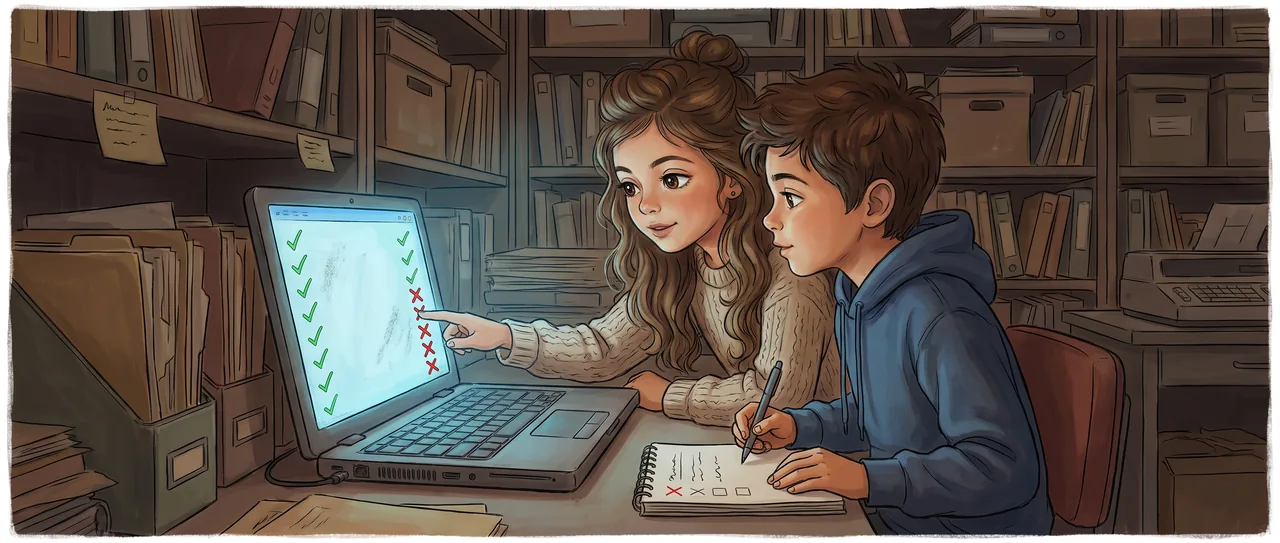
Maya scrolled. Green checkmarks marched down the column. Bicycle. Grandmother's voice. The taste of a lemon. A dog running.
"It's kind of showing off," she said.
"It's trained on thousands of nights. People describe the memory when they wake up, and the model learns to match the description to the pattern." Soren tapped the trackpad. "So it knows what a bicycle-memory looks like in the brain because a hundred people said bicycle."
Then Maya stopped scrolling.
"Wait. Go back up. Those."
There was a cluster of rows near the bottom, and every one of them had a red X. No guess. The model had written the same three letters each time. N-U-L. Null.
"It failed on those," Soren said. "A whole group of them."
"Not random ones, though." Maya put her finger on the screen, which left a small smudge her mother would complain about. "Look what the people wrote when they woke up."
Soren read the description column out loud. Sleeper forty. When they woke, they had written: a feeling like something was about to happen. Sleeper forty-one: the color of being six years old. Sleeper forty-two: my mother's kitchen but not any real day, just all of them at once.
"Those aren't memories," Soren said slowly. "I mean. They are. But they're not of anything."
"They're of everything." Maya leaned back. Her chair creaked. "The bicycle one is easy. Bicycle is a thing. The model can find bicycle because a hundred people pointed at the same thing and said the same word."
"And the null ones," Soren said, and stopped, because he wanted to get it right before he said it. He reached into his bag for the notebook and uncapped the pen. On the page he wrote the three descriptions in a column, one under the other. He looked at them.
"The people couldn't describe them either," he said. "Not really. Forty didn't say what was about to happen. Just the feeling of it. There's no word for the feeling of about-to."
"So the model never learned it." Maya was talking faster now. "It can only learn the ones people can say. If nobody can say it, nobody labeled it, and if nobody labeled it, the model has nothing to match. It's not stupid. It's just been shown the wrong things. The wrong kind of things."
"It's been shown everything people can put into words." Soren tapped the notebook. "Which means these ones down here are the memories that live outside words."
They both looked at the red column for a while. The fan buzzed. Somewhere down the hall a door closed softly.
"Try mine," Maya said suddenly.
"Try your what?"
"There's a memory I have. I've had it forever. I can never tell my mom what it is when she asks. It's like." She screwed up her face. "It's warm, and there's a sound of a spoon in a cup, and it's raining but I'm not cold, and I'm very small, and it isn't a day. It's not a specific day. But it's the most real thing I remember and I can't say what it is."
Soren wrote it down anyway. A spoon in a cup. Rain. Warm. Not a day.
"The model would put a red X on you," he said quietly.
"I know." Maya wasn't upset. She looked almost pleased. "That's the thing. I always thought there was something wrong with me because I couldn't answer. When people ask what's your first memory and everyone else says a birthday or a beach and I say I don't know, it's a feeling, and they look at me funny."
"They look at you the way adults look at me writing in this," Soren said.
"Yeah." She smiled. "But the machine's better than any of them and it can't do it either. It gets the bicycle. It never gets the rain."
Soren stared at the null rows. Then he did the thing he did when he needed to be sure. He filtered the whole file, all thousands of sleepers, and sorted by the red X.
"How many nulls," Maya asked.
"Nine hundred and something." He scrolled. "Out of eleven thousand nights. And they all read like yours. Not a thing. A whole feeling that won't hold still long enough to be a thing."
"So it's not rare." Maya stood up without meaning to. "Everyone has them. Everyone has memories that aren't of anything you can point at. The machine just made them show up as red. It made them visible by failing on them."
"It drew a border," Soren said. He looked at his own handwriting, the spoon and the rain and the not-a-day. "On one side is everything we can say. On the other side is everything we actually feel and can't. And nobody knew the border was there until the machine couldn't cross it."
Maya was quiet. Then she said, "There's a whole country over there. On the other side. And it's most of us. It's the realest part of us and it doesn't have any words in it at all."
Soren didn't answer. He was looking at the screen, where the green checkmarks stopped and the red began, a clean straight line between the memories that could be named and the ones that could only be lived. He reached up and scrolled slowly down through the red, past forty, forty-one, forty-two, all those strangers, all those unnameable warm rooms nobody could describe.
Then he added a new row at the bottom of his notebook page and left the description column blank, and drew a small red X beside it, and turned the page to the empty one waiting behind it.
Read the interactive version, listen to the narration, and earn a gold star →
A science-verified short story for curious kids · Curiosity Land