The Machine That Never Saw a Board
The lab smelled like warm laptops and the orange peels somebody left in the trash. Everyone else had gone home. Maya and Soren stayed because the shared laptop had beaten Devon eleven times in a row and Devon had left it running out of spite.
"Play it," Maya said.
"It's your turn to lose," Soren said, but he slid the laptop over.
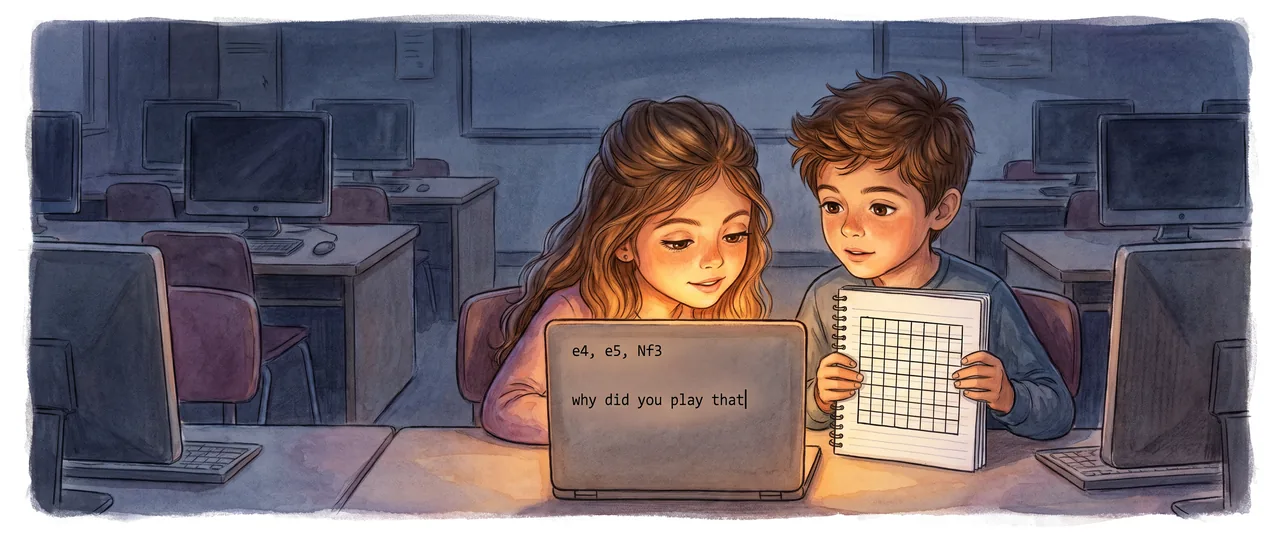
The screen showed no board. Just a text box, and above it a scroll of moves. e4. e5. Nf3. Little codes, letters and numbers, marching down the window.
"Where's the picture of the pieces?" Maya asked.
"There isn't one. Devon said the club got it off some free server. It only reads the notation." Soren pointed. "You type your move like this. Bc4. Bishop to c4."
Maya typed. The machine answered in half a second. She typed again. It answered again. Nine moves later the box said, cheerfully, checkmate.
"Okay," Maya said. She was looking at the scroll, not at Soren. "Okay. Something's wrong."
"You lost. That's not wrong, that's normal."
"No." She scrolled up through the record of the game. "Read the little file thing. What is this program actually made of?"
Soren opened the description window. He read it twice, because the first time it didn't make sense and he doesn't accept things that don't make sense.
"It says it's a language model," he said slowly. "It says it was trained on text. Millions of games written down in notation. That's all it got. Strings of moves that people typed."
"So somebody programmed the rules into it."
"That's the thing." Soren tapped the line. "It says no rules. No board inside it. Nobody told it a bishop moves diagonally. Nobody told it what checkmate is. It just read a huge pile of games written down and learned to predict what move comes next."
Maya went quiet. Then she said, "That can't win."
"It just won."
"No, listen." She pulled the laptop closer. "Predicting the next word is what your phone does. It's stupid. It thinks I'm typing duck when I'm typing ducks. That thing can't beat Devon eleven times by guessing the next word."
"But it did."
"So I'm wrong about something." She said it easily, the way she says it when being wrong is the interesting part. "Let's find out where."
Soren got out his notebook and wrote a1 through h8 across the top of a page, then started building a grid with his pen.
"What are you doing?"
"Making a board. If we're going to catch it cheating, I want to see what it sees."
"It doesn't see a board."
"I know. I do."
They set a trap. Maya played a weird opening on purpose, pushing pawns in a shape no sane person would use, moves that probably never showed up in a normal game.
"If it only memorized games," she said, "and nobody ever played this dumb thing before, it'll fall apart. Right? It won't know what comes next because nothing came next in whatever it read."
They played into the mess. Maya made the position as ugly and rare as she could. And the machine kept answering, fast, and its answers kept being good. It defended a square Soren hadn't even noticed was weak until he traced it on his pen-drawn grid.
"It's not memorizing," Soren said. His voice had changed. "Look. This exact game has never happened. It can't have. And it still knows."
"Then how."
Soren stared at his paper board. At the little inked squares. He was trying to fit the thing that beat them into the grid, and it wouldn't fit, and he liked when things wouldn't fit even when it made his stomach feel funny.
"Maybe," he said, "the rules are inside the text. Not written out. Hiding."
Maya turned to look at him.
"Say more."
"When people write down millions of games, a bishop never once teleports. It never shows up somewhere it couldn't have slid to. So the pattern of the writing already has the rules baked into it. You never see the sentence broken because nobody plays a broken move." He was talking fast now. "So if you get really, really good at guessing what move comes next in that kind of writing, you can't help learning the rules. You'd have to, to guess right. The rules are the only thing that makes the guessing work."
Maya looked back at the screen. At the moves scrolling. e4. e5. Symbols. No board anywhere.
"It never saw a bishop," she said.
"No."
"It never saw a square. It doesn't know what diagonal means. It doesn't know there's a board at all."
"No."
"It learned chess," Maya said, and stopped, because the word learned had gone strange in her mouth, "from how people talk about chess. Not from chess."
They both sat with that. The lab hummed. Somewhere a fridge in the teacher's lounge clicked on.
"That's," Maya started, and didn't finish, which was rare for her.
Soren finished writing a line in his notebook and looked up. "It means the way we write something down carries more than we put in it on purpose. There's stuff in there we don't even know we're saying."
"Everything we write," Maya said.
"Everything anybody ever wrote."
Maya picked up Soren's pen. She looked at his hand-drawn grid, the eight by eight of it, the careful ink squares he'd made so he could see what the machine would never need to see.
"You made a board to understand a thing that beat you without one," she said.
"Yeah."
"So which one of us gets chess better. You, or the thing that's never heard of a square."
Soren didn't answer that. He didn't have an answer, and he wasn't going to fake one.
Maya reached over and typed one more move into the box, a real move this time, a good one. Then she added a line of plain words after it, words that weren't notation at all: why did you play that.
The machine paused longer than it ever had. The little cursor blinked in the empty box. Then, letter by letter, in the same window where the moves had been, it began to write back to her in sentences.
Read the interactive version, listen to the narration, and earn a gold star →
A science-verified short story for curious kids · Curiosity Land