The Fossils Inside
The museum had closed twenty minutes ago, but the genetics exhibit was still lit. Maya's mother was upstairs arguing budgets in a room Maya was not allowed into, so Maya walked the empty hall alone with a volunteer named Priya who kept a ring of keys and a thermos of coffee.
The exhibit was mostly about fossils. That was the theme the museum had chosen. One long wall of bones, then a turn, then a smaller room called The Fossils You Carry.
"They ran out of money before they finished this part," Priya said. "Half the labels aren't even printed. It's my least favorite room."
Maya liked it immediately.
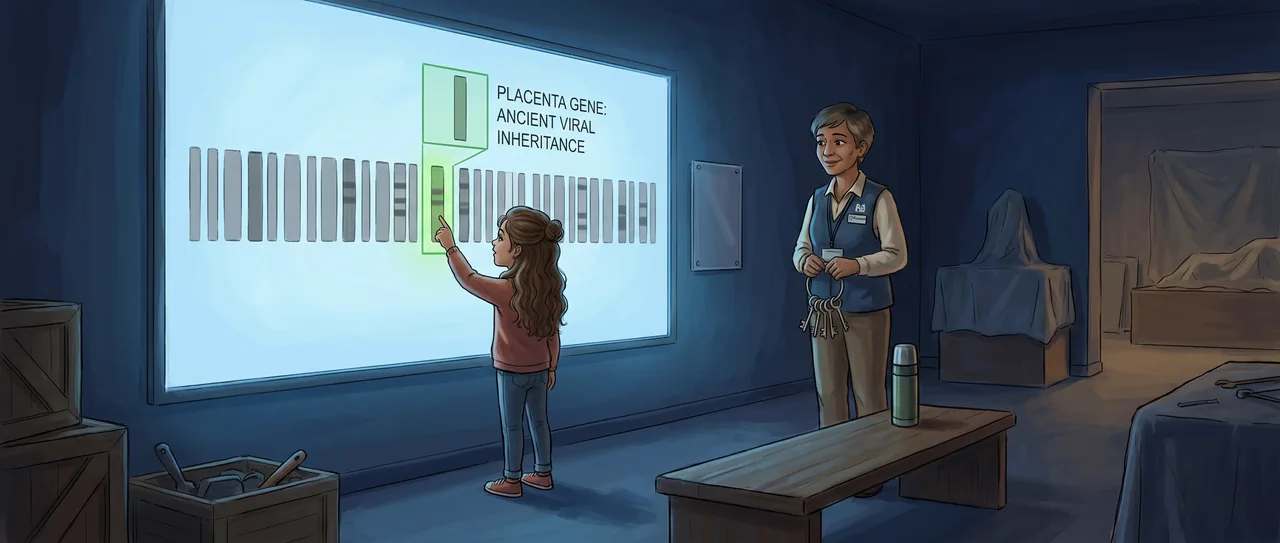
There was a screen with a line of colored bands, a strip meant to stand in for a strand of human DNA. Most of the bands were labeled with words like eye color and enzymes. But scattered all through the strip were gray bands, unmarked, and there were a lot of them. More than she expected. She counted along one segment and lost track and started again.
"What are the gray ones," Maya asked.
Priya squinted at the screen. "Junk, I think. The leftover parts. The label for that one never got installed." She tapped a blank plastic frame on the wall where a placard should have been.
Maya did not think a thing that took up that much of the strip was leftover. Leftover was crumbs. This was closer to a third of the sandwich.
She pressed the arrow on the screen. A gray band expanded. Text bloomed beside it, the part that had been programmed even though the wall label was missing.
Virus, it said. Ancient. Integrated approximately thirty million years ago.
Maya read it twice.
"Priya. This one's a virus."
"A picture of a virus, maybe."
"No." Maya pointed. "It says it's inside. It says it got in and stayed."
Priya came closer, coffee steaming. She read the little block of text with the slow face of someone reading something they were about to have opinions about. "Huh," she said. "That can't be right. If a virus got into your DNA you'd be sick."
Maya pressed the next band. Same word. Virus. Different number. Different age. Then another. Then a cluster of them so close together they looked like a single gray smear, each one a separate infection from a separate ancestor from a separate impossibly long time ago.
The strip on the screen was human. It said so at the top. This was not a display about disease. This was a display about what a person is made of.
"They didn't make us sick," Maya said slowly. "They got in a really long time ago. Into somebody who then had babies."
Priya frowned. "You can't inherit a cold."
"You can't inherit a cold you caught. But if it got into the part that makes the babies." Maya stopped. She was moving faster than she could say it. "Then it's not the sick person's virus anymore. It's just. Part of the instructions. It gets copied every time, forever, like everything else in there."
She looked at the smear of gray bands and felt the room change size.
Every person in the parking lot outside. Every person in the budget meeting upstairs. Her mother. Herself. All of them walking around built partly out of the wreckage of infections that happened before there were people to get infected. The viruses had lost. They had also, in a way she did not have a word for yet, won completely.
"That's horrible," Priya said, but she said it the way you say something is horrible when you actually mean you cannot stop looking at it.
"I don't think it's horrible," Maya said. She kept pressing bands. One of the gray ones was different. It had a small green outline the others didn't have, and when she opened it the text was longer, and this part the museum had clearly cared about, because someone had written it in plain words.
This viral gene is still used. It builds part of the placenta, the organ that connects a parent to a growing baby. Without this ancient virus, live birth as mammals do it may not exist.
Maya went very quiet. A virus, a thing whose entire job was to break into cells and copy itself, had broken in so long ago and so completely that the body had stopped fighting it and started using it. Used the break-in tool to build the exact machinery that let mothers hold babies inside them at all. The thing that had once been an attack was now the reason she had ever been carried anywhere.
"Priya," she said. "This one isn't leftover. This one's the reason I'm here."
Priya opened her mouth and then didn't say anything. She set the thermos down on the bench.
Maya went back to the start of the strip and looked at all the gray bands again, the ones the museum had called junk, the ones with no printed label because the money ran out before anyone explained them. There were so many. A whole crowd of ancient losers who had failed to make anyone permanently sick and had instead become permanent. Some doing nothing anyone had figured out. Some quietly holding up the floor of what a human was.
She thought about the word junk and how easy it was to write that on a blank frame and walk away. How something could sit right in the middle of you, taking up a third of the sandwich, and get called leftover just because nobody had finished reading it yet.
"How many are there," Priya asked. Her voice had changed. She was asking for real now.
"I keep losing count," Maya said. "There's too many."
She stood back so the whole strip was in front of her at once, the labeled bands bright and confident, the gray bands scattered between them like stones nobody had turned over. Upstairs a door opened and her mother's voice came down the stairwell, tired, calling her name.
Maya didn't answer yet. She reached out and pressed one more gray band, an unmarked one, deep in the middle of the strip, just to see what the museum had hidden behind the label it never printed.
Read the interactive version, listen to the narration, and earn a gold star →
A science-verified short story for curious kids · Curiosity Land