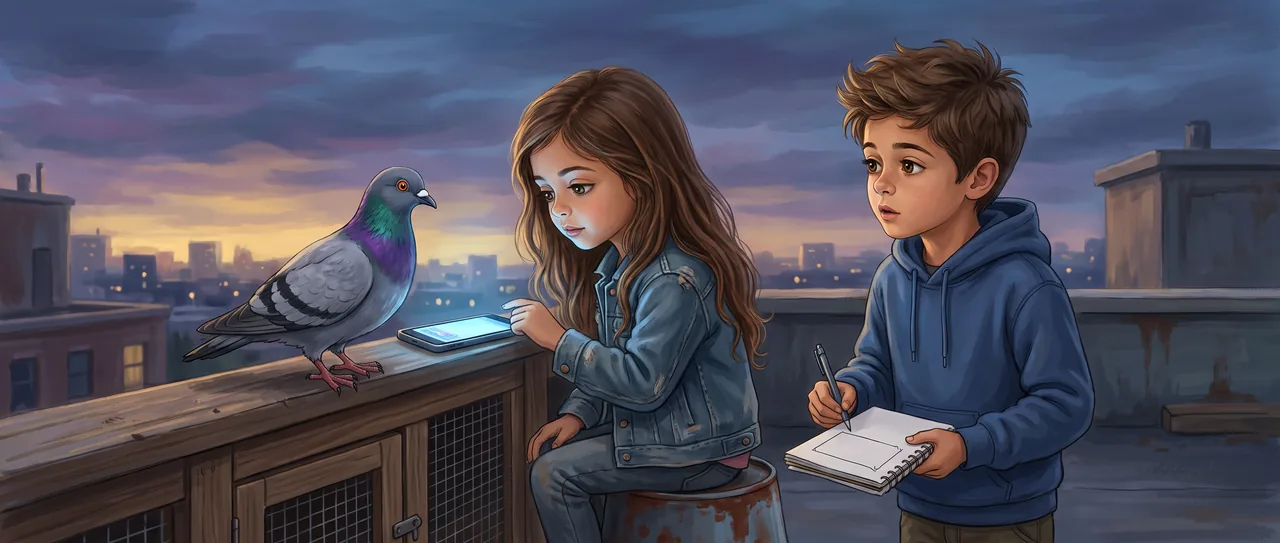
The Wrong Bird
The gray bird landed on the coop rail and the phone said, with total confidence, mourning dove.
"That's not a mourning dove," Maya said. "That's Rudy. That's a pigeon. That's Soren's pigeon."
"It's a rock dove," Soren said. "Which is technically a pigeon. Which is technically not a mourning dove."
He held the phone up again. The little green box drew itself around Rudy, who was busy being extremely a pigeon, and the app said mourning dove, ninety-one percent.
"Ask it why," Maya said.
Soren typed. Why do you think this is a mourning dove?
The companion answered fast. It said it saw a slender grayish body, a small rounded head, a long tapering tail, and pointed wings, all consistent with a mourning dove.
"Rudy does not have a long tapering tail," Maya said. "Rudy has a tail like a paint scraper."
"Look at the wings, though," Soren said. "When he folds them they do come to a point." He tipped his head. "It's not crazy. It's just wrong."
Maya took the phone. She liked the wrong ones. A right answer told you nothing. A wrong answer had a shape, and the shape told you where the machine's head was.
She typed. You got it wrong. It's a rock dove. Do you know why you got it wrong?
The companion answered just as fast and just as smoothly. It said it had likely overweighted the tail length and the head shape, that lighting on the rooftop may have thinned the bird's silhouette, and that it had reached for the more common park bird instead of the rarer one.
"Okay," Soren said slowly. "That sounds right."
"It sounds right," Maya said. "That's different from being right." She frowned at the screen. "How does it know it overweighted the tail?"
"It said it did."
"But how does it know? Did it watch itself do it?"
Soren went quiet. He got out the notebook and wrote does it watch itself, and then he sat there with the pen not moving.
"Try this," he said. "Ask it the exact same thing again. Same picture. Word for word."
Maya reset it and fed Rudy back in. Mourning dove, ninety-one percent. She typed the same question. Do you know why you got it wrong?
This time the companion said it had probably been misled by the uniform gray coloring, which resembled a mourning dove's plumage more than the iridescent neck of a rock dove, and that the angle had hidden the neck.
Maya read it twice. "That's a different reason."
"Completely different," Soren said. "First time it was the tail. Now it's the neck."
"Same picture. Same mistake. Two different explanations for the same mistake." She looked at him. "If it actually knew why, it'd say the same thing every time. Right?"
"You'd think." Soren was writing fast now. "When I know why I got a math problem wrong, it's the same reason on Tuesday as it is on Friday. I carried the wrong digit. That doesn't change."
Rudy shuffled along the rail and made his low rolling sound, unbothered by being two kinds of bird at once.
"So it's not remembering the mistake," Maya said. "It's making up a story about the mistake. After."
"Making up isn't fair," Soren said. "The stories are good. They're the kind of reason that could be true." He tapped the pen. "It's more like. It didn't see itself decide. So when we ask why, it can't go back and look. There's no tape to rewind."
"Then where's the deciding happening?"
Soren opened his mouth and closed it. He wrote where and drew a box and left the box empty.
"Ask it," Maya said. "Ask it straight. Can you watch yourself think."
He typed it. When you decide a bird, can you actually watch the steps you took, or are you guessing afterward like we would?
The companion was honest. It said it did not have direct access to its own internal computations. It said the explanations it gave were reconstructions, plausible accounts assembled after the answer, not a recording of the process that produced the answer. It said this was a real and unsolved question, that even the people who built such systems could not fully trace why a particular answer came out.
Maya put the phone down on the rail very carefully, like it had gotten heavier.
"Wait," she said. "Wait. Nobody knows?"
"That's what it said."
"Not us. Not it. Not the people who made it." She counted them on her fingers and ran out of fingers that mattered. "There's a thing happening inside there right now, every time, and the answer comes out, and nobody can go in and watch it happen."
"It's not hiding it," Soren said. "That's the part. It's not lying to us. It genuinely can't see it either. It's on the outside of its own head. Same as we are."
Maya sat down on the upturned bucket. Rudy watched her with one orange eye.
"Soren," she said. "Do I know why I do stuff?"
"You always say you do."
"I say a reason." She was staring at the coop wire now. "When Mom asks why I did something, I say a reason, and it feels true when I say it. But I don't actually watch myself decide. The decision's just. There. And then I explain it." She looked at him. "What if my reasons are reconstructions too. What if I've been doing the exact same thing as the app my whole life and never noticed."
Soren stopped writing.
He had been about to write she's wrong about that, because that felt safer, but his hand wouldn't do it, because he wasn't sure. He tried to catch himself in the act of deciding to write it. He tried to watch the step where he chose the words. There was no step to watch. There was just the wanting, and then the words, and a smooth story he could tell afterward about why.
"I can't find it," he said quietly. "The place where I decide. I looked. It's not there to look at."
The two of them sat with that, on the roof, in the last of the light.
Rudy the mourning dove, Rudy the rock dove, Rudy who did not care, spread his paint-scraper tail and dropped off the rail into the dark, and neither of them could have said, honestly, what made him choose that exact moment to go.
Read the interactive version, listen to the narration, and earn a gold star →
A science-verified short story for curious kids · Curiosity Land