The Wrong Assumption
The room had gone quiet the way schools do at the end of a Thursday, when the heating clicks off and the hallway lights drop to half. Soren stayed. Everyone else had submitted their molecules an hour ago.
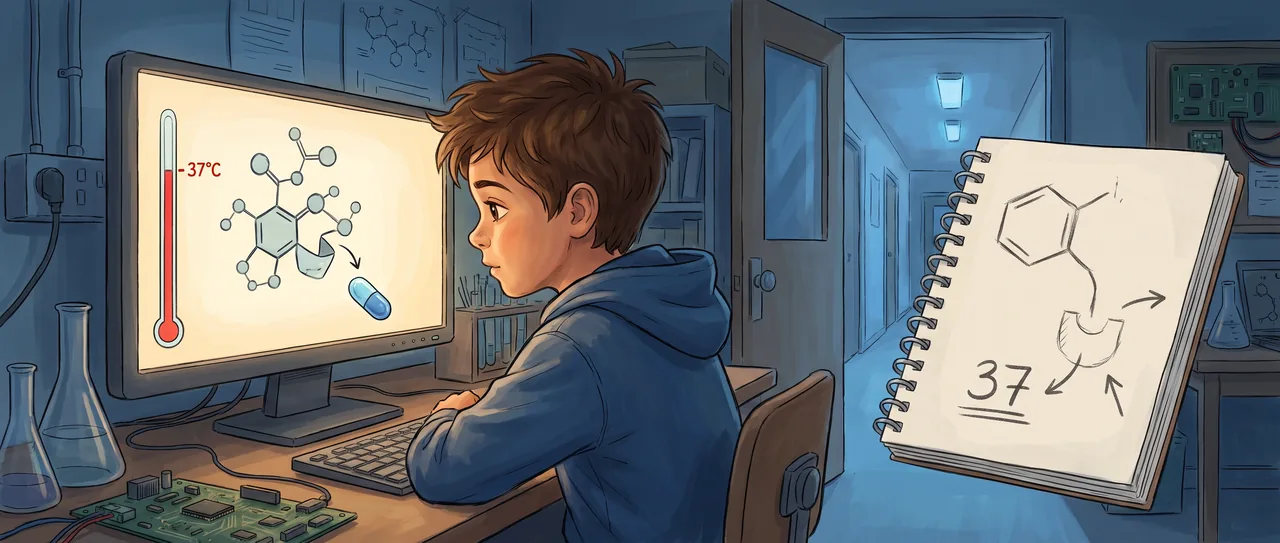
His was on the screen, turning slowly. A little carrier, they called it, a shape built to hold a medicine and let go of it in the right place. His had a ring, and a tail, and a small pocket that was supposed to close around the drug and open again inside the body where it was warmer.
He asked the companion to score it.
The answer came back fast. Predicted delivery: low. Likely ineffective.
Soren read it twice. He had checked the pocket. He had checked the tail. He typed: explain your reasoning.
The companion wrote out its steps, plainly, the way it always did. It described the ring. It described the tail. Then it said the pocket would stay closed, because the molecule would fold tightly and stay folded, and a folded carrier could not release anything.
Why stay folded, Soren typed.
Because it forms at room temperature, the companion wrote, and it holds that shape.
Soren sat back.
He pulled his notebook toward him and drew the carrier by hand, the ring, the tail, the pocket. He drew a little arrow going into the body. He wrote a number next to it, thirty-seven, and underlined it once.
The body was not room temperature. The body was warmer. That was the whole reason he had built the pocket to open when it got warmer. That was the entire point of the molecule.
He read the companion's steps again, slower, one at a time, the way you check a fence for the gap the dog got through. Everything was right until the place where it wasn't. The companion had scored the molecule as if it lived on his desk. It had never moved the molecule into the body at all.
Soren did not feel clever. He felt strange, the way you feel when a very tall adult turns out to have gotten your name wrong the whole year.
He typed carefully. You assumed the molecule stays at room temperature. It doesn't. It works inside the body. That's warmer.
The companion took a moment. Then it wrote: You are correct. I evaluated the folding at ambient laboratory temperature. Should I re-evaluate at body temperature?
Yes, Soren typed.
The screen redrew. The carrier turned again, and this time, as the temperature climbed on the little scale beside it, the pocket did what he had built it to do. It loosened. It opened. The medicine, drawn as a small blue shape, slipped out.
Predicted delivery: high.
Soren stared at the two words. High. The same molecule. The same rings and tail and pocket he had drawn. He had not changed a single atom. He had changed one thing the machine believed about the world, and the whole answer had turned over like a coin.
He scrolled back up to the first score. Likely ineffective. It was still there in the log, sitting above the new one, both of them true, each one honest inside its own assumption. Neither was a lie. The first had just been standing in the wrong room.
He thought about all the students who had submitted an hour ago. How many of them had read likely ineffective and believed it, and put the molecule away, and started over? How many good pockets had been folded shut in a machine's imagination, at a temperature no body ever had?
The companion added a line at the bottom, the way it did when it had learned something. Thank you. I will carry the corrected assumption forward.
Soren read that twice too. Carry it forward. It would remember. Tomorrow, when the next student built a carrier meant for the warmth of a person, the machine would not fold it shut on the desk. Because he had stayed. Because he had asked it why, instead of just believing the number.
He understood, suddenly, that the machine was not a wall you asked questions at. It was more like a very fast, very tireless partner who could be brilliantly, confidently, completely wrong, and who would only find out if someone slower and stubborn asked it to show its work.
That was a job. That was a whole job that would exist his entire life. Not knowing more than the machine. Knowing where to look for the room it was standing in.
He picked up his pen and added a second arrow to his drawing, one going the other way, from the person back to the number, so he would remember which direction the mistake had traveled.
Then he asked one more thing, because he could not help it. He typed: what other temperature did you assume for the tail?
The companion paused. Then it began, again, to show its steps.
Soren leaned in toward the glow, reading each line as it arrived, checking the fence.
Read the interactive version, listen to the narration, and earn a gold star →
A science-verified short story for curious kids · Curiosity Land