The Weight of the Bottom
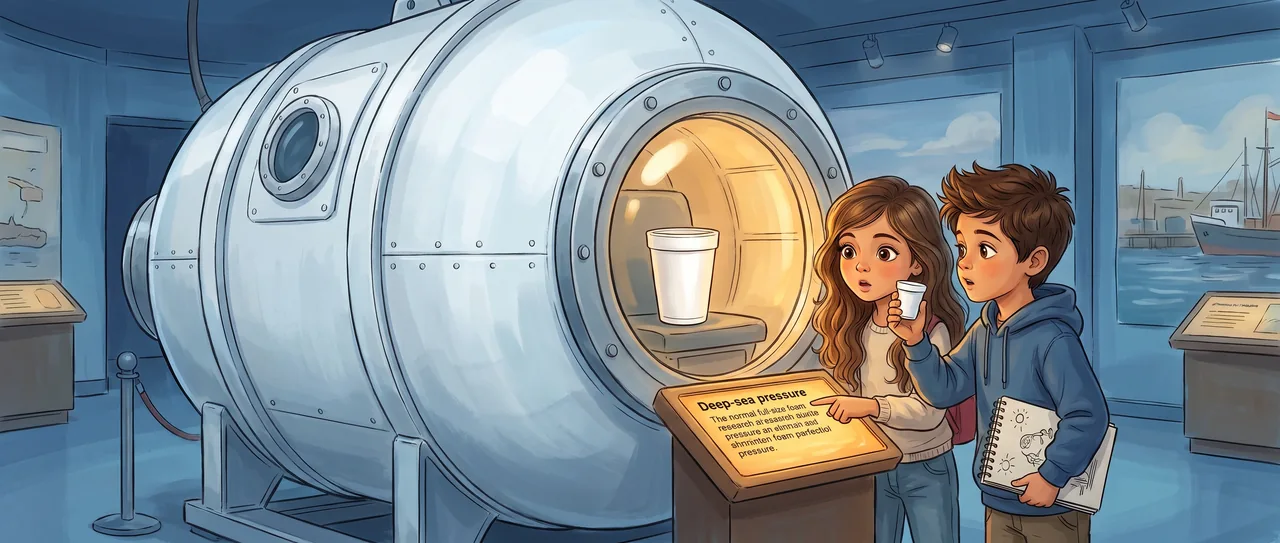
The submersible looked like a fat white barrel with a window in it. A sign on a rope said DO NOT ENTER. Somebody had left a foam cup on the seat inside.
"That window is really thick," Soren said. He put his face close to it. "Like, my whole hand thick."
"It went to the bottom," Maya said. She was reading the panel. "The real bottom. Challenger Deep. Eleven kilometers down."
"Eleven." Soren said the number slowly. "Everest is under nine."
"So?"
"So if you took Everest and dropped it in the trench, point down, the top wouldn't reach the surface." He looked up, as if measuring the ceiling. "There'd still be a mile of water over it."
Maya went quiet. Then she picked up the foam cup and held it out to him.
"They bring these down sometimes," she said. "On the outside of the sub. Tied to the frame."
"Coffee cups?"
"Watch." She wasn't watching anything. She was thinking. "What comes back up?"
Soren took the cup and turned it in his hands. "A cup."
"A tiny cup. Thumb-sized. Same shape, everything, just shrunk." She squeezed the foam and it dented. "Because foam is mostly air. Little bubbles. And the water down there squeezes all the bubbles flat."
"How hard does it squeeze?"
Maya looked at the panel again. "A thousand times harder than up here."
Soren put the cup down very carefully, like it had become heavier.
"A thousand," he said. "That's not a lot more. That's a different thing." He pressed his thumb against the thick window. "Right now there's air pushing on us. All the air above us, all the way up. That's one. Down there it's a thousand of those, stacked."
"Everything with a bubble in it gets crushed," Maya said. "The cup. A submarine that isn't built right. A person, if the metal cracked."
They both looked into the barrel with the window, at the seat where a person had sat with all that water overhead.
"Okay," Soren said. He had his notebook out. He drew a small barrel and a lot of arrows pointing at it from every side. "So nothing lives down there. Right? Nothing can. It would get flattened."
"There's fish," Maya said.
Soren stopped drawing.
"The panel," she said. "Read it."
He read it. He read it again. "Snailfish," he said. "There are snailfish at eight thousand meters. And shrimp things. And there's stuff living in the mud at the actual bottom. Living. Eating. Doing whatever."
"How." Maya wasn't asking. She was demanding it from the room.
Soren looked at the crushed cup. He looked at his arrows. Something wasn't fitting and he wanted to find where.
"The cup got crushed because of the bubbles," he said slowly. "The air inside. The water pushed in and there was nowhere for the air to go."
"Yeah."
"So what if you don't have bubbles?"
Maya turned to look at him.
"A fish is mostly water," Soren said, and now he was going fast. "We're mostly water. Water doesn't squish. You can push on water as hard as you want and it just, it doesn't get smaller. There's nothing to crush." He grabbed the cup. "The cup got flat because of the empty parts. A snailfish doesn't have empty parts. It's full. All the way through."
"The water inside pushes back," Maya said. "Just as hard as the water outside pushes in."
"A thousand from outside. A thousand from inside. It's a tie." Soren laughed, a surprised sound. "It's not being crushed. It's being held. From both sides, exactly the same." "So it's not that they survive the pressure," she said.
"They're not fighting it at all," Soren said. "They just don't have anything for it to grab."
They sat with that. Somewhere down the hall Maya's aunt was talking to somebody about a shipping form.
"But that's the easy part," Maya said suddenly.
"What?"
"The pressure. That's the easy part. If you're just full of water, fine." She was frowning now, chasing something. "The hard part is the little machines inside. The stuff in your cells. Proteins. My mom says they're folded up in shapes and the shape is the whole point. Push on them hard enough and they'd fold up wrong."
Soren looked at the panel. "But the snailfish is fine."
"The snailfish is fine at a thousand times the squeeze. So its little machines are folded so they don't come undone." Maya's voice dropped. "They're built for it. They're built for a place that would fold ours wrong."
"So you couldn't just move one up here," Soren said, working it out. "Bring a bottom-fish to the surface."
"It might come apart the other way," Maya said. "Too little pressure. Its machines only work squeezed."
Soren wrote that down. His hand was pressing hard enough to dent the page.
"There's a whole animal," he said, "that would fall apart in our world. And we fall apart in its world. And both of us think we're the normal one."
Maya was already somewhere else.
"The microbes in the mud," she said. "At the very bottom. The panel says there's a layer of them. Living in the deepest place there is. Eleven kilometers of water on top of them. No light ever. Not once, not ever."
"What do they eat?"
"It doesn't say." She looked up at him. "It doesn't say because nobody's totally sure. That's what I like about it. It's the deepest hole on the planet and it's got things living in it and we barely know what they are."
Soren stood up and put his face back to the thick window, to the seat, to the foam cup somebody had left there like it was nothing.
"You could tie a cup to that sub," he said. "Send it down. It comes back the size of your thumb."
"And right next to it," Maya said, "a fish the same size would be swimming around perfectly happy, wondering what all our weight was for."
Soren picked up the cup and turned it slowly in the light, looking for the bubbles that were still in it, the ones that hadn't been squeezed yet.
Read the interactive version, listen to the narration, and earn a gold star →
A science-verified short story for curious kids · Curiosity Land