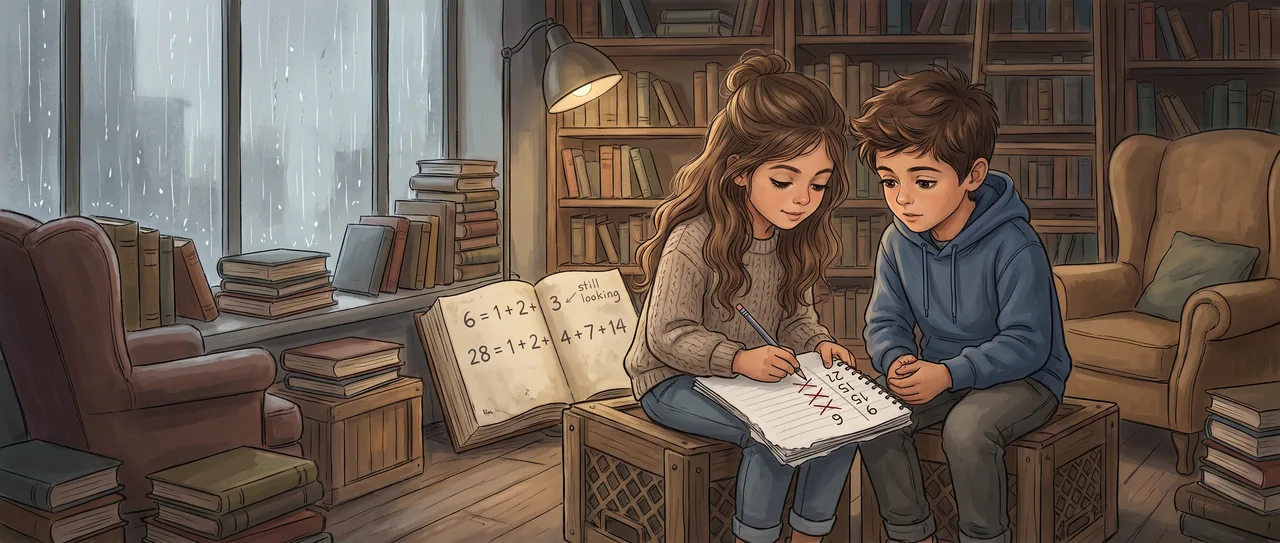
The Number That Won't Come
The book smelled like a basement and cost fifty cents. Soren opened it anyway, because the spine said Theory of Numbers and someone had written in the margin in pencil, so faint it was almost gone.
"Look at this," he said. "Somebody did homework in here a hundred years ago."
Maya leaned over. The pencil marks made a little tower.
6 = 1 + 2 + 3
28 = 1 + 2 + 4 + 7 + 14
Under that, in the same hand: still looking.
"Add up the numbers that divide six," Soren said. "Not six itself. One, two, three. You get six back."
"Weird," said Maya. "Do it again with twenty-eight."
He did it out loud. One and two and four and seven and fourteen. Twenty-eight.
"So the number is exactly its own pieces," she said. "Nothing left over. Nothing missing."
"They're called perfect," Soren said, reading the tiny printed heading. "Perfect numbers."
Maya sat down on an upturned milk crate. Rain ran down the front window in ropes.
"What's the next one," she said. It wasn't really a question. She was already trying.
"You can't just guess. You have to check every number."
"Then I'll check. You take the odd ones, I'll take the even ones."
Soren almost said something, then didn't. He tore two pages from the back of his own notebook and handed her one.
They worked. The shop owner, an old man with reading glasses pushed up into gray hair, glanced over once and went back to pricing records. He did not ask what they were doing. He seemed like a person who had learned not to.
Maya got there first. "Four hundred ninety-six," she said. "One, two, four, eight, sixteen, thirty-one, sixty-two, and so on. It adds back to itself. I did it twice."
"That's even too," Soren said. He was frowning at his own page. "Maya. All of mine are failing."
"What do you mean failing."
"I mean every odd number I try, the pieces add up to either too much or not enough. Never exactly the number." He turned the page around so she could see the wreckage of his arithmetic, number after number crossed out. "Nine. Its divisors are one and three. That's four. Too small. Fifteen. One, three, five. Nine. Too small. Twenty-one. One, three, seven. Eleven. Too small."
"Try a bigger one."
"I did. They keep being too small, or they overshoot. I can't land on one."
Maya took his page and looked at the pattern of crossed-out numbers. "Six is even," she said slowly. "Twenty-eight, even. Four ninety-six, even."
"So?"
"So every perfect number we found is even. And you can't get an odd one to work. At all."
Soren went quiet. Then he pulled the old book back toward him and read the rest of the page, the part below the pencil marks, the printed part.
"Maya."
"What."
"It says nobody knows."
"Knows what."
He read it straight off the page so he wouldn't get it wrong. "It is not known whether any odd perfect number exists."
Maya took the book. Read it herself. Read it again.
"That's not a homework problem," she said.
"No."
"That's not, like, a thing they haven't taught us yet."
"No. It's a thing nobody has taught anybody. Ever."
The rain kept coming down the window. Somewhere behind the shelves the old man dropped a record into a sleeve with a soft flat sound.
"Wait," Maya said. "How long have people been looking."
Soren checked the front of the book, the little roman numerals, then did the thing where he built the answer out of what he already knew. "The Greeks knew six and twenty-eight. That's Euclid. That's more than two thousand years ago."
"Two thousand years," Maya said.
"People who did nothing but this. People way better at it than us. Computers now, checking numbers so big you couldn't write them down in this whole shop." He stopped. "And nobody has found an odd one. And nobody has proved there isn't one."
Maya looked at Soren's page again, all those honest little failures in pencil. Nine. Fifteen. Twenty-one. Each one tried, each one too small.
"So your page," she said. "Your page of failing."
"What about it."
"That's the exact thing. That's the actual not-knowing. You did the same thing on this milk crate that they've been doing for two thousand years."
Soren looked down at his own handwriting. The crossed-out numbers looked different to him now. Not like mistakes. Like a place where a road ran out and the map just stopped and said we don't know what's past here.
"Someone wrote still looking in the margin," he said quietly. "In pencil. Like they were going to come back to it."
"Maybe they never found it."
"Maybe there's nothing to find. Maybe every odd number is like the ones on my page. Too small or too big, forever. And you'd have to prove that about all of them. Every single odd number that will ever exist."
"Or," said Maya, and she was leaning forward now, elbows on her knees, "there's one. Way out there. So big nobody's reached it yet. Just sitting there being perfect and odd and nobody's ever seen it."
Neither of them said anything for a second.
"Both of those are insane," Soren said.
"I know," said Maya. "And it has to be one of them."
She took the pencil out of the crease of the book, the same kind of soft gray pencil that had written the margin note. She turned Soren's page over to the blank side.
"What are you doing," he said.
"Starting a bigger one. You said the odds keep coming up too small. But they get a tiny bit closer sometimes, right? So I want to see if they get closer or if it's random."
Soren pulled his crate around next to hers so he could see the numbers as she made them.
Outside, the rain kept writing down the window, and the old man rang up nobody, and on the back of a torn notebook page a new column of odd numbers began, none of them landing yet.
Read the interactive version, listen to the narration, and earn a gold star →
A science-verified short story for curious kids · Curiosity Land