The Gray Coming Inland
The dead trees stood in the water like they had forgotten how to fall down.
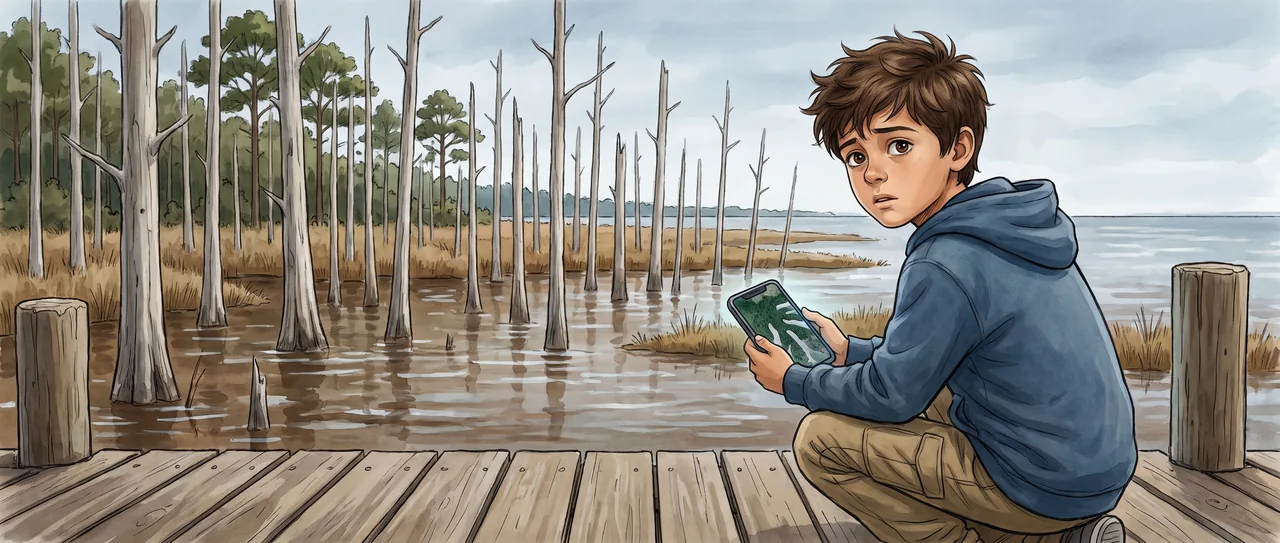
Soren counted them from the pier while his aunt fixed a channel marker. Thirty-one gray trunks, no bark, no branches worth the name, standing in a foot of brown water where the marsh met the sound. They were the color of old bone. Behind them, further from the water, some trees still had a little green at the top, the way a candle still has flame when the rest has burned to nothing.
"Cedars," his aunt said, not looking up. "That whole stretch was forest when I was your age. We used to walk out there." She threaded a bolt. "Now you'd need a boat."
Soren pulled out his notebook and drew the line of trees. Living green at the top of the drawing. Gray in the middle. Open water at the bottom. He drew an arrow, then didn't know which way to point it.
"Did a storm kill them?" he asked.
"No storm." She wiped her hands. "They just stopped one year. All at once, kind of. Grandpa said the well went salty first. Then the garden. Then the trees."
Soren looked at the water around the trunks. It looked like ordinary water. He crouched at the edge of the pier where the tide was coming through a gap in the marsh grass and put his finger in and touched it to his tongue before his aunt could tell him not to.
Salt. Not a little. A lot.
That was the part that didn't sit right. The ocean was over the dunes, more than a mile off. You could barely hear it. But the salt was here, standing quietly around the feet of trees that had grown up thinking they were safe inland.
"How does the salt get all the way here?" he said.
"Comes up underneath." His aunt tapped the boards with her boot. "Ground's like a sponge. Fresh water sits on top, salt water pushes under. When the sea comes up even a little, the salt slides in below where you can't see it. Roots find it before we do."
Soren sat with that. The trees had not been flooded. Nothing had knocked them over. The water had come up from below, through the dirt, into the roots, and the trees had drunk it without knowing, and the salt had done the rest. They were still standing because nothing had told them to fall.
He walked the pier to the far end where a man was fishing. The man had a phone propped on the rail with a map on it, the kind that showed the land from above.
"Can I see the marsh on that?" Soren asked.
The man shrugged and turned it. Soren pinched the map bigger. From above, the living forest was dark green, a solid mass inland. And reaching into it, like fingers, were patches of pale gray. He had seen that gray from ground level. From up here it had a shape. The gray fingers all pointed the same direction. Away from the sound. Inland.
"That gray is the dead ones," Soren said.
"Guess so," said the man, and cast his line.
Soren scrolled the map north. More gray. He scrolled south. More gray, all along the coast, wherever the land was low and flat, the same pale patches eating into the green, all of them leaning inland like the whole edge of the country was slowly turning to bone from the outside in.
He went back to his aunt.
"You can see it from space," he said. "The dead trees. Satellites see them."
"I believe it." She snapped her toolbox shut.
"So somebody's watching it happen." He said it slowly. "From up there. The gray part getting bigger every year. They can measure it."
"Somebody watches everything now."
Soren looked back at the thirty-one trunks. He understood now that they were not a graveyard. A graveyard is where things end and stay. This was a front line, and it was moving, and the trees standing in the water were not the dead of the battle. They were the map of where the battle had already passed. The green trees behind them, the ones with a little flame left at the top, those were standing on ground that was still fresh. For now. The salt was already underneath them, sliding in, and they didn't know.
"How fast?" he asked.
"How fast what?"
"The gray. How fast does it come inland."
His aunt thought. "Grandpa's cedars, from the water to where they are now, that's maybe forty years. So. Not fast like a car. Fast like a shadow in the afternoon. You don't see it move. You look away and look back and it's somewhere else."
Soren wrote that down. A shadow you can't watch move but can measure between two glances.
He thought about the satellites. Somebody up there had two pictures, one from years ago and one from now, and laid them on top of each other, and the difference between them was the gray, creeping. You could not see it move from the pier any more than you could watch the hour hand on a clock. But you could see that it had moved. That was the trick of it. The whole coast was a clock, and the dead trees were the hands, and you had to look away and come back with better eyes to read it.
He wondered where the green line would be when he was his aunt's age. Where the water would be. He looked at the ground under the pier, the ordinary dirt of the marsh edge, and thought about the salt already down there, patient, moving in under everything, waiting for the sea to rise the last little bit that would let it up into the roots.
"I want to see the two pictures," he said. "The old one and the new one. I want to see how much it moved."
His aunt handed him the fishing man's map without asking, and pointed at a small slider on the side that scrubbed the years backward.
Soren pulled the slider back. The gray fingers shrank toward the water, and the green closed over the marsh, and the thirty-one cedars stood up alive and dark. He held his thumb on the slider and let it go, and watched the green pull back and the gray come reaching inland again, year over year, toward the pier, toward his shoes, toward him.
Read the interactive version, listen to the narration, and earn a gold star →
A science-verified short story for curious kids · Curiosity Land