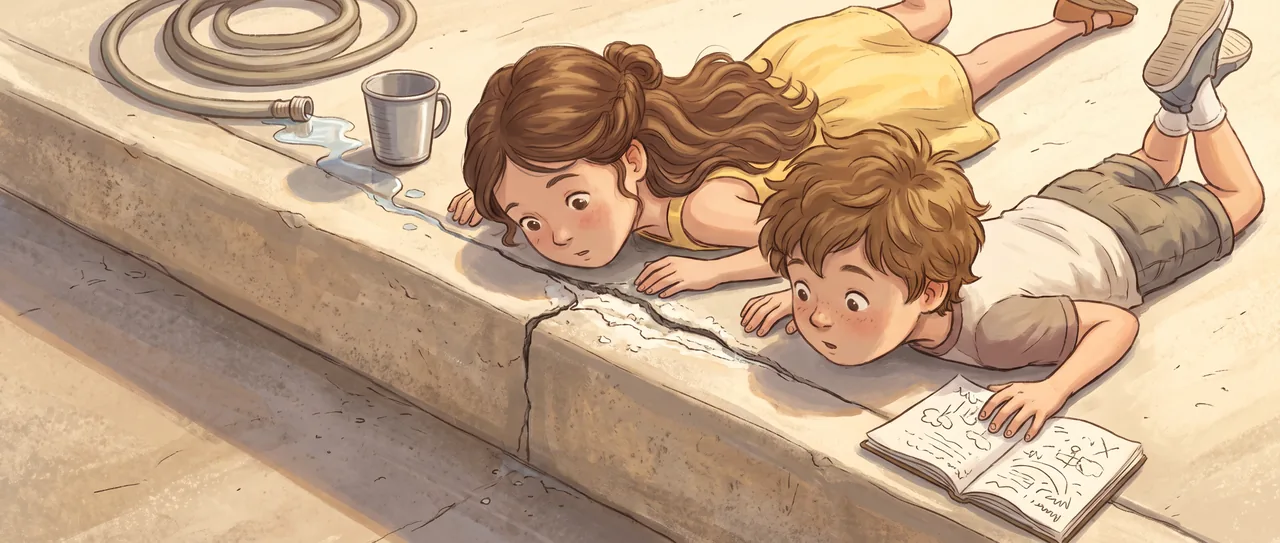
The Crack That Fixed Itself
The curb had a crack in it before they even used it once.
"We wrecked it," Maya said. She crouched by the long gray block they had poured three weeks ago. The crack ran across the top like a thin dark hair. "We let it dry too fast. My dad said so."
"Your dad said it might," Soren said. He was reading the empty bag again, the one his uncle had left in the garage with a note that said try this, it's the weird stuff. "He didn't say we wrecked it."
"A crack is wrecked."
"A crack is a crack." Soren turned the bag over. The label had a lot of small print and one line in bigger letters. He read it out loud. "Contains bio-additive. Do not be alarmed by mineral growth."
Maya stopped poking the crack. "Mineral growth."
"That's what it says."
"Growth like it grows?"
"That's usually what growth means."
She sat back on her heels. "Soren. Concrete doesn't grow. It sits there. That's the whole point of concrete."
"I know." He wrote the line from the bag onto his page. Mineral growth. Then he looked at the crack. "So why would they put that on a bag of it."
They both looked at the thin dark line. It did nothing, the way cracks do.
"Water," Maya said suddenly.
"What about it?"
"The bag. Read the part before that."
Soren found it. "Keep dry until use. Activated by moisture." He looked up. "You think the crack does something if it gets wet?"
"I think everything about this is weird and there's a hose right there."
They filled a cup. Maya poured a little into the crack, slow, watching it disappear down into the dark. Then they waited.
Waiting is the hardest thing two eleven-year-olds can do. They lasted about four minutes.
"Nothing," Maya said.
"It's a rock," Soren said. "Rocks are slow."
So they left it. They skated the driveway. They came back the next day and Maya got down on her stomach with her face right next to the crack and said a word she was not supposed to say.
"What," Soren said.
"There's white stuff in it."
He got down next to her. Deep in the crack, where the water had gone, there was a rough pale crust, like the inside of a seashell, like the crumbs at the bottom of a chalk box.
"That wasn't there," Soren said.
"That was NOT there." Maya touched it. It was hard. Not slime, not paint. Stone. New stone, in a place where yesterday there had been nothing but a gap. "Okay. Okay. Where does stone come from. Stone doesn't just show up."
"It says bio-additive." Soren was writing fast now, his letters getting messy. "Bio means alive."
Maya went very quiet, and then she said, "There's something alive in the concrete."
They stared at the block. It looked exactly like a block.
"For three weeks," she said. "It's been sitting in our yard the whole time. Dry. Just, in there."
"Asleep," Soren said. He didn't know if that was the right word but it felt right. "Asleep in the rock. And when the water came in it woke up."
"And made stone." Maya sat all the way up. "How do you make stone by being alive?"
"Shells," Soren said. It came out before he'd finished thinking it. "Snails. Snails are alive and they make shells and shells are basically rock. Clams. Coral." He looked at her. "There's a whole ocean of alive things that make rock."
"So somebody found a tiny one," Maya said slowly, "that eats, what, whatever's in there, and the leftover is stone, and they put a bunch of them in a bag, asleep, and sold it as concrete."
"That poured stuff has millions of them in it," Soren said. "Just waiting."
"For what."
"For a crack." He said it and then he heard himself say it. "Maya. They're waiting for the concrete to break."
She turned to look at him.
"That's the whole thing," Soren said, faster. "That's why the bag isn't alarmed. A crack lets water in. Water wakes them up. They multiply and they lay down stone and the stone fills the crack. The break is the thing that turns them on."
Maya put her hand flat on the top of the curb, near the crack, and left it there.
"So it's not wrecked," she said.
"No."
"It's fixing itself. Right now. Under my hand."
"Millions of them," Soren said. "Down there in the dark. They spent three weeks doing absolutely nothing and they were fine. They can wait for years. My uncle's note said the good stuff lasts decades." He looked at his own hands. "Some crack could happen in that block when we're forty and they'd still wake up."
Maya wasn't listening anymore, not to him. She was looking at the whole yard. The concrete path to the door. The gray wall along the neighbor's drive. The sidewalk out front, cracked in six places, that she had walked over ten thousand times and never once thought about.
"Soren." Her voice had gone strange. "How much concrete is in a city?"
He stopped writing.
"Because if somebody made enough of this," Maya said, "then all of it. Bridges. Buildings. The road. All of it full of things that are asleep. Waiting for a crack. And nobody walking on top even knows they're carrying an ocean around."
Soren looked down the driveway at the cracked sidewalk, and for one second it did not look like a sidewalk. It looked like a lid.
Maya poured the rest of the cup into the crack. They lay down on the warm concrete, cheek to the rough gray surface, close enough to see the pale new stone catching the light.
"Do you think we can hear it," she whispered.
"No," Soren whispered back. "They're too small."
They listened anyway. Somewhere under their faces, in the dark inside the rock, the water was arriving, and the waiting was ending, and the stone was beginning to grow.
Read the interactive version, listen to the narration, and earn a gold star →
A science-verified short story for curious kids · Curiosity Land