The Coastline People
The dataset was free. That was the only reason they had it. A museum had put forty thousand years of a single stranger's DNA on the internet, and anybody who wanted to could look.
"It's called a ghost lineage," Soren said, reading off the museum page. "When you find genes in living people that came from a group nobody has ever dug up. You know the group existed because it's still inside people. But you've never found the actual people."
"So there's a whole population we've only ever met from the inside," Maya said.
"Basically."
Maya leaned back in the wheeled chair and let it drift. "Okay. Put the percentages on the map."
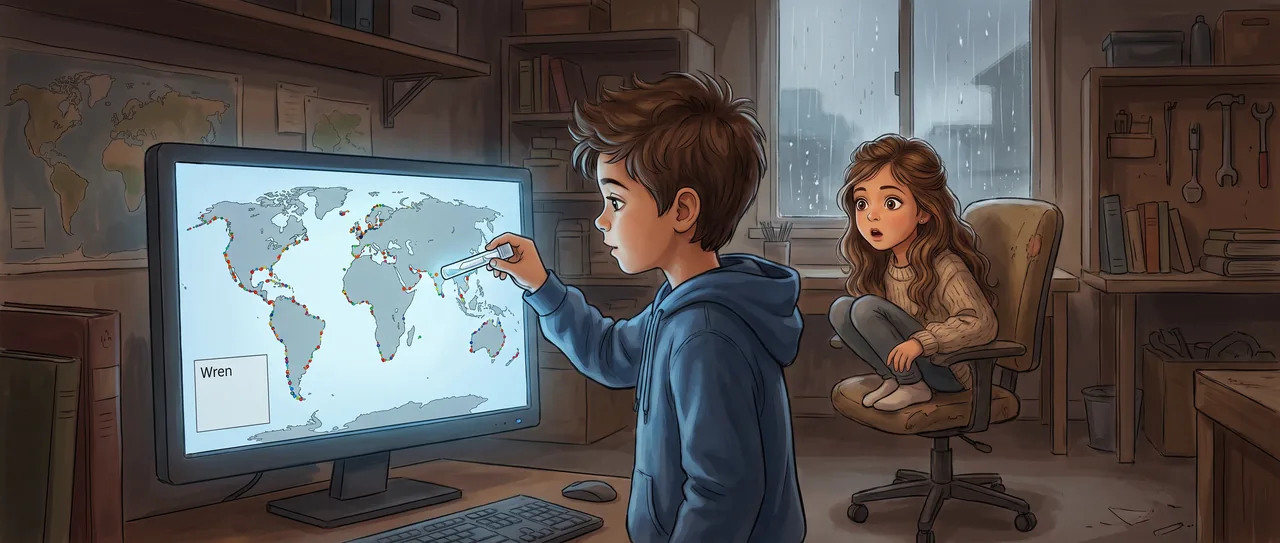
The garage computer was slow, but Grandma's mapping software was good. It took every population in the file and dropped a colored dot where those people lived, sized by how much of the ghost DNA they carried. The map filled in slowly, continent by continent, like rain arriving.
"It's everywhere," Soren said. "That's weird. A tiny bit everywhere."
"Not a lot anywhere," said Maya. "Nobody's mostly them. Everybody's a little them."
They stared at it. The AI assistant they'd been using to clean up the file, a plain text box named Wren that the museum had bundled in, printed a line without being asked.
Mean carrier frequency under three percent. No population above six.
"So they got spread thin," Soren said. "Like one drop of dye in a whole ocean."
"Say that again," Maya said.
"One drop of dye in a whole ocean."
Maya didn't answer. She got up and put her face close to the screen, so close her breath fogged a little circle on it. She was looking at where the biggest dots were. Not the biggest. The bigger ones. The ones that were a five instead of a two.
"Wren," she said. "Take away every dot that's inland. Only keep the ones on the coast."
Half the map went dark. The half that stayed lit made Soren sit up.
"Do the opposite," he said. "Only inland."
What was left was faint. Scattered. Almost nothing.
"The strong ones are on the water," Maya said. "All of them. Different oceans, different continents, doesn't matter. If your people lived by the sea, you've got more of the ghost in you."
Soren pulled his notebook toward him and drew a wobbly coastline, then dotted it. His hand stopped. "That doesn't spread like family," he said. "Family spreads in a blob. You'd get one big patch and it fades out around the edges. This isn't a patch. This is a line. This follows the edge of the land."
"Wren," Maya said. "How old is the bone again?"
Forty thousand years, Wren printed.
"And forty thousand years ago," Soren said slowly, doing the thing where he built the sentence one brick at a time, "the sea was lower. Way lower. Because so much water was locked up in ice. The coastline was somewhere else. Further out."
"So where they actually lived," Maya said, "is underwater now."
Neither of them said anything for a second. The rain went at the garage roof.
"That's why there's no bones," Soren said. "That's why they're a ghost. Everyone digs on land. Every campsite these people ever made, every fire, every grave, it's all down under a hundred meters of ocean. We were never going to find them by digging. The land they lived on isn't land anymore."
"But they got everywhere," Maya said. "Every coast. How does a group of people show up on every coast in the world but never inland?"
Soren looked at his dotted line. "Boats," he said. "They didn't walk. Walking spreads you inland, over mountains, along rivers. These people only touched the water's edge. Coast to coast to coast. They went the fast way. The wet way."
"A seafaring people," Maya said. "Forty thousand years ago. Before anybody thinks anybody was really sailing. And they went so far they ended up a little bit inside almost everyone alive."
Wren printed a line then, and it was not an answer, because Wren had been told to only report patterns, not invent stories.
Pattern consistent with coastal dispersal. Source settlements would lie below current sea level. No physical sites recorded.
"It found the same thing we did," Soren said. He sounded almost offended. "It just found it in numbers."
"No," Maya said. "It found the numbers. We found the people." She sat back down. "It saw a low percentage everywhere. It doesn't know what a coastline feels like. It doesn't know you'd have to be brave to get in a boat when nobody had ever made a boat."
Soren was quiet, writing. Then he stopped writing.
"Maya. If they're inside almost everyone, they're inside us."
Maya held very still. Then she laughed, one short surprised sound.
"Wren," she said. "The bone. The sequence markers for it. Can you check them against a sample?"
We would need a sample.
Soren already had the little cheek-swab kit from the museum's mail-back program, still in its plastic, sitting on the desk where it had been sitting for a week because neither of them had bothered. He tore it open. He ran the swab along the inside of his cheek and held it out to Maya, and she took a fresh one and did the same, and they set both swabs on the desk in their tubes, side by side, where nobody could test them for weeks and where the answer was already, in a way, sitting in the room.
"We can't read them here," Soren said. "It takes a real lab. It takes months."
"I know," Maya said.
"So we don't know if we've got it."
"I know." She was looking at the map again, at the bright line running around the edge of every ocean, the line of a people who left nothing behind but themselves, scattered thin as one drop of dye through everybody breathing on the whole planet.
Soren picked up his tube and held it near the screen, next to a dot on a coast neither of them had ever seen.
Read the interactive version, listen to the narration, and earn a gold star →
A science-verified short story for curious kids · Curiosity Land