The Broken Instruction
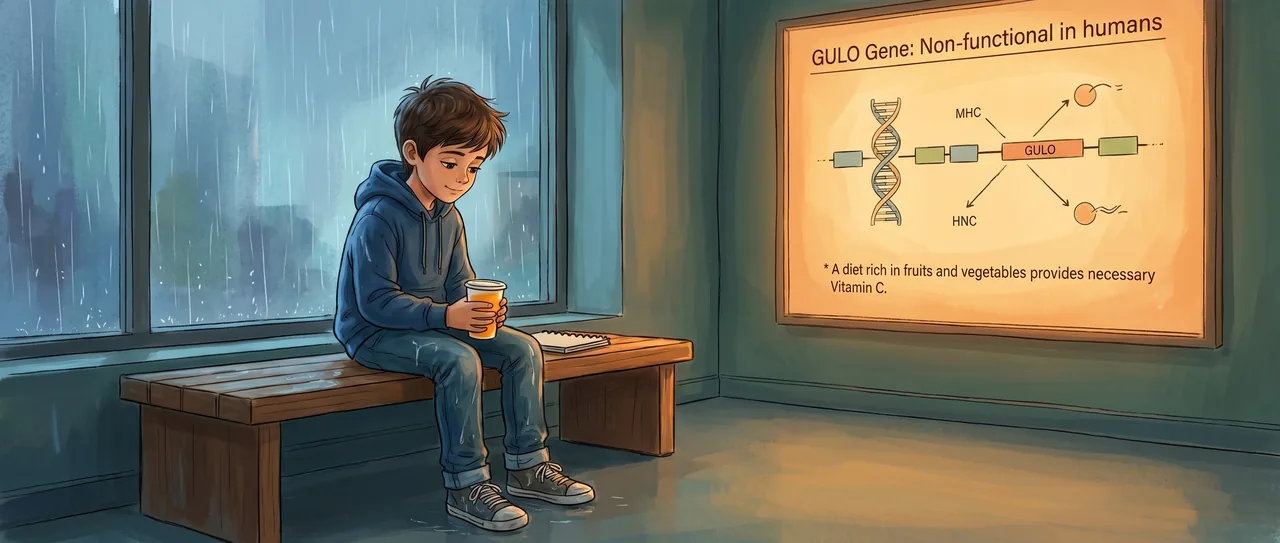
The rain had followed Soren into the museum and now sat in his shoes. His mother had gone to the coffee cart. He was supposed to wait by the whale, but he had wandered instead into a narrow hall lined with glowing panels, and stopped in front of one because a word on it had snagged him.
The word was broken.
Humans carry a broken gene, the panel said. It had a name, GULO, printed in small letters. Almost every other mammal on Earth uses it to make vitamin C inside their own bodies. Dogs make their own. Goats make their own. A goat, standing in a field eating nothing but grass, builds vitamin C out of sugar in its liver all day long, and never has to think about it.
Humans cannot. The gene is still there, the panel said, coiled inside every cell Soren owned. But it does not work. It has not worked for a very long time.
Soren took out his notebook and wrote GULO and under it, still there but off.
He read the next line twice. Sixty million years ago, in an ancestor of ours, the instruction failed. A single change. After that, no descendant could make vitamin C ever again.
He stood very still in front of the glass.
That was the part he could not get past. Not that the gene broke. Things break. The part he could not get past was that it broke sixty million years ago and never got fixed, and here he was, standing in his wet shoes, still carrying the exact same broken instruction. The failure had been copied into him. Copied into everyone in the hall. Copied into his mother out at the coffee cart.
A guard drifted past, keys jingling. Soren almost asked him something, then didn't, because the guard did not look like a person who thought about livers.
He pressed his thumbnail into the notebook page. It made a small crescent dent. He was trying to work out why it hadn't killed everybody.
Because that was the obvious problem. If you break the machine that makes a thing your body needs, your body should be in trouble. A goat that couldn't make vitamin C would get sick. People without vitamin C did get sick. He knew the word, sort of. Sailors, long ago, on long ships. Their gums. It had a name that sounded like a growl.
So the instruction broke, and it should have been a disaster, and it wasn't. Sixty million years of not-disaster. Something had covered for it.
He looked back at the panel. There was a smaller line at the bottom he had skipped because it seemed like a footnote.
Our early primate ancestors ate a diet rich in fruit.
Soren read it and felt the whole thing turn over.
The gene could break because the food already had the answer in it. If you are an animal that spends your whole life in the trees eating figs and leaves and fruit, then vitamin C is arriving in your mouth all day anyway. You don't need the factory in your liver. The factory can rust shut and nobody notices, because the delivery never stops coming.
A broken thing is only broken if you need it.
He wrote that down. Then he sat on the little bench across from the panel because his legs wanted him to.
The ancestor had not survived in spite of the broken gene. It had survived because of what it was already doing. The mutation should have been fatal and instead it just rode along, harmless, because of a habit. Because of breakfast. A mistake and a fruit tree had lined up in time, and the mistake got to stay.
Soren thought about all the millions of years between that ancestor and this bench. The gene had been broken the entire way. Passed down through every single one of them, in a line that never once broke even though the gene never once got fixed. Some of them must have eaten badly. Some of them must have gotten sick. But enough of them ate fruit, or later, once they were people, learned to squeeze it out of oranges and limes and store it and carry it onto ships, and the line held.
He realized his mother had been gone a while and he did not care.
He kept looking at the word broken and it stopped feeling like a bad word. He had always thought of himself, quietly, as a person with something a little off in him. He asked too many questions. He wrote in a notebook while other kids did not. He did not fit the shape of the room he was usually in. He carried it around like a small defect.
And here was the oldest and deepest thing about being human, printed on a wall, and it was a defect too. A thing that stopped working and never got fixed. And it hadn't sunk anyone. It had just changed what you had to pay attention to. It made you a creature that had to notice where its vitamin C came from. That had to go looking. That could not sit in a field and make everything it needed out of grass, and so had to reach out into the world and find the orange and understand the orange.
A whole kind of animal that survives by paying attention to what it needs from outside itself.
Soren found that he was almost laughing, quietly, on the bench, in his wet shoes.
He looked at his own hand. Somewhere inside every cell in it was the gene, still spelled out, still carrying the exact place where it went wrong, sixty million years ago, in an animal in a tree he would never see. Still there. Still off. Riding along in him this whole afternoon.
His mother appeared at the end of the hall with two cups and a look that meant she had been searching.
He stood up and walked toward her, and as he passed the glass he touched nothing, only read the small line one more time, the footnote that was actually the whole story, the one about the fruit.
"Where were you," his mother said, and held out a paper cup.
Orange juice, still cold from the cart. Soren took it and looked at it for a second before he drank.
Read the interactive version, listen to the narration, and earn a gold star →
A science-verified short story for curious kids · Curiosity Land