The Blue Bike That Was Red
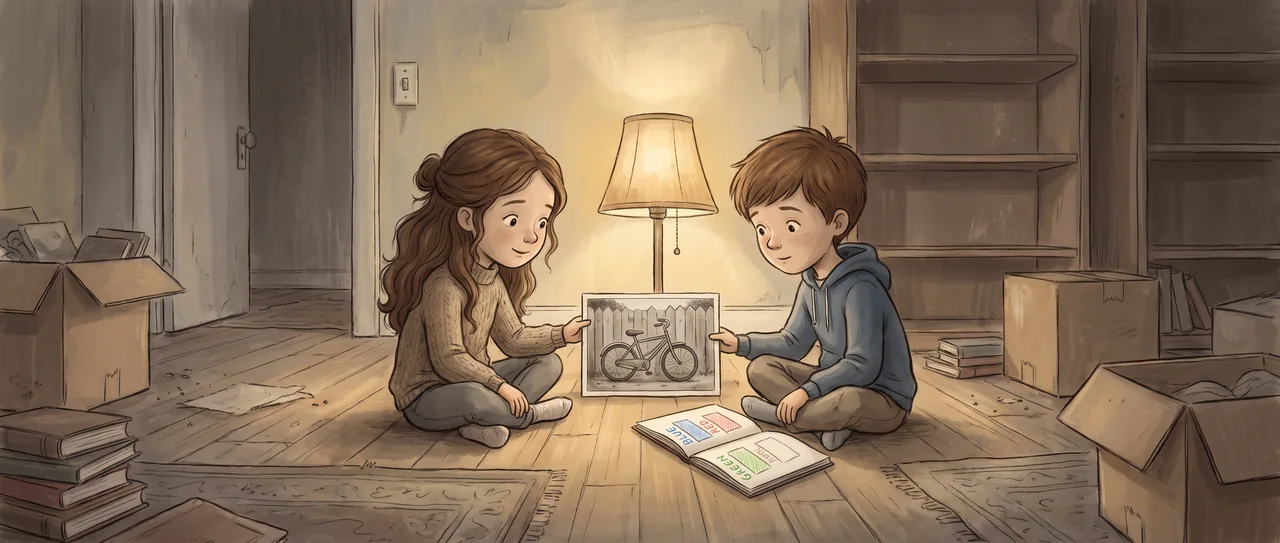
The photograph was small and soft at the corners, and Soren held it under the lamp because the overhead light in his grandmother's apartment had already been packed.
"That's the bike," Maya said. "From the summer with the flat tire. It was blue."
"It was red," said Soren.
"It was blue. I rode it into your grandma's tomato cage and she laughed so hard she dropped the hose."
"That happened," Soren said. "But the bike was red. I have a whole thing about it. There was a red bike."
They both looked at the photograph. In the photograph the bike was leaning against the fence, and it was neither blue nor red, because the photograph was black and white and slightly out of focus, and the bike was just a pale gray shape that could have been anything.
"Okay," Maya said. "So neither of us is looking at the answer. We're both looking at a gray bike."
"Then why am I so sure," Soren said. He wasn't asking her exactly. He was asking the ceiling.
Soren's mother came through with a taped box balanced on her hip. "That's the bike from the tomato summer," she said, without stopping. "Green. Your grandfather painted it green because he had leftover paint." She kept walking. A door closed somewhere down the hall.
Maya and Soren looked at each other.
"Green," Maya said.
"She wasn't even there for the tomato cage part," said Soren. "She was inside."
"But she's the one who'd know the paint."
Soren put the photograph down on the floor between them. He got out his notebook and drew three boxes and labeled them BLUE, RED, GREEN. Then he sat looking at the three boxes like they might vote.
"Here's the thing that's bothering me," Maya said. She was talking fast now. "We were both there. Same fence. Same tomato cage. Same hose. We agree on all of that. We only disagree on the bike."
"So one of us is wrong."
"No. Listen. If the memory was just, like, sitting somewhere, a whole finished picture, it would either be right or somebody wrote over it. But we don't disagree on the whole picture. We agree on almost everything. We just each colored the bike ourselves."
Soren stopped drawing. "Say that again."
"We each colored the bike ourselves," Maya said. "Same story. Different crayon."
Soren thought about it the way he thought about a circuit that mostly worked. Find the part that's behaving wrong. But nothing here was behaving wrong. That was the strange part. Both memories were bright and certain and complete. His red bike had a red so specific he could feel it. Maya's blue bike was just as loud in her head.
"When I remember it," he said slowly, "I don't feel like I'm opening a drawer and taking out a photo. I feel like I'm building it. Right now. As I go."
"Because the fence part is in one place and the laughing part is in another place and the smell of tomato plants is in another place," Maya said, "and every time you remember it you run around collecting all the pieces and gluing them back into one thing."
"And the bike is a piece that's missing," Soren said. "So my brain fills it. With red. Every single time. So confidently that I never noticed it was filling anything."
Maya sat back against the empty bookshelf. "So the reason we're both sure," she said, "is that we're both remembering exactly the way remembering works. We're not remembering the bike. We're rebuilding it. And the glue is a little different every time."
Soren looked at the word RED in his notebook. He had been so sure. He was still sure. That was the part that made his skin go cold and interesting at the same time. Being sure had never once been proof.
"Then every time I've told that story," he said, "the bike got a little more red. I painted it a little more each time I said it."
"That's why your grandma's laugh is so good in your version," Maya said quietly. "You've been retelling it. Polishing it. It's not the day anymore. It's the best version of the day."
Soren didn't answer right away. Down the hall a box scraped across the floor. The apartment smelled like dust and tape and, faintly, still, like his grandmother, which was another thing he was building right now out of pieces and would keep building after every trace of the smell was gone.
"That's kind of terrible," he said.
"Why terrible?"
"Because it means I don't have her the way I thought I had her. I have a story I keep redrawing. And it moves a little every time. And I can't stop it moving." "Or," she said, "you get to keep her out of pieces. Every time. She's not stuck in one drawer that could get lost. She's spread out everywhere. Her laugh in one place, the tomatoes in another, the hose in another. You have to go get all of it and put her back together to remember her. And you can. You just did. You'll do it again tomorrow."
Soren picked up the gray photograph again. The bike sat there being no color at all, waiting for whoever looked at it to decide.
"So the real bike," he said. "The actual one. It's gone. It's just green in a fact my mom carries and gray in this picture and blue in you and red in me."
"Four bikes," Maya said. "None of them the one from the fence."
"Four bikes," Soren agreed. He was smiling now, the strange cold-and-warm smile of someone who has just been shown a much larger room than the one he walked into.
"Try it," Maya said. "Right now. Remember it on purpose. Watch yourself build it."
Soren closed his eyes. He put down the fence first. Then the tomato cage. Then the hose, and the laugh, gathering them the way you gather cards off a floor. And then, at the end, in the place where the bike went, he watched his own mind reach in and hand him the color, quick and certain and made-up, before he could even ask.
It was red.
He opened his eyes and reached for the pencil and, under the three boxes, drew a fourth, and left it empty.
Read the interactive version, listen to the narration, and earn a gold star →
A science-verified short story for curious kids · Curiosity Land