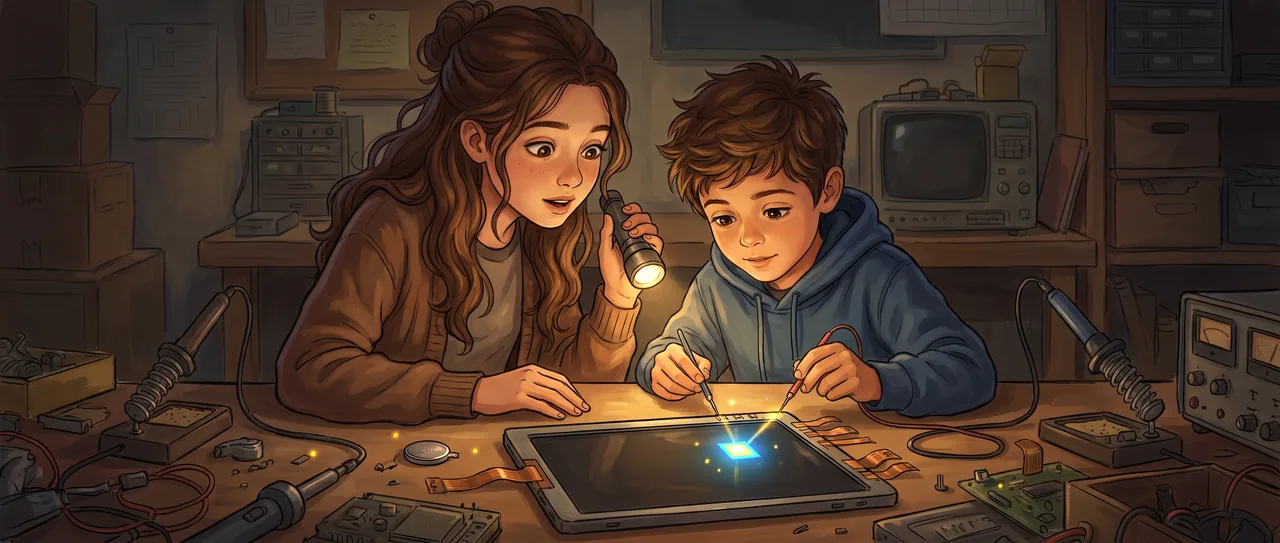
The Screen That Wouldn't Die
The laptop screen was dead, which was exactly why Soren wanted it.
"Free glass," he said, unscrewing the last corner. "And whatever's inside."
"It's not dead," Maya said. She was pressing her thumb against the black rectangle. "Watch."
Where she pressed, the black bloomed. Not into color exactly. Into a bruise of blue and yellow that spread out from her thumb and stayed after she lifted it, then slowly healed back to black.
Soren stopped unscrewing.
"Do it again," he said.
She dragged her thumb across the surface. A smear of color followed it, like she was finger-painting on something that wasn't wet.
"It's a liquid," she said. "There's liquid in there."
"It's glass. Glass doesn't do that."
"I'm not saying it's not glass. I'm saying there's a liquid trapped between the glass." She pressed again, harder, and watched the colors push out of the way and then flow back. "See how it comes back? A crack wouldn't come back."
Soren put the screwdriver down. He got the little flashlight from his pocket and shone it flat across the surface, sideways, the way you look at a table to see if it's dusty.
"There's a texture," he said. "Under the black. Lines. All going the same way."
"A liquid doesn't have lines going the same way. Liquid is messy."
"This one has lines." He turned the screen ninety degrees. "And when I turn it, the black changes. It's darker one way than the other way."
Maya took the screen from him and turned it back and forth. He was right. Tilt one way, deep black. Tilt the other, a paler gray that let a little light leak through.
"So it's a liquid," she said slowly, "that has a direction."
"Liquids don't have a direction."
"This one does." She said it the way she said things she was sure of before she knew why. "It flows, so it's a liquid. But it points, so it's like a crystal. Crystals are the pointing thing. All the atoms lined up in rows."
Soren picked up his notebook and drew two boxes. In one he drew dots scattered everywhere. In the other he drew tiny arrows all lined up in neat rows, like a marching band.
"Liquid," he said, tapping the dots. "Crystal," he tapped the arrows. "You can't be both. If it flows, the arrows scramble. If the arrows stay lined up, it can't flow."
"Then how does it do that," Maya said, and pressed her thumb in again, and the color bloomed and healed, bloomed and healed.
They both looked at it.
"It flows AND the arrows stay lined up," Soren said, very slowly, like he was reading a sentence in a language he was inventing as he went. "The molecules can slide past each other. But while they slide, they keep pointing the same way."
"Like a school of fish," Maya said. "They swim. They move. But they all face the same direction the whole time."
Soren wrote fish in the box between his two drawings, in the empty space that wasn't liquid and wasn't crystal.
"Okay," he said. "But it was working before it broke. It showed pictures. So something told the fish where to point."
Maya was already looking at the two thin films peeled off the broken corner, the ones Soren had almost thrown away. She held them up to the flashlight. Alone, each one was faintly cloudy. She turned one against the other, slowly.
At one angle, light poured through both. She kept turning. The light dimmed. Kept turning. The two films together went completely black, blocking the flashlight like a closed door.
"Soren." Her voice went quiet. "The light only comes through if the films agree. When they cross, it's black."
He held the screen up to the flashlight and pressed his thumb into the middle. Where he pressed, the black went pale. Light came through.
"I'm untwisting them," he said. "With my thumb. When the fish are twisted between the crossed films, they turn the light so it can sneak through. When I push them flat, the light can't turn, and it hits the second film and stops."
"So a picture is just a million tiny places," Maya said, "where something twists the fish or lets them go."
"Something," Soren repeated. "Not a thumb. It ran for years without a thumb."
Maya looked at the ribbon of copper contacts along the dead edge of the screen, the flat gold fingers that used to plug into the computer.
"Electricity," she said. "The computer sent electricity into every tiny square. That's the something. Electricity tells the fish which way to point. No wires touching them. Just the field."
Soren didn't answer right away. He was pressing his thumb into the corner and watching the bloom, and she could tell he wanted to check it before he believed it.
"If that's true," he said, "then every letter I ever read on a screen was a molecule choosing to twist or not twist. Every video. Every game. All of it. Fish turning in the dark because a voltage told them to."
"Billions of them," Maya said. "In one screen. Turning faster than we can see."
"And they were doing it the whole time. Right in front of my face. Every single day." He pressed his thumb in and lifted it and the color bloomed and slid away, a school of something too small to see, scattering and re-forming under the skin of the glass.
"They're still doing it," Maya said. "The dead ones. The ones the computer can't talk to anymore. They still point. They still flow. We just don't have the voltage to tell them where to go."
Soren looked at the flat gold contacts, the mouth the screen used to listen with.
"We could," he said. "A battery's a voltage. A little one. Just to see one square move on purpose."
Maya was already digging through the parts bin for a coin cell and two wires, her hands quick and sure, and Soren was smoothing the copper ribbon flat under the flashlight so they could find where the first fish were waiting.
He touched one wire to the ribbon. Under the glass, in a place no thumb had pressed, a single point of color came awake.
Read the interactive version, listen to the narration, and earn a gold star →
A science-verified short story for curious kids · Curiosity Land