The Moon That Never Keeps Its Face
The library had one computer that still ran the old astronomy archive, and it lived in the back corner where nobody sat, which was exactly why Maya sat there.
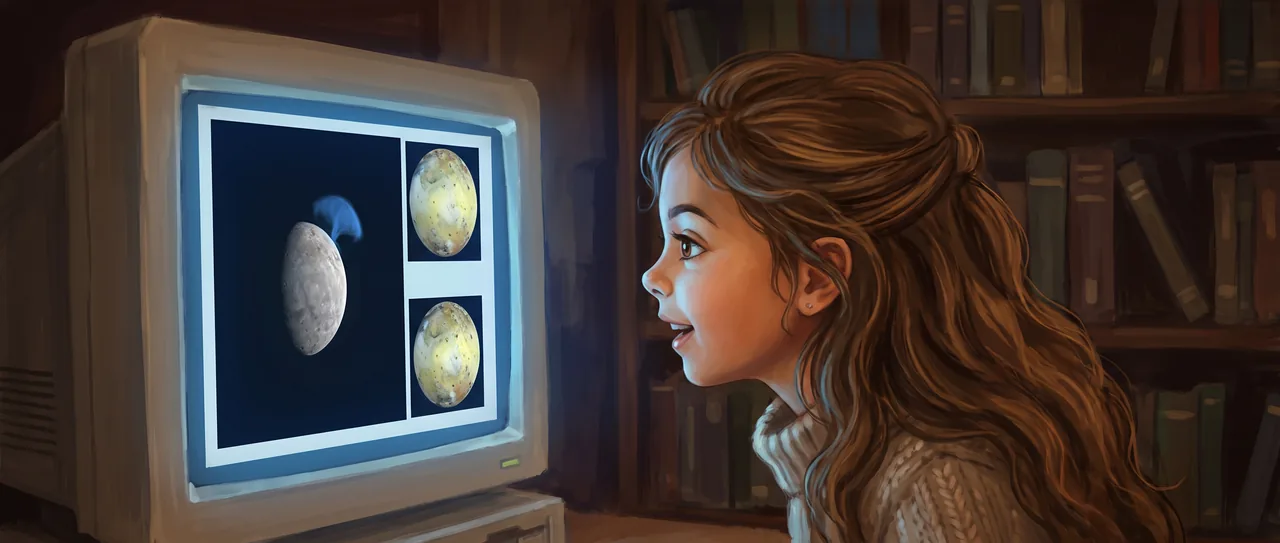
She had come in for a book about Saturn's rings. She left the book unopened on the table. On the screen were two pictures of the same moon, side by side, because the archive liked to show you before and after. Both pictures were labeled Io. Both had the same date stamp for the mission. But underneath, in small gray letters, one said 1979 and one said 1996.
Maya leaned in close enough that the screen light turned her face blue.
The two moons did not match.
They were the same size. They sat in the same spot. But the spots on them, the dark blotches and the pale yellow smears, had moved. A black mark that sat near the top of the first picture was gone in the second. A new pale ring had opened up in the bottom half, round and clean, like something had spilled and dried there.
Maya sat back. Then she leaned in again.
Her first thought was that someone had mislabeled the pictures. Two different moons. Jupiter had dozens. Easy mistake. She checked the numbers along the edge, the coordinates the archive printed for everything, and the numbers were the same. Same moon. Same face turned toward the camera.
Her second thought was clouds. Planets had clouds that moved. But this was a moon, and it had no air to hold clouds, and the marks were not soft like clouds. They had edges.
She pulled the two pictures closer together on the screen until they almost overlapped. That was when she saw it properly. It was not that a few spots had drifted. It was that the whole surface had been redrawn. Not moved. Replaced. As if between one picture and the other, someone had taken the moon out, painted it fresh, and put it back.
Seventeen years apart. A moon should not change its face in seventeen years. The Moon in Maya's own sky had worn the same craters since before there were dinosaurs to look up at them. She knew that. Craters were the whole point of moons. They kept every scar forever because nothing up there ever wiped them clean.
Unless something did.
Maya opened a third image the archive had tucked below the other two. It was not a clean portrait. It was a picture taken from the side, of the edge of the moon against black space, and out past that edge, rising off the surface, was a shape.
It looked like a fountain.
It looked like an umbrella made of faint blue light, opening up off the rim of the world and hanging there.
Maya read the caption twice. It said the plume rose three hundred kilometers above the surface.
She did the number slowly, in her head, the way she did numbers when she did not trust them. Three hundred kilometers straight up. That was farther than the distance across a whole country she had driven through once, and it took the whole day. Except this was not sideways across land. This was straight up, off a ball of rock, into empty space, thrown by something underneath.
A volcano. The caption said volcano.
Maya knew volcanoes. She had seen the videos, the orange rivers, the towns with the mountain smoking behind them. Those threw ash a few kilometers up and everybody ran. This one threw sulfur three hundred kilometers up, past where any air stopped, into the dark, and did it so often that in the time between two photographs it had painted the entire moon a new color.
That was why the spots had moved. They were not spots. They were the leftovers of eruptions, the fresh yellow, the cooling black, and they got buried and covered and buried again, over and over, faster than the craters could pile up. The moon could not keep a single scar. Something inside it kept smoothing everything away and starting over, like a face that would not hold an expression. She had grown up being told that space was cold and quiet and finished. That the good, loud things had all happened long ago, when the planets formed, and now everything just drifted. She had believed it a little, even while she hated believing it.
And here was a moon that had erupted while she was walking into this library. That was erupting now, probably, in the eight minutes it took the light to even reach Jupiter from the Sun and the long while more to reach here. Somewhere out past the asteroids a mountain was throwing a blue umbrella of sulfur into the dark, and would still be throwing it when she went home, and when she was asleep, and when she was old.
She reached into her bag for her notebook and flipped past the Saturn notes she had come in to take. Her pen stopped over the blank page.
What do you even write. That a moon has no old face because it will not stop making new ones.
Maya looked back at the two pictures, the 1979 and the 1996, the two faces of the same moon that had never once been the same face.
She pulled up a fourth image. The archive kept going. There were pictures from later missions, and later, each one a different moon wearing the same name. She clicked through them one after another, and the yellow shifted, and the black marks opened and closed, and the pale rings bloomed in new places every time.
Nobody else was in the corner. The screen light kept changing color on her face as the moon changed under her finger, and she clicked to the next one, and the next, chasing the eruption she knew was happening right now that no picture could ever be quite fast enough to hold.
Read the interactive version, listen to the narration, and earn a gold star →
A science-verified short story for curious kids · Curiosity Land