The Blood Test
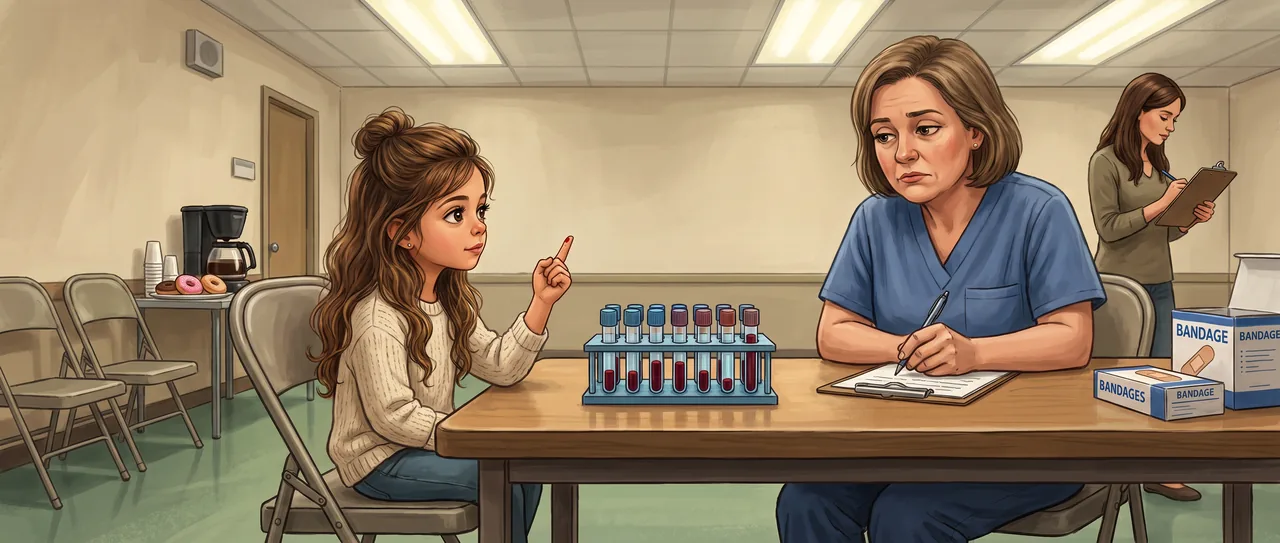
The nurse pricked Maya's finger and squeezed a bead of blood into a little tube of blue liquid.
"Iron test," the nurse said. "If your blood sinks, you've got enough. If it floats, we send you home."
Maya watched the dark drop wobble at the surface, then slide down through the blue like a diver going deep.
"Sinks," the nurse said. "You're not donating, hon, you're eleven. Your mom is. But your iron's fine."
"Why does iron sink," Maya said.
"Heavier than the liquid."
"No, I mean." Maya frowned. "Why is there iron in me at all. It's a metal."
The nurse laughed the way adults laugh when they want a question to stop. "There's just a little. Keeps your blood red." She turned to the next person in line.
Maya sat back down on the folding chair next to her mother, who was filling out a form with a pen chained to a clipboard. She looked at the small red dot on her fingertip. A metal. The same stuff as a wrench, as a nail, as the chain on the clipboard pen. It was inside her, moving around, and it had been there her whole life and she had never once thought about where it came from.
She knew things came from places. Water came from rain and rivers. Wood came from trees. Trees came from seeds and sunlight and dirt. Dirt came from rocks breaking down and things dying. Everything, if you kept asking, came from something before it.
So the iron came from food. She'd eaten it. Spinach, her mother always said, and red meat. Fine. But the spinach got it from the soil, and the soil got it from rock, and the rock.
Maya stopped.
The rock got it from the Earth. From when the Earth was made. And the Earth was made from the same cloud of stuff the Sun was made from, a swirling cloud, she'd seen the picture in a book, a flat spinning disk with the young Sun in the middle. So the iron was already in the cloud. Before there was an Earth. Before there was a sun to shine on any spinach.
Which meant the chain didn't stop at food. It went up.
"Mom," Maya said. "Where does iron come from. Like, first. The very first iron."
Her mother didn't look up from the form. "Mines, I think. Or is that coal. Ask your science teacher."
Maya looked back at the tube on the nurse's table, the drop of her own blood at the bottom of it now, settled, dark. Hydrogen and helium. She remembered that from somewhere. The universe, at the start, was almost only hydrogen and helium. The two lightest things. Nothing else. No iron. No calcium, which she also had, in her bones, she was fairly sure, because milk was for bones and bones were hard like stone. No oxygen either, and she was breathing oxygen right now, in this stuffy church basement that smelled like coffee and bandages.
So where had all of it come from, if the early universe was only the two lightest things.
Something had to have made the heavier ones. Built them. Taken hydrogen and pressed it into something bigger and heavier, over and over, up the ladder, hydrogen to helium to carbon to oxygen, all the way up to iron.
And the only place she could think of that was hot enough and heavy enough and old enough to press hydrogen into anything was a star. The iron was made inside a star. Not the Sun. The Sun was too young, the Sun came from the cloud that already had the iron in it. So a star before the Sun. An older star. One that made iron in its center and then, somehow, had to have come apart, had to have burst and thrown the iron out into space, or how else would it get into a cloud, into a rock, into soil, into spinach, into her.
A star had exploded. And some of it had ended up in the tube on the nurse's table.
"Mom," Maya said again.
"Almost done, baby."
Maya didn't finish the question, because she was working out the size of it. The calcium in her bones, made in a star. The oxygen she was breathing in and out right now, made in a star. The iron the nurse had just watched sink through blue liquid, made in the crushing center of a star that had died before the Sun was even a spark, that had scattered itself across an enormous dark, and gathered again into a spinning disk, and become rock and rain and roots and a girl on a folding chair.
She held up her finger and looked at the red dot again. It looked completely ordinary. It looked like nothing. It looked like a scrape from a bike fall.
The nurse came back with a cotton ball. "All done, sweetheart, you can wipe that off."
"It's really old," Maya said.
"What is?"
"This." Maya turned her fingertip toward the nurse. "The iron. It's older than the Sun. It got made inside a different star and that star blew up and that's the only way it could be here."
The nurse blinked. "You're a funny kid."
"Every single person you tested today," Maya said. "Every drop that sank. Same thing. All of it."
The nurse looked at her rack of little tubes, a dozen of them, each with its dark bead settled at the bottom.
"Doesn't that," Maya started, and then didn't know how to finish, because there wasn't a small way to say it.
Her mother stood, pressing a cotton ball into the crook of her own elbow, ready to leave.
Maya stayed in her chair a moment longer, looking down the row of tubes on the table, at all that ancient dark iron waiting quietly at the bottom of the blue, once part of something that had burned and burst and thrown itself across the whole reach of space to end up here, sinking.
Read the interactive version, listen to the narration, and earn a gold star →
A science-verified short story for curious kids · Curiosity Land