One Hundred Years of Falling
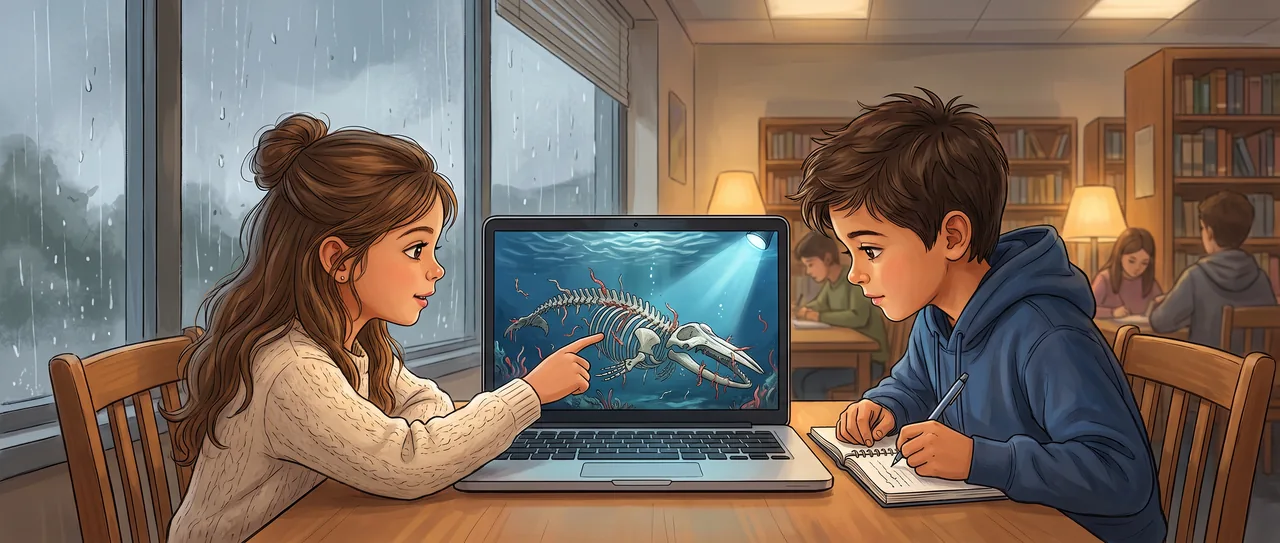
The science class had gone, but the laptop stayed, glowing on the library table with a video looping in silence. A whale, dead and enormous, lay on the seafloor in a cone of submarine light.
"That's grim," said Maya, sitting down with her sandwich.
"Watch it again," said Soren. He clicked the bar back to the start. "Something's off about the timing."
The caption ran along the bottom. Year one. Year ten. Year forty. Maya stopped chewing.
"It's not one video," she said. "It's the same whale. Over and over. But the animals keep changing."
"That's what's off," said Soren. "A dead thing should just, you know. Be gone. Bacteria, done. But look."
At year one the carcass was buried in movement. Hagfish poured over it like water. Sleeper sharks the size of canoes tore at the flank. A soft grey rain of scraps drifted down and something small caught every piece before it hit the mud.
"Everything's here," Maya said. "Everything within smelling distance came."
"For miles," said Soren. "The deep sea is basically empty. Then one whale drops and it's a feast that shouldn't exist down there."
Maya leaned closer. "How much whale is that."
"A big one? Forty tons. Maybe more."
"Forty tons," she repeated. "Falling into a place where nothing usually falls." She dragged the slider forward. The sharks vanished. The hagfish thinned. Now the bones lay mostly bare, and something new had arrived. The mud around the skeleton had turned into a carpet. Worms, thousands of them, red and feathery, and pale snails, and crabs picking through a garden that had not been there before.
"Where'd they all come from?" Maya asked. "The big stuff cleaned it out. This should be the boring part."
"It's the opposite," said Soren. He had his notebook open. His pen moved down the page in a short list. "The scavengers didn't take everything. They spread it. Now the bones are soaked in whale, the mud's soaked in whale, and a whole different crowd shows up to eat what the first crowd left behind."
"So it's not one meal," said Maya slowly. "It's a town."
"Keep going."
She pushed the slider again. Year forty. Then the caption did something that made her sit back.
Year seventy.
"Seventy years," she said. "It's still going. It's just bones now. What's left to eat?"
On the screen the skeleton had gone strange. The bones were no longer white. They were furred, shaggy, coated in something that shivered in the current like grass in wind. And the water above them wrinkled, the way air does over hot pavement.
"That's not decay," Maya said. "That looks alive. The whole skeleton looks alive."
Soren stopped writing. "Bones are full of fat. Whale bones especially. Under the seafloor, bacteria break that fat down, and they don't use oxygen to do it. They make sulfide instead. Poison, basically." He tapped the shivering fur. "And then something eats the poison."
"Eats the poison," Maya said.
"Bacteria that live on sulfide. And animals that farm those bacteria on their own bodies. That fuzz is a whole ecosystem running on chemicals from a dead whale's bones. No sunlight. No leftover meat. Just the bones, cooking slowly, for decades."
Maya was very quiet. The rain ticked against the library window.
"Say the years again," she said.
Soren read them off his page. "Scavengers first. Months to a couple of years. Then the enrichment crowd, the worms and snails, years to decades. Then the bone-and-sulfide stage. That one can last" he checked "up to a hundred years."
"A hundred years," said Maya. "One whale."
"One whale."
She looked at the screen, at the shivering skeleton, and then she said the thing that made Soren put his pen down entirely.
"So there are animals down there," she said, "whose entire lives, start to finish, happen on one dead whale. Their parents lived there. They'll die there. They've never been anywhere else. The whole world, to them, is one skeleton in the dark."
"Some of those worms," Soren said carefully, "we didn't even know existed until we found them on whale falls. Whole species. Their only home is the bones."
"Then what happens when the whale runs out."
That was the question. Soren looked at his list and did not have a line for it.
"They'd need another whale," he said. "Somewhere out there in all that empty water, another whale would have to die and sink close enough for the larvae to find it before this one's gone."
"Close enough," said Maya. "In an ocean."
"The whales are always dying somewhere," Soren said. "Old ones, sick ones. It's been happening for millions of years. So the falls must be scattered across the whole seafloor like" he searched for it "like stepping stones. And the larvae drift, and most of them find nothing, and some of them land on the next stone."
Maya pressed the slider all the way to the end. The video looped back to the beginning, to the fresh whale sinking, forty tons falling through the dark toward a floor where something was already waiting.
"So the stepping stones are moving," she said. "They appear where a whale happens to die and disappear when the bones give out, and the animals have to island-hop across the bottom of the ocean forever, from one dead giant to the next, and they've been doing it the whole time we've been up here not knowing."
"The whole time," said Soren.
The bell for fifth period rang somewhere down the hall. Neither of them moved.
Maya put her finger on the glass, over the falling whale, and traced it down. "Right now," she said. "Somewhere under all that water. There's one just landing. And something's swimming toward it that has never seen anything else in its life."
Soren pulled the laptop closer and started the video over.
Read the interactive version, listen to the narration, and earn a gold star →
A science-verified short story for curious kids · Curiosity Land