What the Shrimp Keeps To Itself
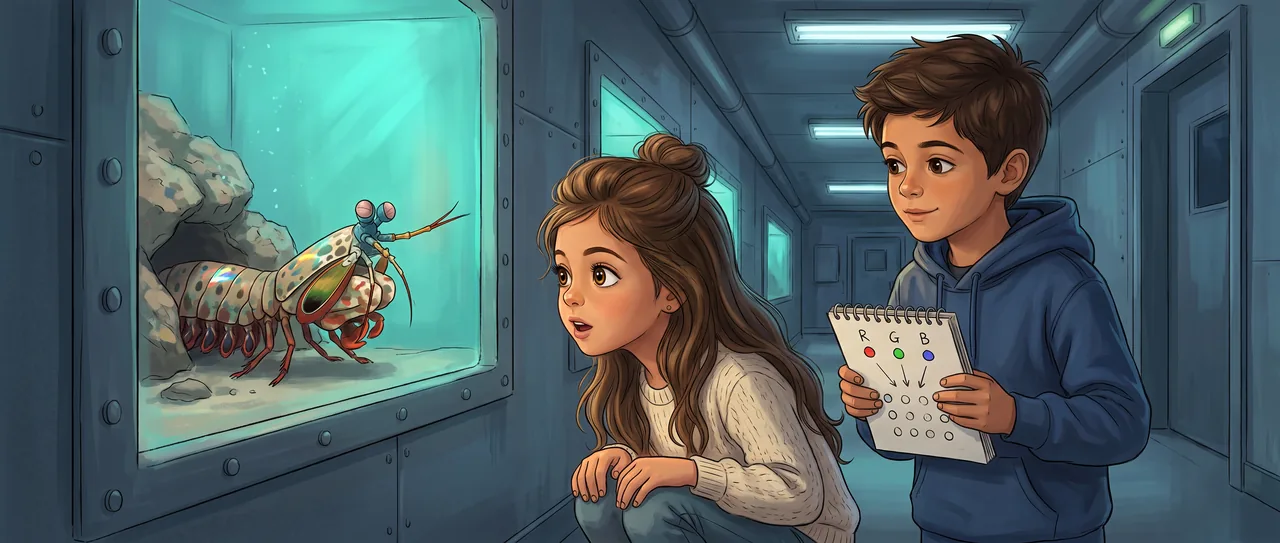
The mantis shrimp was the color of a spilled paint set, and it was watching them back.
"His eyes move separately," Soren said. "That one's looking at you and the other one's looking at me."
"Both at once," Maya said. She leaned so close her nose fogged the tank. "Read the sign."
Soren read it. The little placard was bolted to the service wall, meant for staff, not for kids stuck waiting in a corridor that smelled like salt and bleach. "Mantis shrimp have sixteen types of color receptors. Humans have three."
"Three," Maya repeated. "Red, green, blue. That's all we've got."
"And every color you've ever seen is those three mixed." Soren turned the words over. "Sunset. A peacock. Your grandma's whole quilt. Three receptors, mixing."
"So he's got thirteen more than us." Maya tapped the glass, gently. The shrimp swiveled one stalk toward her finger. "What's he seeing that we're not?"
"The sign says ultraviolet. And polarized light."
"Which is what?"
Soren thought about it the way he thought about everything, in steps. "Light waves wobble in different directions as they travel. Usually every direction at once. But sometimes they all line up, wobbling the same way. That's polarized. Off water. Off wet leaves. Sunglasses block it."
"And we can't see the difference."
"No. To us it's all just light."
Maya went quiet, both hands flat on the cold glass. The shrimp clicked something against the tank floor.
"Okay," she said. "But here's the thing that doesn't fit."
"What."
"Sixteen receptors should mean he sees way more colors than us. Right? More sensors, more colors." She frowned. "But I read something once. I think they tested him. And he was terrible at it. Worse than us."
Soren looked at her. "Worse how."
"They showed shrimp two colors close together and trained them to pick one. Humans can tell colors apart when they're really close. The shrimp couldn't. He'd mess up colors that a person tells apart easy."
"That can't be right," Soren said. "Sixteen receptors."
"That's the part that doesn't fit. That's why I'm saying it." Maya's finger traced the edge of the tank. "Sixteen sensors and bad at colors. Both true. So what's he doing with them?"
The corridor light buzzed overhead. Somewhere a pump hummed. The shrimp sat in his crevice, two independent eyes tracking two different children.
Soren pulled his notebook out of his back pocket. He drew three dots, labeled them R, G, B, and drew lines between them mixing. Then, underneath, he drew sixteen dots and stopped, because he didn't know what lines to draw.
"When we see a color," he said slowly, "our brain does math. My red sensor fires this much, my green fires that much, the brain compares them, subtracts, and figures out the exact shade. Comparing. That's the work."
"Right."
"Comparing takes time. A tiny bit of time. The brain has to do the subtraction."
Maya's head came up. "But he doesn't compare."
"What?"
"That's it. That's the thing." She was talking fast now, hands off the glass, moving. "He's got a sensor for each color already. Sixteen doors, and each door just opens for its own color. No mixing. No subtracting. No math. He doesn't figure out the color. He just knows, boom, that door opened."
Soren stared at his sixteen dots. "So he can't tell close colors apart, because he doesn't have any in-between doors. Nothing between them to compare."
"But he's fast," Maya said. "He's so fast. He looks at something and there's no thinking. The right door opens and he's already moving."
"He punches things at sixty miles an hour," Soren said. "Underwater. Fast enough to boil the water for an instant."
"So he doesn't have time for our kind of seeing." Maya pressed her lips together. "We see slow and careful and exact. He sees fast and rough and right now."
Soren wrote: not more colors. faster colors. He underlined faster twice.
"And the ultraviolet," he said. "And the polarized light. Those aren't for prettier sunsets. Those are more doors. More things that just open, instantly, no thinking."
"He's seeing whole channels we don't have at all," Maya said. "Not better versions of ours. Different ones. The wobble direction of light. The ultraviolet coming off another shrimp's shell." She looked at the animal in the crevice. "There could be a whole shrimp language written in ultraviolet on their bodies. Signals. And every human who ever lived walked right past it."
"Written in light we're blind to," Soren said. "Right in front of us. The whole time."
They both went still. The shrimp shifted, and something on his shell caught the corridor light and threw back a color Maya didn't have a word for, and then it was gone, and she understood she might have been the only one to catch even the edge of it, and that the shrimp had seen it fully, and had thought nothing of it at all.
"Soren," she said quietly. "There's a version of that tank where the two of us are the ones who can barely see."
"There's a version of everywhere like that." He capped his pen. "The sunglasses on the counter at home. They cut polarized light. Which means there's a pattern in the sky, off water, off car windows, all day, every day, that we only know about because bees and shrimp told us it was there."
"We built a machine to see a thing an animal sees for free."
"We built a lot of them." Soren almost smiled. "Cameras that see ultraviolet. Filters that see polarization. We're slow but we noticed we were missing something. We went and got the doors."
Maya laughed, once, short. "That's the part I like. We only have three. But we figured out there were more than three. From inside three."
Down the corridor a door opened and Soren's aunt called that she was almost finished, two minutes.
Neither of them answered. The mantis shrimp had come halfway out of his crevice now, both eyes rolling, each aimed somewhere the other wasn't, taking in the corridor, the tanks, the two dim warm-blooded shapes pressed to his glass, all of it arriving through sixteen doors at once, none of it slowed down by a single thought.
Maya crouched to his level and stayed there, eye to eye to eye, watching the one small animal see more of the room than either of them ever would.
Read the interactive version, listen to the narration, and earn a gold star →
A science-verified short story for curious kids · Curiosity Land