The Star That Already Lied Once
The bus had a flat tire and no spare that fit, so Mr. Okafor said everybody out, and stand off the road, and do not, whatever you do, wander into the field.
Maya wandered to the edge of the field.
"He said not to," Soren said, following her anyway.
"I'm at the edge. The edge isn't the field." She was looking up. Out here the sky was not the gray city sky. It was crowded. It looked overloaded, like somebody had spilled it.
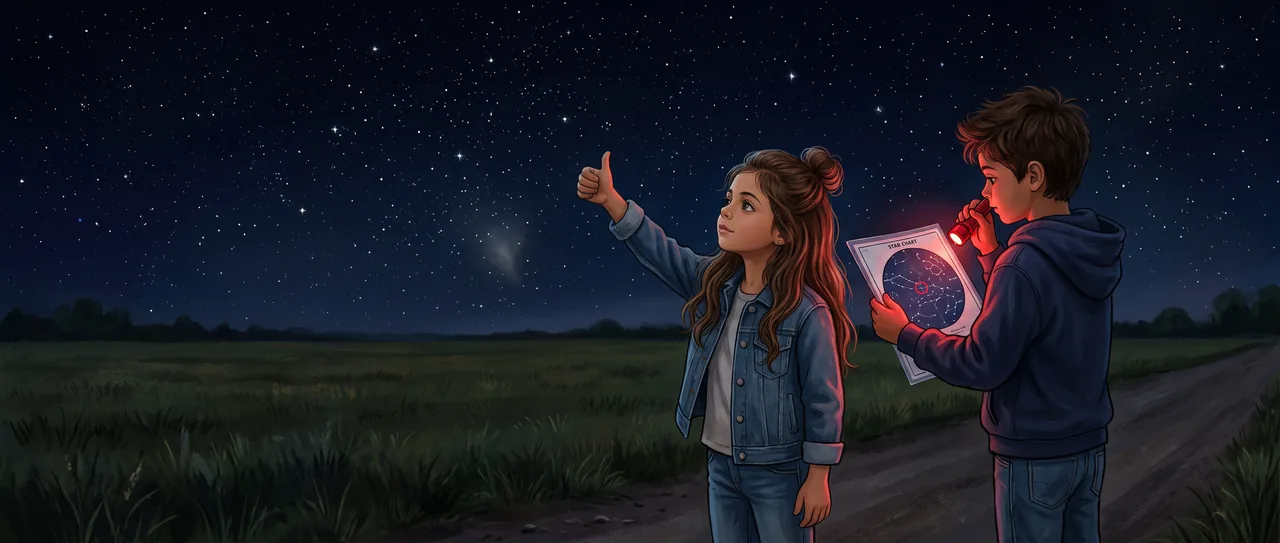
Soren had the star chart from the museum, the good laminated one, and a red flashlight so it wouldn't kill their night vision. He held the chart up and turned in a slow circle until the shapes matched.
"There's the false cross," he said. "So down from that, low, that smudge. That's the Carina Nebula."
"Which one's the smudge?"
"The one that looks like breath on cold glass."
Maya found it. A soft blur where the other stars were sharp points. She didn't like it. Not scared didn't like it. Puzzled didn't like it.
"That one's wrong," she said.
"Wrong how?"
"The chart says there's a bright star right there. Eta Carinae. But I can barely see it. The chart's got it marked big."
Soren checked. She was right. The symbol on the chart was fat, important, and the actual star was a dim little nothing you'd miss if you weren't hunting for it.
"Maybe the chart's old," he said.
"Or maybe the star changed."
He liked that better than he expected to. He turned the chart over. On the back the museum had printed notes in tiny letters, and he read them with the red light, moving his lips.
"Okay. Listen to this. In eighteen forty-three this star got so bright it was the second brightest star in the whole sky. Brighter than everything except one. Sailors used it to navigate."
"That little smudge?"
"That little smudge. For about twenty years. Then it faded back down."
Maya took the chart. Read it herself. "It says it threw off two clouds of gas. It half blew up."
"Half."
"It half blew up and survived. And now it's dim again." She handed it back. "So it lied."
"Stars don't lie."
"That one did. It got huge and everybody looked and then it went, never mind."
Soren wrote something down. His hand moved across the page and stopped and started again.
"How far away is it," Maya said. Not really a question. A demand aimed at the chart.
He found the number. "Seven thousand five hundred light years. Around there. They're not totally sure."
Maya went quiet at the edge of the field. Then she said, "Say that again slower."
"Light years. The distance light goes in a year. And light is the fastest thing there is."
"So the light we're looking at right now."
"Left the star seven thousand five hundred years ago."
"Before the pyramids."
"Before the pyramids."
Maya looked at the smudge. "Soren. The eighteen forty-three thing. The getting super bright."
"Yeah."
"When did that actually happen. Not when we saw it. When did it happen."
Soren stopped writing.
He looked at the chart. He looked at the smudge. He did the arithmetic out loud, slowly, the way he did when he wanted to be sure and not just fast.
"The light got here in eighteen forty-three. But it took seven thousand five hundred years to arrive. So the star actually did the exploding part around seven thousand years before that. It happened. It's over. It's been over the whole time people were writing it down as news."
"So the sailors," Maya said.
"The sailors were steering by an explosion that already ended before there were sailors."
The field made its field noises. Something clicked in the grass.
"Then here's the part," Maya said, and her voice got careful. "That star. Right now. The real one, wherever it actually is tonight."
"Go on."
"We have no idea what it's doing. The light showing us the dim smudge is seven thousand five hundred years old too. So the smudge is old news. The star could be anything now. It could be exactly the same."
Soren finished it, because that was how they worked, one of them starting the sentence and the other one unable to leave it hanging.
"Or it could already be gone."
Neither of them said anything.
"The notes say," Soren read, quieter now, "that it's one of the most massive stars we know. And massive stars don't fade away nice. They blow up completely. A hypernova. Bigger than a regular one. The notes say when Eta Carinae goes, it'll be bright enough to see in the daytime."
"In the day. With the sun out."
"A star. In the afternoon."
Maya turned the whole thing over in the dark. "But if it already went. Seven thousand years ago. Then the light of it exploding."
"Is already on its way," Soren said.
"Crossing right now. Coming."
"And we wouldn't know. There's no way to know. It could get here in a hundred thousand years. Or."
He didn't finish that one. He didn't have to.
Maya lifted her hand and covered the smudge with her thumb, then took her thumb away, then covered it again. Testing something that couldn't be tested.
"So when we look at it," she said, "we're not looking at a star. We're looking at a letter. And the star that mailed it might not be there anymore. And there might be another letter already coming that says everything's different. And it's just, out there. In the dark. Between us. Right now. Moving."
"Yeah," Soren said. His pen had stopped.
"That's the whole sky, isn't it." Maya wasn't asking him. She was looking up at the crowded, overloaded, spilled sky, every point of it. "All of it. Every one of those is old. We're standing in a field reading a whole sky of old mail."
From the road Mr. Okafor called that the repair truck was five minutes out, everybody back, watch for cars.
Maya didn't move.
She kept her eyes on the dim little smudge that had been the second brightest star in the sky, that had lied once, that might already be a blaze racing toward an ordinary afternoon nobody had picked yet.
Behind them the repair truck's headlights swung across the field, and for a second every blade of grass threw a long thin shadow, and then the light passed, and the stars came back.
Read the interactive version, listen to the narration, and earn a gold star →
A science-verified short story for curious kids · Curiosity Land