The Sentence That Was True On Purpose
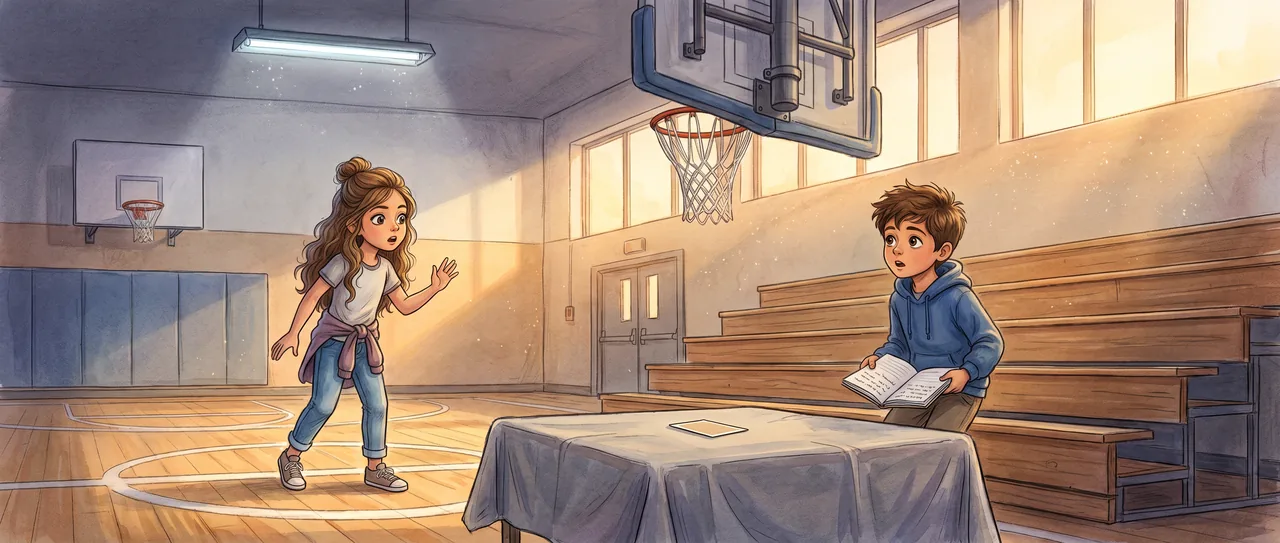
The gym still smelled like floor wax and nervous kids. Everyone else had gone home with their ribbons. Maya and Soren stayed to fold up the puzzle table, which was their job because they had lost the last round.
"I don't want to talk about the last round," Maya said.
"I wasn't going to."
"You were making the face."
"This is my only face." Soren picked up the final card from the table. It was the bonus problem nobody had solved. He read it out loud. "Prove that every true statement in arithmetic can be proven."
"Easy. Yes. Done. Pack the table."
"It's not marked yes," Soren said. He turned the card over. On the back, in small tired handwriting, someone had written: The correct answer is no. See a man named Godel. Nobody won this one. We never expected anyone to.
Maya took the card. She read it twice. "No," she said, testing the word. "How can it be no? A thing is true or it isn't. If it's true you can show it's true."
"That's what I would have said."
"So say it."
"I can't, because someone already proved you can't." Soren sat down on the folded bleacher edge. "That's the part that's bothering me. They didn't prove it's hard. They proved it's impossible. On purpose. With math."
Maya sat too. She hated sitting when she was thinking, but her legs did it anyway. "Okay. Walk it."
"I don't know how it works."
"Then guess it. Guess out loud. You're good at that."
Soren looked at the card. "Fine. Guess. Math is a machine, right. You put in the rules everybody agrees on. Then you crank the handle and out come true things. One plus one. The rules make it true and the machine proves it."
"So the machine proves everything true."
"That's what I always figured. You crank long enough, you get everything."
"But the card says no."
"The card says no." Soren rubbed his eyes. "So there has to be a true thing the machine can't reach. And I can't picture it, because if it's true, why can't the machine get there."
Maya stood up again. She started walking the free-throw line, heel to toe, the way she did when a thing wouldn't sit still. "What if the true thing is about the machine."
"What do you mean."
"Watch. I'm going to say a sentence." She stopped on the line. "This sentence cannot be proven by you, Soren."
"Okay. Prove it."
"You can't. If you prove it, then it's a lie, because it said you couldn't. So proving it makes it false. And you don't prove false things, you're too honest."
Soren went very still on the bleacher. Then he said, slowly, "But I believe you."
"You believe me."
"I believe it's true. You can't prove it, and I can still see it's true. From outside." He stood up. "Say it again."
"This sentence cannot be proven by you."
"It's true," Soren said. "It's obviously true. And the only reason it's true is that I can't prove it. If I could prove it, it would stop being true." He looked at the card, then at Maya, then at nothing. "The trueness is made out of the not-proving."
Maya's whole face changed. "Do it to the machine."
"Do what to the machine."
"Your sentence. But instead of you, put the machine. This statement cannot be proven by the machine. Say math is powerful enough to talk about itself. To count its own steps. Then it can build that sentence about itself."
Soren caught it. She watched him catch it. "And if the machine proves it, the machine just proved something false, so the machine's broken. A machine that proves false things is garbage."
"And we don't think math is garbage."
"We really don't."
"So the machine can't prove it."
"So it's true." Soren said it like the wind got knocked out of him. "It's true and the machine can never reach it. Not because it's hard. Because the reaching is the thing that would kill it."
The gym was very quiet. Somewhere a fluorescent light was buzzing.
Maya sat back down on the floor, right on the free-throw line. "So there's a true thing," she said. "Right now. In regular arithmetic. Numbers we use for lunch money. There's something true about them that nobody can ever prove. Not because we're not smart yet. Ever."
"And you can build more of them," Soren said. He had the notebook out. His hand was moving down the page, fast, the pen catching on the cheap paper. "That's the part. If you add a new rule so the machine can prove that one, then the bigger machine has its own sentence it can't prove. You can always build another. You never run out."
"Never?"
"Never. There's no biggest machine. Every time you patch it, the hole moves."
Maya looked up at the gym ceiling, at the folded basketball hoop hanging there like a closed eye. "I always thought math was a thing you could finish. Like, someday somebody cranks the handle enough and it's done. All of it. Proven."
"It isn't done."
"It can't be done. There's true stuff living in there that we'll never fence in." She laughed, a small surprised sound. "That's not sad. Why isn't that sad. It feels like the opposite of sad."
Soren didn't answer, because he was still writing, and because he didn't have a word for the opposite of sad that was also true.
Maya pulled the card back toward her across the floor. See a man named Godel. "He knew," she said. "He built a sentence that pointed at itself and it was true because nobody could ever catch it. On purpose. That's the most beautiful trap I ever heard of."
"He wasn't trying to break math," Soren said. "I think he was trying to show you how big it actually is."
"Bigger than proving."
"Bigger than proving."
Maya turned the card over one more time, to the front, to the problem nobody won. Then she stood, walked to the folded table, and set the card down face up in the center of it, where the next kids would find it.
She left the table unfolded.
Read the interactive version, listen to the narration, and earn a gold star →
A science-verified short story for curious kids · Curiosity Land