The Poor Soil
The soil smelled like nothing.
Soren had expected it to smell rich. Back home, when you turned over the garden bed, the dirt came up dark and heavy and wet, and it smelled like a hundred things at once, worms and rain and something almost sweet. Here, under the tallest trees he had ever stood beneath, the soil his aunt scraped into a plastic bag was pale. Almost orange. Thin.
He crouched and pressed a pinch of it between his fingers. It felt like old flour.
"That can't be right," he said.
His aunt didn't look up. She was labeling the bag with a marker held in her teeth, which made her words come out flat. "What can't."
"The trees are huge." He tipped his head back. The canopy went up and up until it closed into a green ceiling that dripped and rustled and hid the sky. Everything was alive. Vines strangled other vines. A beetle the size of his thumb walked past his shoe like it owned the trail. "All of this is growing out of nothing."
"Mm," she said, and moved to the next sample spot.
He stayed crouched.
At home the rule was simple. Good dirt made big plants. Bad dirt made small plants. This was bad dirt. He had felt plenty of it, and this was the worst, this pale dry powder that ran through his fingers. But the plants weren't small. The plants were a cathedral.
He wrote the two facts down and looked at them sitting next to each other on the page. Poor soil. Enormous forest. They did not want to be near each other.
He stood and walked slowly along the boardwalk, watching the ground.
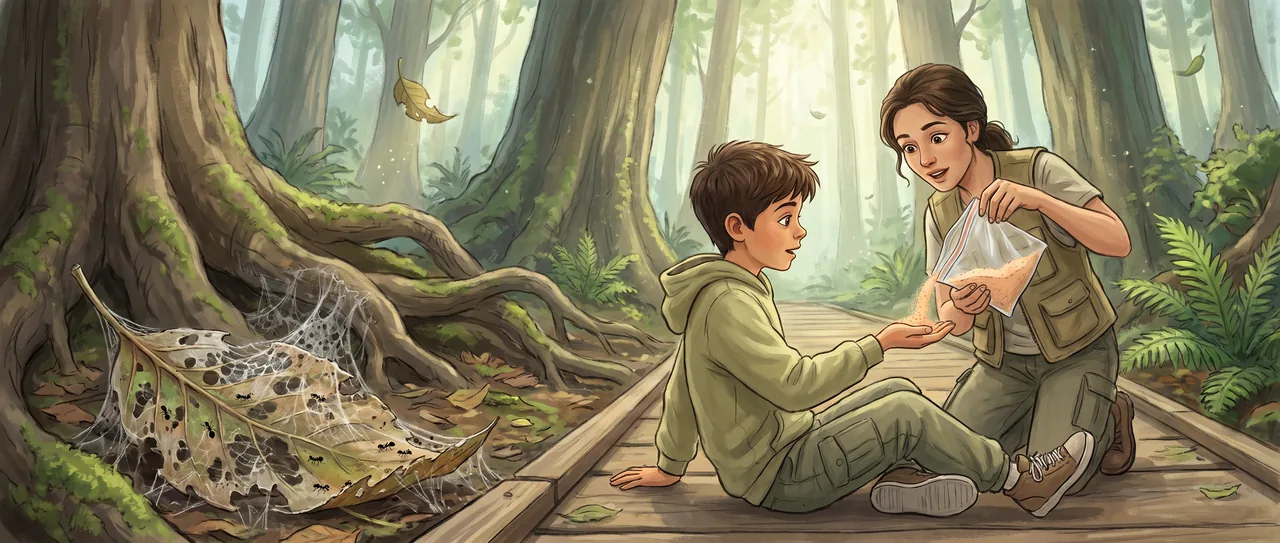
Here was a leaf on the forest floor. It was already soft at the edges, going dark, half its shape eaten away into lace. Next to it, a leaf that was further gone, just veins now, a skeleton pressed into the dirt. And beyond that, no leaf at all, only a smear where a leaf had been.
He knelt and looked closer. The lace leaf was moving. Not in the wind. Ants ran along its ribs. Tiny pale threads, thinner than hair, laced across its underside where it touched the ground. When he lifted a fallen twig nearby it came apart in his hand like wet bread, and the inside was threaded through with the same white webbing, and it was warm, or he imagined it was warm, from all the things working inside it.
Something was eating the forest floor as fast as the forest floor arrived.
"How long," he called, "does a leaf last here? Before it's gone?"
His aunt actually paused this time. "Fast. Weeks. In a place like this a leaf can be gone in six weeks. Back home it might take a year, two years."
"Why so fast?"
"Warm. Wet. Everything's awake all the time." She capped her marker. "The decomposers never get a winter off."
He looked at the skeleton leaf. Weeks. At home the dead leaves piled up. They packed down over the winter, black and cold, and slowly, slowly they became the dark sweet dirt he knew. The richness went into the ground and waited there. That was where the good dirt came from. Dead things, waiting in the soil.
But here nothing waited. Here the fungi and the ants and the warm threads pulled a leaf apart in six weeks and took everything out of it.
He felt the edge of the idea before he had the whole of it. His stomach did the thing it did on a fast elevator.
If everything was pulled out of the leaf that fast, it never got to sink into the soil at all.
"Where does it go?" he said, mostly to himself. "If it doesn't go into the ground."
He looked up.
The roots. He hadn't really looked at the roots. Now that he looked, the trees near the boardwalk didn't drive down into the earth the way trees were supposed to. Their roots spread out sideways, flat, huge flaring walls of root that ran along the top of the soil and vanished under the litter. Some of them lifted right up out of the ground and arched over the leaf lace like fingers.
They weren't reaching down for the richness. There was no richness down there. They were reaching sideways, right at the surface, right where the leaf was dissolving, right where the warm threads were letting go of everything the leaf had held.
The threads. He remembered a picture from a book, roots and fungus tangled together, feeding each other. The white webbing on the twig. The white webbing might be touching the roots too.
Catching it. The whole forest was catching its own falling body before it hit the ground.
Soren sat down hard on the boardwalk.
The soil was poor because it was empty. Not empty like nothing had ever been there. Empty like a house where everyone was standing up. All the richness, all the good dark waiting stuff he knew from home, none of it was in the ground here. It was up. It was in the beetle and the vine and the ant and the leaf and the hundred-foot trees and the green ceiling that hid the sky. It was standing all around him, breathing, dripping, alive. The forest was not growing out of the soil.
The forest was the soil. It had just stood up.
"Soren." His aunt was looking at him now, properly, the sample bag forgotten in her hand. "You okay?"
"If you cut it down," he said slowly, "the ground's got nothing. There's nothing saved up. It's all in the trees."
She didn't answer for a second. "That," she said, "is the whole problem. That's the thing people don't believe until you show them the numbers. The soil looks like it should be the richest in the world." She crouched next to him and let a little of her pale sample run out of the bag onto the boardwalk. "And it's some of the poorest."
Soren held out his hand and let her pour the rest into his palm. It weighed almost nothing.
Above him, a single leaf let go of the canopy and came down turning, and the ants on the floor were already waiting for it.
Read the interactive version, listen to the narration, and earn a gold star →
A science-verified short story for curious kids · Curiosity Land