The Ninety-Eight Percent
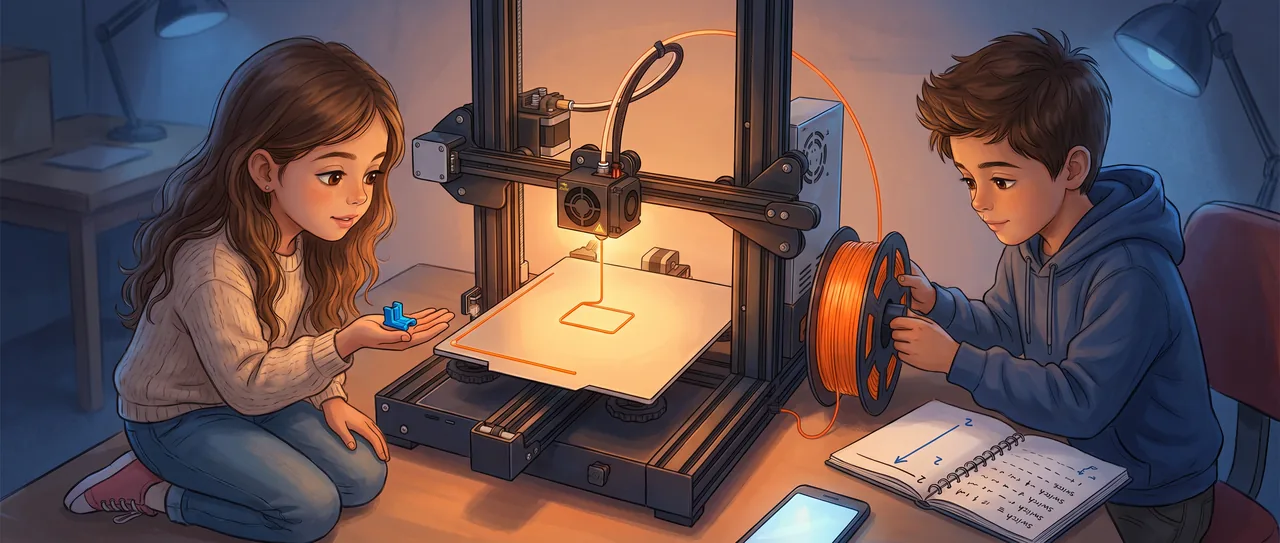
The printer stopped with a beep that meant it was out of plastic.
"We're not even close," Soren said. He looked at the model on the bed. It was supposed to be a chromosome, stretched out long so you could see the genes. They had spooled a whole roll of blue filament into it and gotten maybe a hand's length done.
"How long is the real thing supposed to be?" Maya asked. "If we finished it."
Soren pulled up the number on his phone. He read it twice before he said it out loud. "To scale? Like this? About two meters."
"Two meters," Maya said. "For one strand."
"For the DNA in one cell. Three billion of the little steps. The base pairs."
Maya walked to the shelf where the spent filament rolls were, the almost-empty ones people left behind. She started counting how many they'd need. Then she stopped counting.
"Okay," she said. "Which parts do we actually have to print?"
"All of it. It's a chromosome."
"No. The genes. The parts that do something. We label those blue and skip the rest." She was already reaching for the file to edit it. "How much of it is genes?"
Soren checked. He was quiet for a second, then he laughed, a short surprised laugh. "Two percent."
"Two percent is genes?"
"Two percent of it codes for proteins. That's what a gene does, it's a recipe for a protein." He scrolled. "The other ninety-eight, they used to call it junk DNA. Like packing peanuts. Filler."
Maya turned around. "They named ninety-eight percent of you junk?"
"That's what it says."
"That can't be right."
"It's what everybody thought." Soren was reading faster now. "For a long time. They figured if it didn't build a protein it wasn't for anything."
Maya sat down on the floor next to the printer, which was still ticking as it cooled. "So we could print two percent," she said slowly, "and skip the junk, and have basically the whole important thing in one afternoon."
"Basically."
"Then why does the body keep all of it?"
Soren stopped scrolling.
"Every cell copies the whole two meters," Maya said. "Every time it divides. Copying is work. You said it's a lot of steps. If ninety-eight percent of it is garbage, throw it out. Cells are cheap about everything else. You told me they recycle their own broken parts."
"They do."
"So a body that carried around ninety-eight percent trash for, what, billions of years, and never dropped it." She shook her head. "Nothing keeps the packing peanuts for a billion years."
Soren sat down too, across from her, the phone flat between them. "Keep going."
"I don't have the rest. I just know it's wrong. The garbage story is wrong." She picked at the little blue thread hanging off the model. "What's in the ninety-eight percent? Does it say?"
He read it out this time carefully, the way he did when he wanted to get it right the first time. "Switches. A lot of it is switches. It doesn't build the protein. It decides when the gene turns on. And how much. And in which part of the body."
Maya went very still. Then she said, "So the two percent is the words."
"What?"
"The genes are the words. And the ninety-eight percent is everything else. When you say them. How loud. To who. Whether you say them at all." She was talking with her hands now. "You have the same word in a poem and in a shopping list and it does a completely different thing, right? Same word. The gene's the same in your eye and in your liver. Something has to tell it which one to be."
"The switches," Soren said.
"The switches. That's the ninety-eight percent."
Soren looked at the tiny finished piece on the printer bed, the two percent, sitting there looking like the whole answer and being almost none of it.
"So they had it backwards," he said.
"They had the loud part," Maya said. "The part that shouts a protein, you can hear it, so they found it first. The quiet part was doing all the deciding and nobody could see it doing anything, so they called it junk."
Soren pulled his notebook out of his bag. He turned to a clean page and drew a long line, and near one end he made a short blue mark, and he wrote a two beside it, and along the whole rest of the line he started making little marks, switches, dozens of them, more than he could fit.
"Here's the part that gets me," he said, still drawing. "Two people can have the exact same gene. The exact same word. And one of them turns it up and one turns it down, and they come out different. The difference isn't in the gene at all."
"It's in when you say it," Maya said.
"It's in the ninety-eight percent they threw away."
Maya reached over and took the finished blue piece off the printer bed. It was warm still, and light, and small. She held it in her open hand.
"Reprint it," she said.
"The two percent? It's done."
"No. The whole thing. All of it. The switches too. Different color for the switches." She set the blue piece back down beside the notebook. "I want to see how much of it we didn't think was anything."
Soren looked at the empty filament shelf, and the almost-empty rolls, and the two meters they'd never fit in this room.
"We don't have enough plastic for two meters," he said.
"Then we start," Maya said. "And we run out. And whoever comes in tomorrow finds a chromosome that isn't finished and wonders which parts we thought mattered."
Soren loaded a half-roll of orange onto the machine. He edited the file so the switches printed too, all ninety-eight percent of them, every quiet piece that decided things without ever saying a word.
The printer woke up and drew its first bright orange line across the empty bed.
Read the interactive version, listen to the narration, and earn a gold star →
A science-verified short story for curious kids · Curiosity Land