The Nineteenth Hour
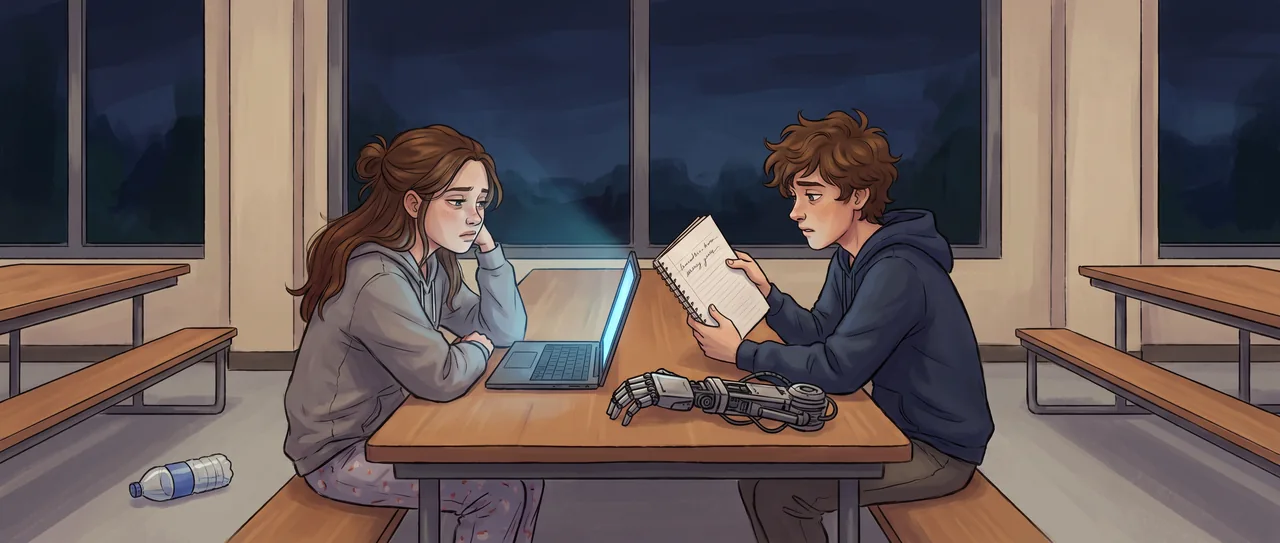
The cafeteria clock said four in the morning. Maya had been awake since seven the day before. She did the math without meaning to, the way she always did, and then forgot it a second later, which should have told her something.
"Try it again," she said.
Soren keyed the command. The robot's arm swung, missed the block, and knocked their water bottle off the table. Neither of them flinched.
They had come in Friday after school with a plan and snacks and a permission slip signed by Coach Petrova, who was asleep across three chairs by the vending machines with her jacket over her face. She had promised to wake up if they needed her. She had also promised she would only rest her eyes.
"The code is fine," Soren said. "The code was fine an hour ago."
"So it's still fine."
"So it's still fine," he agreed.
They ran it eleven more times. It failed eleven more times, each failure slightly different, and each time one of them said something that sounded like a reason. The gripper's too loose. The floor's slippery. The battery's low. They swapped the battery. It failed the same way.
Maya felt wonderful, actually. That was the strange part she would think about later. Her thoughts came fast and easy and every one of them felt correct the instant it arrived. She had never been so sure of anything.
"We should rebuild the whole arm," she said.
Soren looked at the arm they had spent six weeks building. "Okay," he said.
He reached for his notebook. His hand was slow finding the page. He wrote a line, looked at it, and could not read his own handwriting. He had written the arm is lying, which was not a sentence that meant anything, and he stared at it for a while.
"Maya."
"What."
"Read this." He turned the notebook around.
She read it. "The arm is lying."
"I don't know why I wrote that."
"It's a good sentence."
"It isn't. That's the thing." Soren pressed his palm against his eyes. "An hour ago I would have known it wasn't."
Maya started to answer and lost the end of her own thought halfway through. She stopped. In the quiet she noticed her hands were resting on the keyboard, not typing, and she could not remember deciding to stop.
"How long have we been awake," Soren said.
"Since seven. Yesterday."
He counted on his fingers, which he never did. "That's twenty-one hours."
"Feels like the middle of the day."
"That's the problem," Soren said slowly. "It should not feel like the middle of the day."
Maya turned this over. Something in it snagged, the way a thing snags when it does not fit. She reached for the memory of the last hour and found holes in it. The battery. The eleven runs. She could not put them in order.
"Do this," she said. "Say the alphabet backwards."
Soren was too tired to ask why. "Z. Y. X. W." He stopped. "V." A long pause. "U. T." He gave up somewhere around Q, which was not like him at all, and the not-being-like-him was the loudest thing in the room.
"I can't," he said. He sounded almost interested. "I genuinely can't. I could do that in second grade."
"So could I. Let me try." Maya tried. She got tangled at the same place. "That's not because it's hard."
"No."
"It's not hard."
"No," Soren said. "It's us."
They sat with that. Outside the tall cafeteria windows the sky was still black. Maya thought about her uncle, who had once explained why nobody was allowed to drive home from a party if they'd been drinking, how the trouble wasn't just that your hands got clumsy, it was that the part of you that judged your own clumsiness got clumsy too. You felt fine. Feeling fine was the symptom.
"Soren." She said it carefully, because she wanted to catch the thought before it slid off. "When my uncle talks about people who shouldn't drive. He says the worst part is they always think they're okay."
"We think we're okay."
"We think we're great. I feel great."
"I felt great when I decided to rebuild the arm."
Maya looked at the arm. Six weeks of work, and twenty minutes ago she had wanted to tear it apart, and the wanting had felt exactly as certain as everything she had ever been right about. It had felt identical. That was the thing she could not get past. There had been no line between the good ideas and the bad one. They came from the same place and they wore the same face.
"That's what's scary," she said. "It doesn't feel different. Being wrong right now feels exactly like being right."
Soren picked up his pen and could not make his hand do the letters. He put it down.
"When you're drunk you know something's off," he said. "The room moves. You hear yourself talking wrong." He gestured at the still, quiet cafeteria, at his own steady hands. "Nothing's moving. I hear myself fine. And I just failed the alphabet."
"So we can't trust the part of us that would tell us to stop."
"That part's asleep," Soren said. "It's the only part that got to sleep."
Maya laughed, and it came out strange, and she stopped it. She looked at the robot arm, whole, patient, waiting for them to ruin it on the strength of a feeling that felt like genius.
"Rule," she said. "We don't decide anything now. We don't rebuild. We don't rewrite. We write down what we want to do and we don't do it until we've slept."
"Agreed." Soren slid the notebook toward her. "Because right now I'd agree to anything. That's also the problem."
They did not fix the arm. That was the hard part, harder than fixing it would have felt. They powered the robot down. Maya wrote, in letters she checked twice, do not rebuild the arm, you were awake for twenty-one hours and you were not as smart as you felt.
Across the cafeteria Coach Petrova's jacket rose and fell. Maya put her head down on her folded arms, near the sleeping robot, and watched the black windows go slowly, slowly gray.
Read the interactive version, listen to the narration, and earn a gold star →
A science-verified short story for curious kids · Curiosity Land