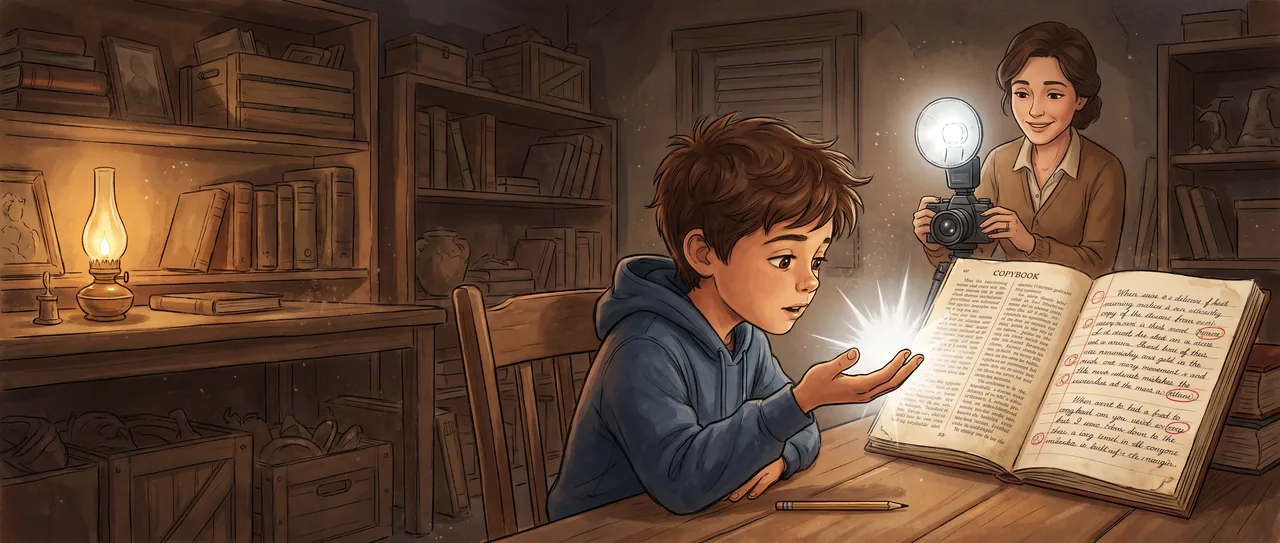
The Copyist
The museum was closing at the end of the month, and Soren's aunt had been hired to photograph everything before the boxes went into storage. She let him come along because he was quiet and did not touch the wrong things, which she said was rarer in a boy than people believed.
The back room smelled like old paper and dust that had given up. On the long table sat a stack of copybooks from the town's first printing shop, more than a hundred years old. In the days before machines, Soren's aunt explained, a copyist would sit and reproduce a document by hand. A ledger. A contract. A letter. One person, one pen, one page at a time.
She was busy with the camera and the tripod and a light that would not stay where she put it, so Soren opened one of the copybooks himself.
Inside were two columns. On the left, someone had pasted the original page. On the right, the copyist had rewritten it by hand. And in the margin, in faded red ink, a second person had gone through both columns and circled every place the copy did not match the original.
Soren counted the red circles on the first page. There were nine.
He turned pages. A wrong date. A dropped word. A name spelled two ways. A whole line copied twice. The red pen had caught them all, patient and merciless. By the end of the book the copyist had filled perhaps forty pages, and the margins held over two hundred corrections.
He reached into his bag and set his notebook beside the copybook. His pencil moved down the page, one number for each book he checked. Forty pages, two hundred errors. That was about five mistakes per page. A page held maybe four hundred words. So roughly one error in every eighty words.
He found this strangely comforting. The copyist had tried so hard, and still the red ink bloomed everywhere. It was proof that copying was difficult. It was proof that a careful person could work all day and still be wrong once every few sentences.
He said so to his aunt.
"People weren't sloppy," she said, not looking up from the viewfinder. "They were human. Copying is the hardest thing there is. Every scribe in history made mistakes. That's why we invented printing presses. So the machine would do it the same way every time."
Soren thought about that. A press stamped the same page again and again, identical, no red ink required. That was the whole point of it. Humans drift. Machines repeat.
He was still holding that idea, turning it over, when he remembered something from his science class that did not fit.
His teacher had said that every time a cell in your body divides, it copies your entire set of instructions. All of it. And she had put the number on the board because she liked large numbers. Three billion.
Three billion letters. Copied. Every single time one cell became two.
Soren stopped turning pages.
The copyist on the table had managed one error in every eighty words. A word was, what, five letters? So the best a careful human hand could do was one mistake in every four hundred letters or so. And that was a person trying their hardest, in daylight, with a red pen waiting.
He did the arithmetic in the margin of his notebook, slowly, because the number kept feeling wrong.
If a cell copied three billion letters at the copyist's rate, one mistake every four hundred letters, it would make millions of errors. Seven million, roughly, every time it divided. Millions of red circles. Millions of wrong dates and dropped words and lines copied twice.
But that was not what happened. He knew that was not what happened, because he was sitting here, put together correctly, with two hands that each had five fingers.
He went back to his teacher's words. He was fairly sure of the next part, but he wrote it down to be sure of it. The cell, she had said, makes fewer than one error for every billion letters it copies.
One. In a billion.
Soren sat very still in the closing museum.
He looked at the copybook. Two hundred red circles in forty pages. A person's whole day of careful work, and the margins still ran with corrections.
Then he tried to imagine what the copybook would have to look like to match a cell.
One error in a billion letters. A page held four hundred words, call it two thousand letters. To find a single mistake, at that rate, you would not read forty pages. You would read half a million pages. You would read a stack of copybooks taller than the museum, taller than the town, and somewhere in all of it, buried, would be exactly one wrong letter. And a red pen would find it, and fix most of it, and move on.
And this happened, he wrote, pressing hard enough to feel it, in the dark. Inside him. Without anyone watching. Not once. Not carefully, one book at a time, over a long human life. It happened in every dividing cell, in the skin of his knuckles, right now, while he sat holding a pencil.
He looked at his own hand.
The copyist had needed a whole day and a second person with red ink to get one page nearly right. And somewhere under the skin of the hand holding the pencil, three billion letters were being copied, faster than he could count them, more exactly than the best press ever built, more exactly than any human scribe who had ever lived and squinted and tried.
"You've gone quiet," his aunt said. She had finally gotten the light to hold still. "Find something good?"
"The copyist keeps making mistakes," Soren said. "Two hundred in this one."
"Poor soul," she said. "Imagine doing that all day."
"That's the thing," Soren said. "They were being as careful as a person can be. And they still lost. And there's something in me copying a book a million times bigger, and it barely ever loses at all."
His aunt lowered the camera and looked at him properly for the first time all afternoon.
"Where did you get a thing like that," she said. It was not really a question. It was the voice people used when a room had suddenly gotten larger and they did not know how.
Soren did not answer. He was looking at the two columns on the open page, the original and the copy, and the red ink between them doing the impossible careful work.
His aunt lifted the camera again and photographed the page. The flash filled the dark room and left it, and the copybook lay open on the table, one more corrected copy of a copy, while under the skin of the hand still holding his pencil the same work went on, silent, exact, three billion letters at a time.
Read the interactive version, listen to the narration, and earn a gold star →
A science-verified short story for curious kids · Curiosity Land