The Blue Nothing
The crate said FRAGILE in three languages and weighed almost nothing.
Maya tilted it. Soren steadied the other end. Whatever was inside shifted like it wasn't there.
"Empty," Maya said.
"The manifest says it isn't." Soren read from the clipboard the museum's registrar had left them. She had gone to find the loading-dock key and told them, over her shoulder, not to touch the blue thing. Then she had been gone twenty minutes.
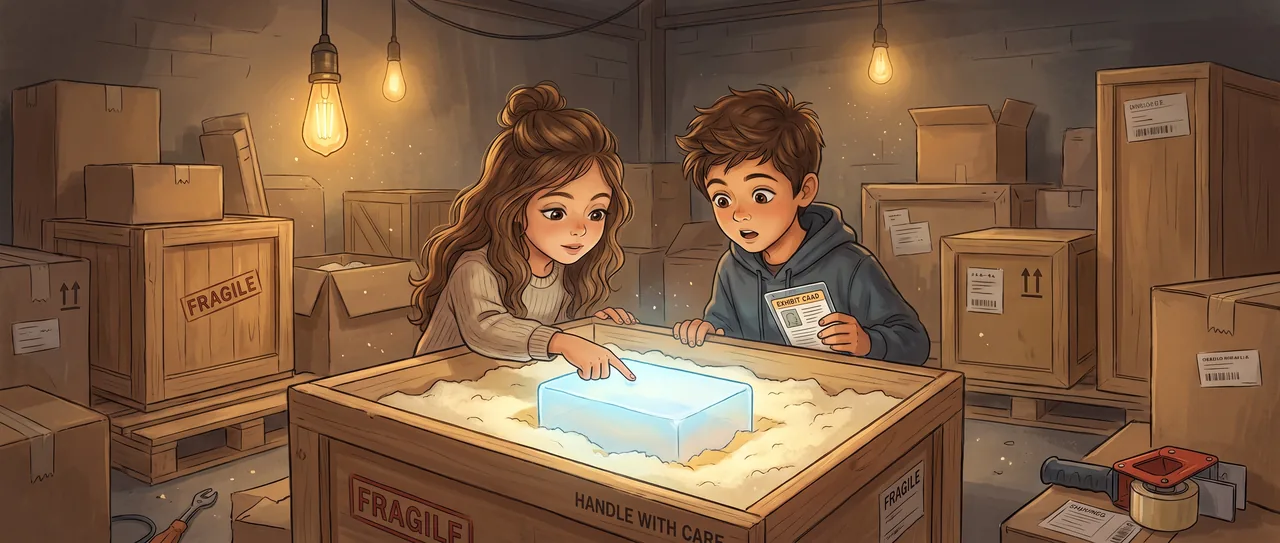
They pried the lid. Foam. More foam. And in the center, resting in a cut-out cradle, a block about the size of a loaf of bread.
It was blue. Not painted blue. Blue the way the sky is blue, blue the way distance is blue, a color that seemed to come from inside it and hang there.
"Don't touch the blue thing," Soren said.
Maya was already reaching. She stopped with her fingers a centimeter away.
"It's making a shadow that isn't dark," she said. "Look. The shadow is warm-colored. Yellowish."
Soren looked. She was right. Light came through the block and came out the other side the color of a low sun.
"Blue coming toward us, yellow going away," he said slowly. "That's the sky. That's actually how the sky works. The little stuff in the air kicks the blue light sideways and lets the rest pass."
"So it's full of little stuff."
"It's full of nothing, is what the manifest says." He turned the clipboard so she could see. "Silica aerogel. Density listed as point-zero-zero-one-six grams per cubic centimeter."
Maya did the arithmetic out loud, the way she did, skipping the middle. "That's basically air. That's air with a shape."
"Frozen smoke, it says here. That's the nickname."
She finally touched it. One fingertip. Her whole face changed.
"Soren."
"What."
"It's not cold and it's not warm. It's nothing. My finger feels like it's touching the idea of a surface." She pressed a little. "And it's hard. It's hard nothing."
He put a finger on it too. She was right again. It was solid, faintly gritty, and it gave back none of the coolness a solid was supposed to give. His finger just stopped, held by something that felt like held breath.
The registrar's voice floated in from the corridor, on the phone, complaining about a key that didn't fit.
"There's a card," Maya said, digging in the foam. She held up a laminated exhibit label, the kind that would have stood beside the block if the exhibit had ever gone up.
She read it out fast. "Best insulator known. They put a flower on top of a slab and a flame underneath and the flower doesn't wilt."
"That can't be a thin slab."
"Says it can." She kept reading. "Fifteen world records. Lightest solid. Best insulator. And — okay. This is the part I don't believe." She held the card closer. "One gram of it. One gram. Has the surface area of a basketball court."
Soren took the card. Read it himself. Read it again. "That's wrong," he said. "A gram is a paperclip. A basketball court is—" He gestured, both arms, and knocked the foam. "That's a building's worth of floor. Inside a paperclip."
"Inside a paperclip," Maya agreed.
"It has to be a mistake."
"It's not a mistake, because look." She pointed at the block, at the blue hanging inside it. "How does it make the whole sky in a bread loaf? You said. Little stuff, everywhere, kicking blue sideways. It has to be little stuff absolutely everywhere. All the way through. There can't be anywhere in there that isn't edge."
Soren stopped.
He was looking at the block, but he had gone somewhere behind it. When he spoke, it was careful, one step laid down before the next.
"Okay. Imagine a sponge. A sponge has a lot of surface because it's full of holes, and holes have walls, and walls are surface."
"Right."
"Now make the holes smaller. Smaller holes, more of them, more walls. More surface crammed into the same space."
"Right." Maya's hands had started moving, folding an imaginary thing smaller and smaller.
"Now make the holes as small as they can possibly be. Not sponge small. Not even dust small." He looked at the blue. "Small like a few atoms across. Pores you can't see with any light, because they're finer than light. Billions of them. Trillions. And every single one has walls, and every wall is surface, and none of it is filled in."
"So the whole thing is nothing but walls," Maya said. "It's a solid that's almost entirely the inside of holes."
"That's why the flower doesn't burn. Heat can't get across. It keeps hitting a wall, then a gap, then a wall, then a gap. It can never run straight through."
"And that's why it's the color of the sky. Because it is the sky. It's the whole sky pressed into a loaf, and the surface—" Maya stopped, and the number that hadn't fit thirty seconds ago dropped into place, and her breath went with it. "The surface isn't on the outside. It's all folded up on the inside. That's where the basketball court is. It's not painted on the block. It's all in there. In the nothing."
They both looked at the small blue block.
A thing you could hold in one hand. And unfold, if you could unfold it, into a floor big enough to run laps on. All of it hidden in pores too fine for light to enter, a whole hidden acreage folded into the space between one breath and the next.
"Everything's like that a little," Soren said quietly. "Isn't it. Every solid has more inside than it shows."
"This one just shows you," Maya said. "By hiding it better than anything."
The registrar came in, phone still against her ear, key finally in hand. She saw them bent over the open crate and pointed at the block and mouthed, sharply, don't.
Maya lifted her hand away. Soren set the laminated card back into its slot in the foam.
Inside the blue block, in a piece of nothing the size of a loaf of bread, a court no one would ever walk lay folded, holding the color of the sky against the light of the loading-dock bulbs.
Read the interactive version, listen to the narration, and earn a gold star →
A science-verified short story for curious kids · Curiosity Land