The Animal That Doesn't Follow the Rules
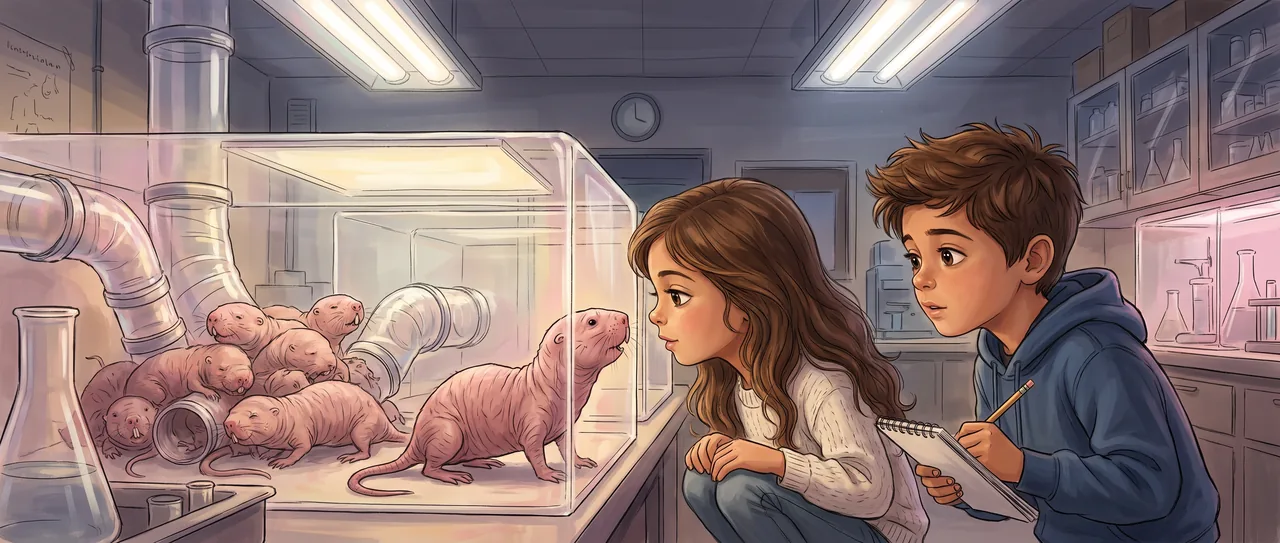
The colony lived in a tangle of clear plastic tubes, and the animals inside were the ugliest things Maya had ever loved on sight.
"They have no fur," Soren said. "Almost none."
"They have teeth on the outside of their lips," Maya said. "Look. So they can dig without eating dirt."
The card taped to the tank said NAKED MOLE RATS and under that, in smaller marker, DO NOT FEED, DO NOT REMOVE LID, ask Dr. Okafor. Dr. Okafor was three rooms away with a red pen and a stack of exams and had told them, kindly, that she would be exactly nine more minutes for the last forty of those nine minutes.
One mole rat wriggled to the front of the tube and pressed its wrinkled pink face to the plastic. It had almost no eyes.
"It's breathing weird," Soren said.
"They all are."
He watched. She was right. The whole pile of them breathed slow, slower than anything that small should. A mouse breathed like a sewing machine. These things breathed like they had all the time in the world.
"Something's wrong with them," Soren said. He didn't mean sick. He meant off. He meant the thing he always meant, the animal behaving in a way the rules didn't allow.
Maya crouched until her nose was level with the tank. "Say what you mean."
"Everything this size dies fast. High heartbeat, short life. A mouse lives two years. This should live two years." He tapped the card. Under DO NOT FEED someone had written a birth date. Two thousand and two.
Maya did the arithmetic on her fingers, ran out of fingers, and stopped.
"That one's older than us," she said. "By a lot."
"That's not how bodies this small work."
"Then it's not working like a body this small."
They stayed with that. On the wall behind the tank was a poster, the kind grad students make at midnight, too many words and one good chart. Maya read out the parts that stuck.
"Cancer," she read. "Almost never. Thousands of them studied. Almost none."
"Everything gets cancer," Soren said. "You get more cells, more time, more chances for a cell to go wrong. That's just numbers. Whales should be swimming tumors. We should be. Everything alive is a lottery you keep buying tickets to."
"They're not buying tickets," Maya said slowly. "They're not playing."
She put her finger on a word she couldn't say. Hyaluronan. Under it the poster said their cells make a giant, sticky version of it, much bigger than the kind in human skin, and it fills the space between their cells like a crowd packed too tight to move.
"So the cells can't pile up," Maya said. "A cell tries to go wrong, tries to shove and multiply, and there's no room. It's too crowded to start a riot."
Soren looked at the pile of animals breathing their slow, patient breath. "That's not a cure. That's just, don't let it start."
"Which is better."
"Which is stranger." He reached for his notebook. His hand found the pencil, opened to a clean page, and drew a box crammed with smaller boxes, no gaps.
One mole rat had climbed out of the pile and was gnawing something in the corner. Maya watched it work its teeth against the same spot, over and over.
"There was a chili pepper thing," she said. "On the video Ms. Reyes showed. They put the stuff that makes peppers burn on their skin. The mole rats didn't care."
"That's acid," Soren said. "Acid is supposed to hurt. That's the whole point of acid. Your nerves scream so you pull away."
"Theirs don't scream."
"Why not?"
Maya looked at the tubes. At the tight tangle. At the animals stacked on animals with barely a gap of air.
"How many are in there?" she asked.
"Too many."
"That's the answer."
Soren waited. This was the part he liked, where she was somewhere ahead of him and he had to walk toward her.
"They live underground," Maya said. "Packed. All of them breathing in one closed burrow, no wind, no fresh air coming in. So the air goes bad. It fills up with the gas you breathe out. It gets sour. Acid, kind of." She pointed at the pepper line on the poster. "If your nerves screamed every time the air went sour, you'd scream all day. You'd never stop. So they turned that scream off."
Soren stopped drawing.
"And the oxygen," Maya said, faster now. "When the air runs all the way out, when there's none left, they don't die. The poster. Eighteen minutes with no oxygen at all." She looked at him. "A person is gone in a few. Brain gone."
"Nothing lives with no oxygen," Soren said. "You run on it. No oxygen, no engine, the engine's done."
"Unless you carry a different engine." She read it off the poster, careful. "They switch. They start burning fructose. Sugar, the kind in fruit. Their whole body flips to a backup fuel that doesn't need air, and waits, and when the air comes back they flip on again."
Soren looked at the little animal gnawing in the corner, older than both of them, sitting in a tube in a locked room, quietly not obeying a single rule he'd been taught.
"It doesn't feel the burn," he said. "It almost never gets the cancer. It can turn off breathing and wait." He set the pencil down. "Every single thing I know about how animals work, it does the opposite."
"No," Maya said. "Not the opposite. It solved it. We just thought the rules were the rules."
The mole rat by the glass turned its almost-eyes toward them, or toward nothing, and held still. Its sides rose. Fell. A long, long pause. Rose again.
Soren counted the seconds between one breath and the next, out loud, and got all the way to twenty before he had to start over.
Read the interactive version, listen to the narration, and earn a gold star →
A science-verified short story for curious kids · Curiosity Land