The Yellow Band
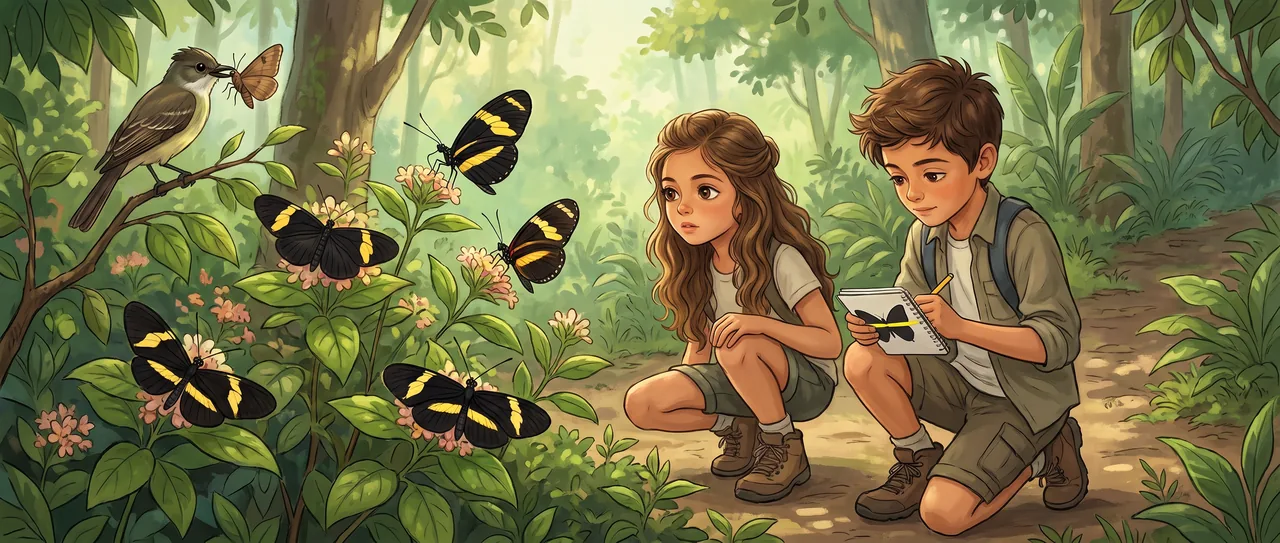
The guide had promised them a blue morpho and then walked off to argue with the other guide about lunch. So Maya and Soren stood at the bend in the trail with a borrowed camera and a laminated card of local butterflies.
"There," Maya said. "Black wings, yellow stripe. That one."
Soren found it on the card. "Postman butterfly. Heliconius."
"There's another one." Maya pointed. "Same stripe."
"That one's on a different page," Soren said. He held the card at arm's length. "Different species. But look at the wings."
They looked at the wings. Black, with one bold yellow band cutting across, the same yellow, the same place.
"That's weird," Maya said.
"Camouflage is supposed to make you blend in," Soren said. "These are the opposite of blending in. You could see that yellow from across the river."
"So they want to be seen."
"By something. Yeah."
Maya crouched at a flowering bush where three of the black-and-yellow butterflies were feeding. She held very still and counted. "Soren. These aren't all the same shape. That one's wings are longer. That one's rounder."
Soren came down next to her with the card. "Rounder is a different family entirely. That's not even a Heliconius. That's a moth thing. It just, it looks the same from here."
"How many different kinds are wearing the same jacket?"
Soren counted against the card. "Four. At least four. All different. All yellow band, all black."
"Why would four different animals decide to dress alike?"
"They didn't decide," Soren said. "Nothing decides that. But something made it happen four separate times." He got out his notebook and drew the yellow band, one clean line across a black wing.
A bird dropped onto the bush, some small flycatcher, quick and hungry. It cocked its head at the butterflies. Then it left them completely alone and snapped up a plain brown moth instead.
"Did you see that," Maya said. "It ignored the yellow ones."
"It went straight past them." Soren sat back on his heels. "It wasn't scared of the yellow. It was, it knew the yellow."
"Knew it how?"
"Somebody taught it. Somebody yellow." Soren was talking faster now. "These butterflies taste terrible. The card says it. Toxic. So a young bird tries one, gets a horrible mouthful, and never forgets the yellow band."
Maya's eyes went to the feeding bush and stayed there. "But the bird only has to learn once."
"Once, yeah."
"So it doesn't matter which butterfly the bird bit." She turned to him. "If I'm a yellow-band butterfly, and some other kind of yellow-band butterfly already got eaten teaching the bird the lesson, then the bird already knows. I never even meet the bird. I just have the right jacket."
Soren stopped drawing.
"Say that again," he said.
"The lesson gets learned on somebody," Maya said. "Every yellow butterfly the bird bites and hates makes every other yellow butterfly safer. Even ones it's never seen. Even different species."
Soren looked at the four kinds of butterfly, all wearing the one signal, none of them the same animal.
"That's why there's four," he said slowly. "If four thousand toxic butterflies all wear yellow bands, a young bird learns the lesson after biting one or two. The lesson gets spread across all of them. But if they all had different patterns, the bird would have to learn each pattern separately. Bite a striped one. Bite a spotted one. Bite a checkered one. That's a lot more butterflies getting eaten to teach the same bird."
"So sharing the pattern means fewer of everybody dies." Maya sat down flat in the dirt, not caring. "They're not competing. They're, they're pooling. Like everybody in the whole forest agreed to use the same warning sign so it only has to be learned once."
"Nobody agreed, though," Soren said. "That's the part. There's no meeting. No butterfly knows any of this. The ones that happened to look a little more yellow got eaten a little less, so there were more of them next year, and more the year after, four separate times, in four separate families, all drifting toward the exact same yellow." He shook his head. "They cooperate and none of them knows they're doing it."
"None of them can know," Maya said. "It's a butterfly."
They were quiet. The bush moved. More yellow bands than they had counted at first, some Heliconius, some moths, some things they had no page for, all flashing the same signal into the green.
"It's a language," Maya said. "The yellow is a word. And the word means don't. And it works even though not one of them can speak it."
"It works because not one of them can lie about it," Soren said. "They can't fake tasting bad. If a bird bites a yellow band it really is disgusting. Every single time. So the word stays true." He wrote that down, pressing hard. A signal nobody controls that nobody can lie about.
Maya was watching him write and grinning. "You know what this means about you," she said.
"What."
"Every kid who ever got sent to the corner for asking too many questions. Every one who tasted awful to the boring people." She waved a hand at the bush. "You're the yellow band. You get bitten first so the rest of them learn."
Soren laughed, surprised. "That's not science."
"No," Maya said. "But it's true."
The guide called from up the trail, something about the blue morpho, finally. Neither of them moved.
A new bird landed on the bush. It looked hard at all that yellow. Then it lifted off with nothing in its beak and flew across the river, carrying a lesson it had never had to learn itself.
Read the interactive version, listen to the narration, and earn a gold star →
A science-verified short story for curious kids · Curiosity Land