The Word for the Feeling
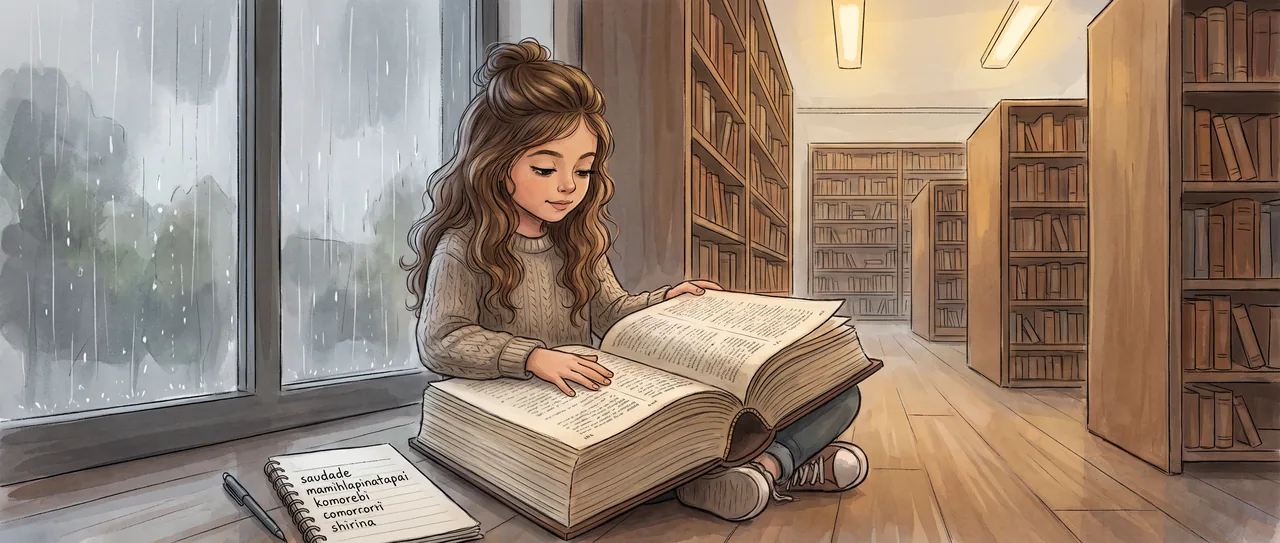
The rain had been going long enough that Maya stopped hearing it. She was on the floor of the language section, back against the shelf, with a dictionary open across her knees the size of a paving stone.
Her mom's shift at the front desk ended at five. It was three forty.
The dictionary was a special kind. It only translated words that did not translate. On the left page was a word from another language. On the right page was a paragraph explaining the feeling it named, because there was no single English word to put there.
Maya read one and stopped.
The word was from Japanese. The paragraph said it meant the specific feeling of looking at someone you love while they sleep, and feeling grateful and sad at the same time because they will not always be there. Maya read it twice. She knew that feeling. She had felt it watching her little brother nap in the car. She had never once thought it was a thing with edges. She had thought it was just a smear of stuff with no name.
She turned the page.
There was a Portuguese word for the ache of missing something that might never come back, that you are almost glad to feel because it proves the thing was real. There was a German word for feeling alone in a way that only happens in a forest. There was a word from an Inuit language for the restless waiting when you keep going to the window to see if a person has arrived yet.
Maya sat up straighter.
She had done that. She had gone to the window four times last winter waiting for her dad's flight to land, and each time her mom asked what she was doing, and Maya had said nothing, because there was no answer. There had been no answer in English. There had been an answer this whole time. It was just kept somewhere else.
She pulled her notebook out of her bag and opened it on the floor beside the dictionary. Her pen moved down the page in a list.
Then she stopped, because a worse and better thought had arrived.
If the window-feeling had a name in one language and not in hers, then the name was not sitting inside the feeling like a pit inside a peach. The name came from outside. Somebody, somewhere, a long time ago, had decided that this smear of waiting-and-hoping was one thing and had drawn a line around it and handed it to their children. And her own people had drawn the lines somewhere else, so that for her the window-feeling stayed a smear.
Maya put her hand flat on the open page.
She had always believed feelings were just there, the way her heartbeat was there. Everybody had a heart. Everybody had fear, everybody had happy, everybody had that one. She had believed the words were like labels on jars that already existed. Fear in this jar. Happy in that one. The jars came with the person.
But the dictionary was full of jars that other people had and she did not. And that only worked one way. It meant she was walking around with feelings that had never been sorted into jars at all. Feelings with no line drawn around them. Feelings she could not even count, because to count them she would need edges, and the edges were exactly what she did not have.
She thought about the word happy. She tried to feel the edges of it. Where did happy stop and something else start? She could not find the wall. She had just always been told there was one.
A librarian pushed a cart past the end of the aisle. Mrs. Okafor, who did the story hours and always smelled like peppermint.
"You've been very quiet back here," Mrs. Okafor said. "Found something good?"
"Do you feel the same feelings in both your languages?" Maya asked.
Mrs. Okafor laughed, surprised. "What a question. No. Honestly, no. There are things I only feel in Igbo. When I try to say them in English they get smaller. Like pouring water into a cup that's the wrong shape." She tapped the cart and moved on, because a cart does not push itself and it was nearly four.
Maya stayed on the floor.
Same water. Wrong cup. So the feeling was the water, poured in from somewhere, and the word was the cup, and the shape of the cup changed the shape of the feeling. Not just what you called it. What it actually was when you held it.
Which meant her brain, right now, quietly, without asking her, was pouring every experience she had into whatever cups her language had handed her. The window-feeling had gone into the cup called nothing, so she had felt nothing with a name and a lot of something with no name.
And it also meant something A person in another country, holding a different set of cups, was not just naming her feelings differently. They were feeling differently. The furniture inside them was arranged in rooms she would never walk through. And they would never walk through hers. Nobody had the whole set. There was no complete set. The set had never been printed.
Maya looked at her list. Four borrowed words. Four cups she had not been born with.
She understood, in her body, that she had spent eleven years assuming everyone was quietly feeling the same things she was, just in other rooms of the same house. And the house was bigger than that. The house had rooms with no doors from where she stood, and rooms only she was standing in, and she had no way to describe those to anyone, ever, because describing needed a cup and the cup did not exist yet.
Somebody, though, had made the window-word once. It had not existed and then a person made it. Which meant cups could be made. Which meant the smear she had felt watching her brother sleep might not have to stay a smear forever.
She picked up her pen. At the top of the list she wrote a blank line, and after it a description, in her own words, of the exact feeling she had right now, on the floor, in the rain, with a dictionary too heavy for her lap. She left the word part empty.
Then she went to the window to see if her mom was done yet.
Read the interactive version, listen to the narration, and earn a gold star →
A science-verified short story for curious kids · Curiosity Land