The Two Oranges
The whiteboard in the hallway still had one drawing on it. Two circles, one arrow between them, and above the arrow somebody had written EQUALS, then crossed it out, then written it again.
"That's wrong," Maya said. "One thing can't equal two of the same thing."
"It's not wrong," said the graduate student packing a bag. Her name tag said Priya. "It's the most correct thing on that board. It's just annoying." She kept coiling a laptop cable and did not look at them.
Soren stood in front of the circles. He had a habit of standing very close to things he didn't trust.
"Draw it slower," he said.
Priya sighed the sigh of a person who wanted to leave. Then she uncapped a marker, because she was also a person who could not let a wrong idea sit in front of a kid.
"Fine. One orange." She tapped the left circle. "Cut it into pieces. Five pieces. Take those exact pieces, don't add anything, don't stretch anything. Slide them around, spin some of them. Put them back together." She tapped the right circle. Then she drew a second circle beside it. "You get two oranges. Both the same size as the one you started with."
"No," said Maya.
"Yes."
"Where does the second orange come from?"
"That," Priya said, "is the annoying part."
Soren pulled his notebook out of his coat pocket. He drew five wobbly shapes and slid his finger between them like he was moving them on a table.
"If you don't add anything," he said, "the amount has to stay the same. You can't get more orange out of one orange."
"You can't get more orange," Priya agreed. "You get more pieces of space that behave like orange."
Maya frowned. "That's a cheat sentence."
A second student had stopped stacking chairs to listen. He had chalk dust on one sleeve. "It sounds like a cheat," he said. "It isn't. Ask her the real question."
"What's the real question," said Soren.
"How big are the pieces," the chalk-dust student said.
Priya smiled for the first time. "There it is."
Maya looked at the five shapes in Soren's notebook. She looked at them for a while.
"You can't measure them," she said slowly. "That's the trick. The pieces aren't a size."
Priya put the marker down. "Say that again."
"The pieces don't have a size," Maya said, faster now. "Not zero. Not small. They just, they aren't the kind of thing you can put a number on. So when you slide them around, nothing tells you the total is supposed to stay the same. Because there's no total."
The hallway got quiet in the way rooms get quiet when a kid says the thing the adults spent a year learning.
"They're called non-measurable sets," Priya said. "Most people go their whole lives having never met one. You just met one."
Soren was not satisfied. Soren was almost never satisfied at the moment Maya was.
"But an orange is real," he said. "A real orange has a size. If I cut a real orange into five pieces and slide them around, I get one orange's worth of orange. I've done it. I did it at lunch."
"You're completely right," Priya said. "You cannot do this to a real orange."
"Then it's not real."
"It's real math about a fake orange." She crouched down so she was level with him, which he noticed and filed away as the thing the good ones did. "A real orange is made of atoms. Atoms are little and there's a smallest amount of orange, one atom, and you can't cut smaller. So a real orange can't be sliced into the strange pieces. But the orange in the math isn't made of atoms. It's made of points. And there is no smallest point. Between any two points there's another point, forever, all the way down."
Soren wrote forever, all the way down and underlined it once.
"So the ball is smooth," Maya said. "Infinitely smooth. No smallest piece to stop you."
"And because it's infinitely smooth," the chalk-dust student said, "you can find pieces so tangled up, so scattered, that measuring them stops making sense. And once measuring stops making sense, doubling stops being impossible."
Soren stared at his own two circles. "So the second orange doesn't come from anywhere," he said. "There was already enough. There was always enough. The one orange had two oranges' worth of points inside it the whole time. Because it had infinite points. And half of infinity is still infinity."
Priya stood up very slowly.
"How old are you," she said.
"Eleven," said Soren.
"Both of us," said Maya.
Priya looked at the chalk-dust student. The chalk-dust student looked back at her with an expression Maya recognized, because she had worn it herself, the expression of a person who thought they were the only one who found something this strange and had just found out they weren't.
"When I first understood this," Priya said, "I was twenty-two and I didn't sleep. I thought something was broken in the world. I thought if you could double a ball you could break anything. It took me a long time to understand it doesn't break the world. It breaks the idea that everything can be measured. Those are different."
"Which parts can't be measured," Maya asked. "How do you find them."
"You don't, quite," Priya said. "That's the last strange thing. The proof says the pieces exist. It doesn't tell you how to point at them. You can prove they're there without ever being able to hold one up."
Soren looked at her like she had said the most impossible sentence of the whole afternoon.
"You can know something exists," he said, "and never be able to find it."
"In mathematics," Priya said, "yes. All the time."
Maya was already drawing on the board. She wiped a corner clean with her sleeve and drew one circle. Then, next to it, she drew a second circle. Then she stood there with the marker, not drawing a third, because she had understood that she could keep going.
"Two makes four," she said. "Four makes eight."
"Keep the marker," Priya said. "We're going home."
The two students picked up their bags. The chalk-dust one paused at the door.
"It's called Banach-Tarski," he said. "If you want to look it up. Two names, because it took two of them."
Then they were gone, and the hallway was empty except for the whiteboard.
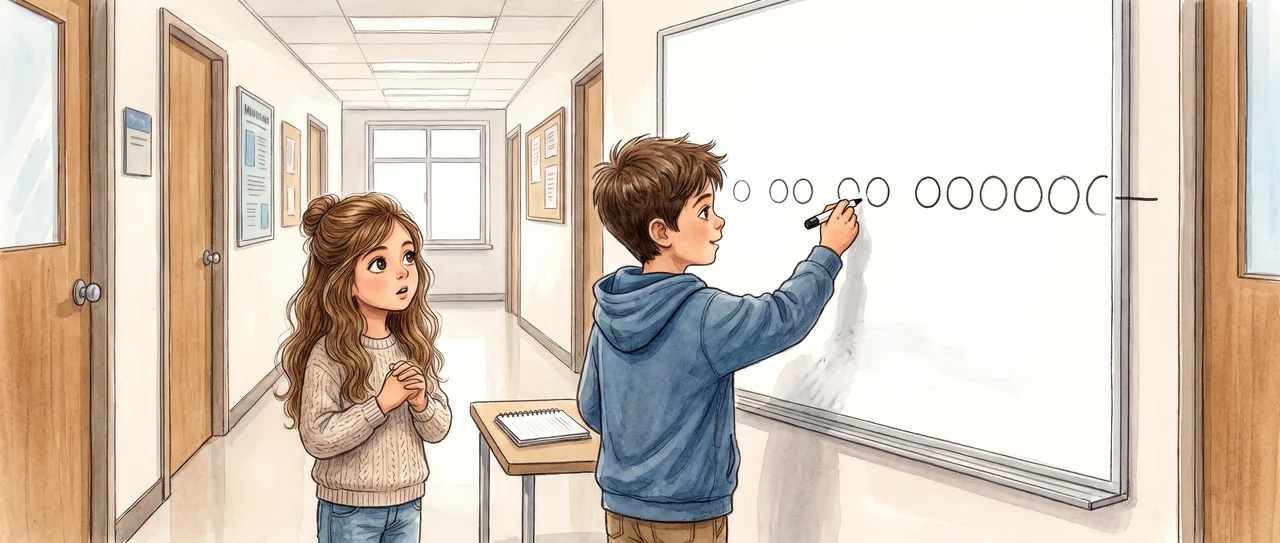
Maya put the marker in Soren's hand. He looked at the row of circles she had started, one becoming two, and he drew the next one, and the next, until he ran out of board and the last circle spilled off the edge with nowhere left to go.
Read the interactive version, listen to the narration, and earn a gold star →
A science-verified short story for curious kids · Curiosity Land