The Toad at the Edge of the Map
The storm had shut the road, so the ranger station was where they were stuck. Maya had already circled the whole main room twice. Soren was still on his first circle, because he kept stopping.
"These are dated," he said.
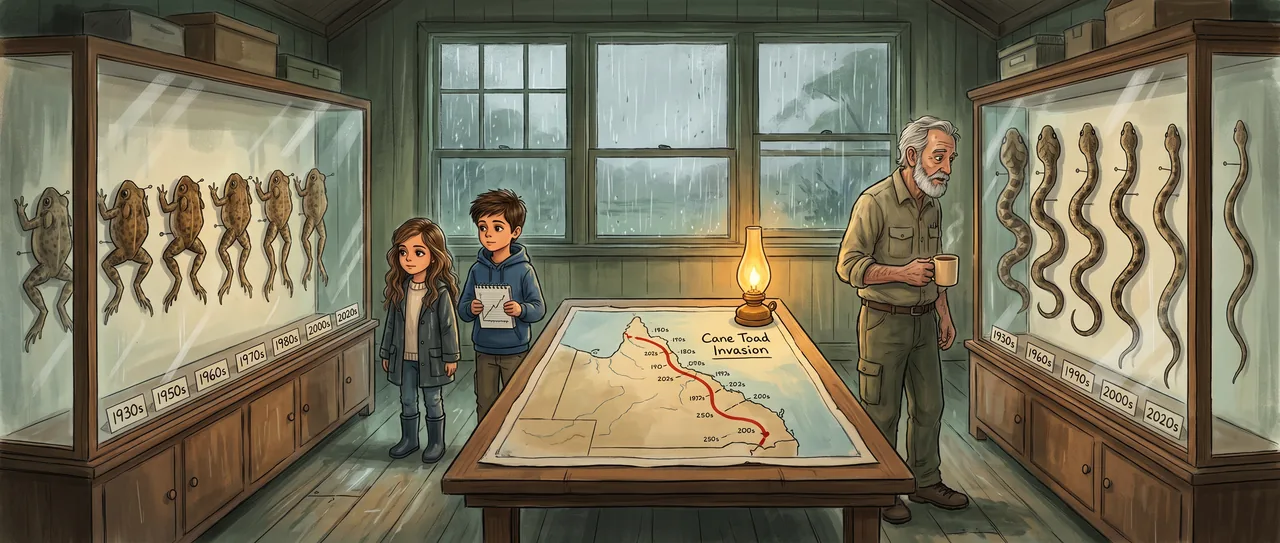
A wall of glass cases held cane toads, pinned flat, each with a little handwritten card. The dates ran from the nineteen thirties up to last year.
"So?" said Maya, coming back over.
"So look at the legs."
She looked. The oldest toads, brown and cracked with age, had short back legs folded up like a squat. The newest ones, glossy and dark, had legs that stretched almost off the card.
"They got taller," Maya said.
"Longer legs. Same animal. Same species, I mean. Same everything except the legs got longer."
"Maybe he pinned them different."
Soren shook his head. "He measured them. Look, the cards have numbers." He read one. "Snout to vent, leg length. The old ones are all one size. The new ones are all bigger. It's not how he pinned them."
Maya went quiet, then said, "Toads spread out from where they got dumped, right? Somebody let them go and they walked across the whole country."
"Hopped."
"Whatever. Eighty years of hopping." She tapped the newest case. "Which toad gets to the front of the invasion? The one that hops the farthest every night."
"The long-legged one."
"So the long-legged ones are always the ones out front. And they meet other long-legged ones out front. And they have long-legged babies." She spread her hands like she was pushing something across a map. "The front keeps sorting for longer legs. It sorts itself."
Soren had his notebook out. His pencil moved down the page in a column of little dashes, short then long. "That's really fast, though. That's not a million years. That's your grandma's lifetime."
"Younger than that."
An old man came in from the back room carrying two mugs of tea he clearly meant for himself. He blinked at them.
"You pinned all these?" Maya asked.
"Fifty-one years," the ranger said. He set one mug down like he'd decided to share. "Pest species. We track the front. It moves about sixty kilometres a year now. Used to be ten."
"Because the legs got longer," Soren said.
The old man's face did something complicated. "That's the theory some of the university people push. I catch toads. I don't hold with too much theory." He said it the way people say things they have decided a long time ago and stopped checking.
Maya was already at the next wall. This one wasn't toads.
"These are snakes," she said.
Small snakes, pinned in curves, also dated, also carded. Soren came over.
"Same trick," he said. "Look at the dates."
"They're the same size, though. Snakes didn't get longer."
"Not the body." Soren leaned close to the glass, then closer. "The heads. The old snakes have big heads. Fat heads. The new ones have skinny little heads."
Maya looked from the toad wall to the snake wall and back. "Toad's poison," she said slowly. "Really poison. The whole thing, poison."
"So a snake that eats one dies," Soren said.
"A snake that eats a big one dies." Maya's voice sped up. "A little toad might not have enough poison to kill you. A big fat toad definitely does. So which snake lives?"
Soren got there at the same second. "The one with a mouth too small to swallow a big toad."
They both turned to the old man.
"The snakes are getting smaller mouths," Maya said, "because the ones with big mouths ate the toads and died. And you have it. You have it right here on your own wall. Fifty-one years of it."
The ranger set his tea down. He looked at the snake wall like he had never actually looked at it, only dusted it.
"I catalogued those," he said. "I wrote the head measurements myself. Every one." He said it very quietly. "I never lined them up in order."
"You didn't put them next to each other," Soren said.
"Different cases. Different years." The old man moved along the glass, and now he was the one stopping every few steps. "Big to small. It's right there. It's just right there."
Maya pressed both palms flat on the map table in the middle of the room, a real map, the invasion front drawn on it as a red line curving down the coast, dated every few years.
"It's a race," she said. "The toads at the front are getting faster and the snakes at the front are getting a smaller bite, and both of them are doing it at the same time, and you can watch it. You can actually watch it happen. It's not slow. Everyone says it's slow."
"Millions of years," Soren said. "That's what the books say. Fossils. Deep time."
"But it isn't only that." She looked at the red line, at the dates crawling south. "It's happening on the wall. It's happening on the road that's flooded right now. Something out there tonight is a little bit longer in the leg than its parents were."
The old man had stopped in front of the newest snake, the one with the neat small head, dated last spring.
"I have been calling it a pest problem," he said, mostly to himself. "For fifty-one years I have been calling it a pest problem."
"It's that too," Maya said, not unkindly.
"It's that too," he agreed. He didn't pick his tea back up.
Soren was still writing, the dashes turning into a curve now, two curves, one climbing and one dropping, crossing somewhere in the middle of the page.
Outside the rain kept the road shut. Somewhere past the window a toad no one had pinned yet took one long jump toward the front, and behind it a snake with a mouth too small to matter closed on nothing and let it go.
Read the interactive version, listen to the narration, and earn a gold star →
A science-verified short story for curious kids · Curiosity Land