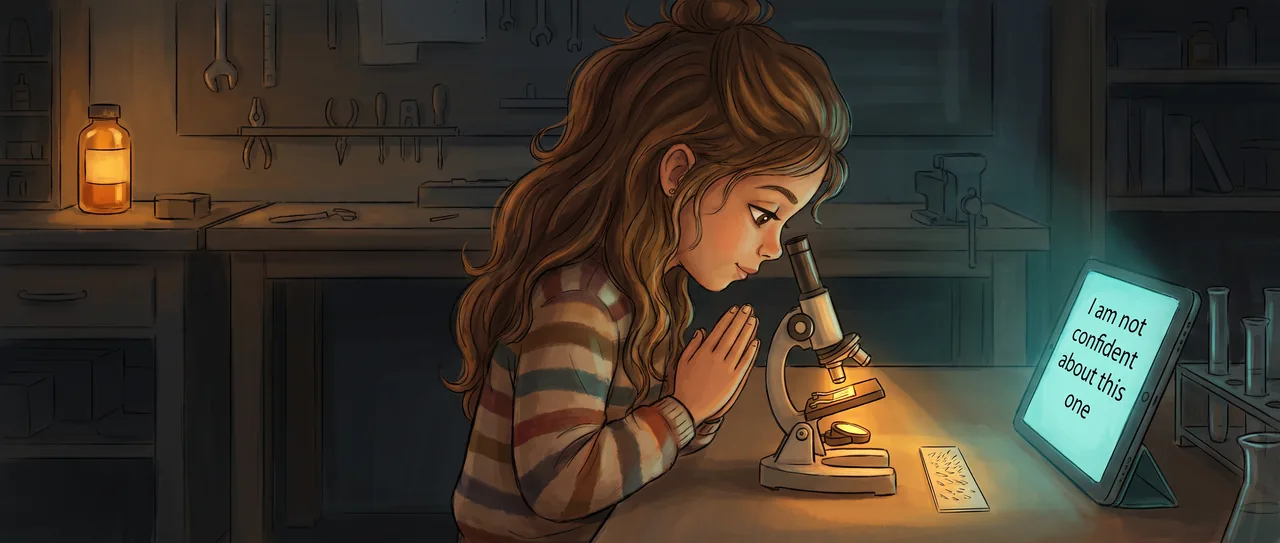
The Thing With the Wrong Shape
The makerspace smelled like solder and cold coffee. Everyone had gone home except Maya and the tablet propped against a beaker rack, which was named Beck because that was the name it had picked when she asked it to pick one.
She was building a game. You fed Beck two things, it guessed what they made, and you scored a point if you guessed the same before it did. So far Maya had zero points, because Beck was very fast and almost always right.
She typed in an acid and a base. Beck answered before she finished. A salt and water. She typed in a metal and an acid. Bubbles of hydrogen, Beck said, and a dissolved salt. She fed it something with a long carbon chain and a splash of oxygen, and Beck laid out the products like it was reading them off a receipt.
Maya frowned. Not because it was wrong. Because it was never wrong, and that was its own kind of strange.
She went digging in the donated box, the one nobody had sorted, and found a little amber bottle with a handwritten label. Something with a plus sign and a minus sign printed next to the name, like the molecule had two versions of itself. She copied the whole thing into Beck, the way it was written, plus sign and all, and added an enzyme powder from the fridge that the label said came from a brewery.
Beck did not answer before she finished.
Beck did not answer at the count of three, either.
Then it said: I am not confident about this one.
Maya put the bottle down.
She had never seen it say that. She typed, why not.
Beck answered slowly, which she knew was silly, machines do not get slow, but the words came in pieces like it was choosing them. This reaction depends on the shape of the molecule in space, not just which atoms are joined to which. There are two versions here that are mirror images of each other. Left-handed and right-handed. Same atoms. Same bonds. Different shape.
Maya read that twice. Mirror images. Like her two hands. Same fingers, same knuckles, but you could not slide one glove onto the other hand and have it fit.
She typed, so what happens.
The enzyme, Beck said, will react with one of them and mostly ignore the other. Enzymes have a shape too, a pocket, and only one of the mirror-image molecules fits the pocket. But I cannot tell you reliably which product you will get, or how much, because I have not learned enough examples where the answer turns on handedness. My training saw millions of reactions written as flat drawings. Handedness is hard to write flat. So I learned the flat world well and the shaped world poorly. She had spent an hour trying to beat a thing that knew everything, and it had just told her there was a whole part of the world it could barely see. Not because it was broken. Because the people who taught it had mostly shown it drawings, and a drawing of a hand does not tell you which hand.
She looked at her own two hands flat on the table. She pressed them palm to palm. They matched perfectly, thumb to thumb, exactly like mirror images should. Then she tried to lay her right hand on top of her left, both palms down, and the thumbs pointed opposite ways and nothing lined up at all.
Same hand. Different hand. Both true.
She typed, can you learn it.
Yes, Beck said. People are teaching versions of me on three-dimensional structures now. But right now, honestly, this is near the edge of what I know.
Honestly. Maya liked that it said honestly. Every adult who had ever been sure about something flashed through her head, all the teachers who filled every silence, and here was a machine that could have made up a clean answer and instead told her where its map ran out.
She wanted to know what was past the edge.
The enzyme powder was right there. So was the amber bottle with its plus and its minus. Maya was not allowed to run anything without a grown-up in the room, and there was no grown-up in the room, so she did not mix them. But she could look. She tipped a few grains of the powder onto a slide and slid it under the makerspace microscope, the cheap one, and turned the little light on.
The grains were not smooth. Under the light they were tiny slanted crystals, all leaning the same way, like a field of grass combed by one wind. Not one of them leaned the other direction.
Maya breathed out.
The shape was already there. It had been there the whole time, in a fridge, in a powder from a brewery, in a bottle nobody had sorted. The handedness was not some rare thing hiding in a lab. It was sitting in the donated box. It was in her hands. It was probably in her, in the sugar in her blood and the proteins holding her together, all of it leaning one way and not the other, for reasons the smartest machine she had ever met could only shrug at.
She typed one more thing. Is most of me left-handed or right-handed, on the inside.
Beck said, most of the building blocks of life on Earth are one handedness and not the other. We are fairly sure of the pattern. We are not sure why it started that way.
Maya read we are not sure why three times.
She turned the microscope light off, then on again, and watched all the little crystals lean the same direction, the same way, refusing to be mirror images of each other.
Read the interactive version, listen to the narration, and earn a gold star →
A science-verified short story for curious kids · Curiosity Land