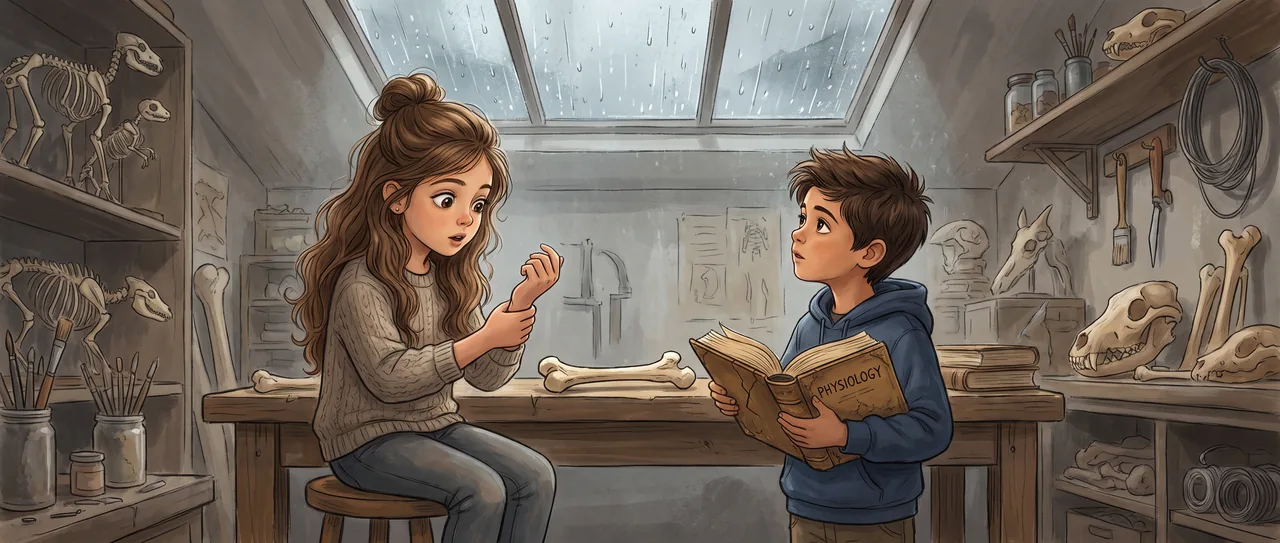
The Skeleton You Keep Losing
The rain had turned the whole museum into a holding pen, and the class had been herded off to the gift shop. Maya and Soren got left behind in the workroom because Maya had asked the conservator a question and then asked four more.
The conservator, a tired woman named Ada with plaster on her sleeves, was gluing a cracked femur back onto a mount. Not a real one. A cast.
"Why fake?" Maya asked.
"Real ones are too valuable to hang where kids can knock them," Ada said. "Also real ones are heavier than you'd think. And lighter than you'd think. Both." She waved a hand and went back to the glue.
"That's not an answer," Maya said.
"It's the only one I've got. I fix mounts, I don't teach anatomy."
Soren was reading the little card by the femur. He read it twice. Then he read the number out loud.
"It says one cubic inch of bone can hold nineteen thousand pounds."
"Bones break all the time," Maya said. "People break arms."
"They break because of leverage," Soren said. "You twist a long thing, the ends win. But a straight-down push. A little cube of it." He held up his thumb and finger, an inch apart. "That much would hold a truck."
Maya looked at her own arm. She pressed a thumb into her forearm, into the hard rail under the skin.
"Stronger than concrete," Soren said, still reading. "By weight. Reinforced concrete."
"We're made of the thing they build bridges out of," Maya said. "Better than the thing they build bridges out of." She stood up straighter without meaning to.
Ada snorted. "Concrete doesn't heal, though. Crack a bridge, it stays cracked till somebody pours more."
Maya went quiet. Then, "Bones heal."
"Bones heal," Ada agreed.
"How does concrete know where it broke?" Maya said. "It doesn't. So how does bone."
Soren put down the card. This was the part he liked, the part where the fact stopped being a number and started being a problem.
"It has to have workers," he said slowly. "Something living in there that finds the crack."
"Little repair guys," Maya said.
"But then," Soren said, and stopped, because he'd caught the edge of something and didn't want to lose it. "If the repair guys can build bone. They can build it anytime. Not just when it breaks."
"So they'd only build when there's a crack," Maya said. "Otherwise your arm would keep getting fatter forever."
"Unless." Soren looked at the cast femur, so white and finished and done. "Unless somebody's also taking it away. At the same time."
The workroom got smaller. The rain kept hammering the skylight.
"Ada," Maya said. "Is bone alive?"
Ada actually stopped gluing. "The casts aren't."
"Not the casts. Mine."
"Full of blood," Ada said. "Full of nerves. That's why the marrow's a big deal, that's where your blood gets made. It's about the most alive thing you've got. I just glue the dead copies."
Maya turned to Soren. "If it's alive, and there's builders, and there's takers."
"Then it's never the same bone," Soren said. "Not really. It's like a river. Same shape, different water."
"Say that again," Maya said, because she wanted to hear if it held.
"The femur stays a femur," Soren said, working it out with his hands, one hand the shape and one hand a stream running through it. "But the actual stuff. The mineral. Somebody dissolves a little, somebody lays down a little, all day, your whole life. So the femur you have now isn't the femur you had."
"When," Maya said.
"When what."
"When does it finish. When is none of the old one left."
Soren didn't know. He looked at Ada. Ada shrugged, but slower now, like the question had gotten into her too.
"There's a number for everything in this place," she said. "There's a book on the shelf. Physiology something. Second from the end."
Soren got it down. It was heavy and the spine cracked when it opened, which felt wrong in a room full of things being repaired. He found bone. He ran his finger down the page and stopped.
"Ten years," he said.
"Ten years what," said Maya.
"To replace all of it. The whole skeleton. Every ten years or so, dissolved and rebuilt. All of it." He looked up. "There's a word. Remodeling."
Maya sat down on the workroom stool very carefully, the way you sit when the floor has done something.
"I'm eleven," she said.
"Yeah."
"So I've done it once. The whole thing, once, since I was a baby. And most of it twice." She held her own wrist. "The bones that held me up when I was learning to walk. Gone. Taken apart. Some builder took them apart while I was asleep and I didn't feel it."
"You didn't need them anymore," Soren said. "They made you new ones. Bigger. That's how you got taller. Not the same bones stretching. New ones, over and over."
"I've been leaving myself behind the whole time," Maya said. "Like a snake but slower. And on the inside."
Ada had stopped pretending to glue.
"Here's the part I can't hold," Maya said, and Soren leaned in, because this was Maya finding the crack. "The strongest thing in me. The nineteen-thousand-pounds thing. The bridge thing. It's also the thing that never sits still. It's not strong because it's finished. It's strong because it's never finished."
Soren opened his notebook. His pen moved down the page: same shape, different water, ten years, never finished.
"The concrete just cracks and waits," Maya said quietly. "We take ourselves apart on purpose. And put ourselves back. Every day. Right now."
"Right now," Soren said.
They both went still and listened .
Ada picked up her glue again. She looked at the cast femur in her hands, the finished white one that would never change, and set it down without gluing it, and looked instead at her own two hands holding it.
Read the interactive version, listen to the narration, and earn a gold star →
A science-verified short story for curious kids · Curiosity Land