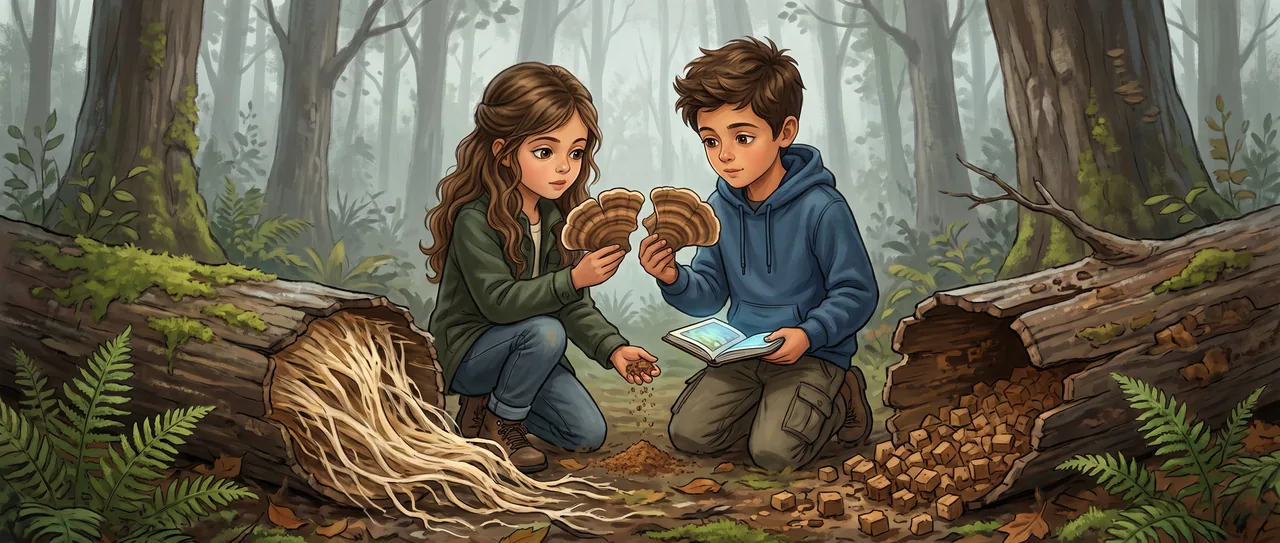
The Log That Chose Its Tools
The app wanted them to photograph every bracket fungus in the plot and tag the wood underneath. Simple. Except the app kept arguing with them.
"It says this one is oak," Soren said, crouched over a shelf of pale fungus. "But it wants me to confirm. Why does it care what the log is?"
"Because the fungus cares," Maya said. She was three logs away, on her knees in the leaf mush. "Come look at this. This is a maple. And this one over here is a pine. Same kind of fungus on both."
"How do you know it's the same kind?"
"Same fan. Same brown stripes. Same everything." She sat back on her heels. "But the wood underneath isn't rotting the same way."
Soren came over and looked. On the maple, the wood had gone stringy and pale, like wet paper pulled into threads. On the pine, it had cracked into little brown cubes that crumbled when he pressed them.
"Two different rots," he said. "So it's two different fungi. Has to be."
"It doesn't look like two fungi."
"Rot is chemistry. Different chemistry, different worker." He got out his notebook and drew the two patterns, the threads and the cubes, side by side. "That's the safe guess."
Maya peeled a strip of the pine fungus and held it next to a strip of the maple fungus. She turned them in the gray light. She smelled them, which made Soren wince.
"Same worker," she said.
"You can't smell that."
"I can smell that they're the same. I just can't tell you why yet." She handed him both strips. "You check."
So he checked, the way he checked things, slowly. Same rubbery feel. Same white edge going brown. Same tiny pores on the underside, and when he counted them against a fingernail, same spacing. He wanted to find one difference and could not.
"Okay," he said. "Let's say you're right. Same fungus. Then why is it making paper threads on the maple and crumbly cubes on the pine?"
"Because the wood is different."
"The fungus doesn't know the wood is different. It doesn't have a brain. It doesn't have anything. It's just threads."
Maya went quiet. She picked up a cube of the rotted pine and rolled it between her fingers until it powdered.
"Wood isn't one thing," she said finally. "Right? My aunt does furniture. She's always saying oak fights you and pine gives up."
"Different hardness."
"Different what, though. Made of different stuff."
Soren thought about it. "There's the stringy stuff and the glue. Cellulose is the strings. And there's a brown glue that holds it stiff." He tapped his own drawing. "Lignin. Trees put in different amounts. Pine's got a lot of the glue. That's why it's sappy and stiff."
"So if the fungus wants the sugar in the strings, it has to get past the glue first."
"On the pine, yeah. Lots of glue to deal with."
"And on the maple, less glue, more strings." Maya looked from one log to the other. "So it would need different tools for each one."
"Fungi don't have tools."
"Enzymes," she said. "That's the tools. My aunt has a whole drawer, one blade for soft wood, one for the hard stuff, because you'd wreck the wrong blade on the wrong wood." She was talking faster now. "What if the fungus has a drawer."
Soren stopped drawing.
"Say that again."
"A drawer of enzymes. And on the pine it reaches for the glue-cutting ones because that's the problem in front of it. And on the maple it reaches for the string-cutting ones because that's the problem there. Different problem, different mix. That's why the rot looks different. Same fungus. Different reach."
"It can't reach," Soren said, but softer, testing his own words against hers. "It can't decide. Deciding needs a brain."
"Then how does the log full of glue get glue-cutters and the log full of strings get string-cutters?" Maya asked. "If it made the same mix every time, one of these logs would barely rot. But they're both rotting. Just differently. It's matching."
Soren looked at the two logs for a long time. The stringy one. The cubed one. Same fan-shaped fungus riding both.
"It would have to taste the wood," he said slowly. "Not with a mouth. With chemistry. The wood touches the threads, and whatever's in the wood switches on the right tools and switches off the wrong ones. So the tools that get made are the ones the wood asked for. Without anybody choosing."
"The wood picks the blade," Maya said.
"The wood picks the blade," Soren repeated. He wrote it down exactly like that. Then he sat very still with the pencil not moving.
"There's no thinker," he said. "That's the part. There's no thinker anywhere in it. The whole thing is solving a chemistry problem and there's nobody home solving it."
Maya nodded. She was looking at the pine cubes in her palm.
"It figured out the pine," she said. "It figured out something my aunt needs a whole drawer and forty years to know. And it's just threads."
"It's not figuring," Soren said. "That's what's making my neck feel weird. It's getting the right answer without figuring. Every log in this whole forest. The right mix, every time, no brain."
They both looked out at the plot then, at the dozens of fallen logs going soft under the ferns, each one a different tree, each one with its pale fans working at it.
"How many are getting it right, right now," Maya said. It wasn't really a question.
Soren didn't answer. He turned back to the app, which was still waiting for him to confirm the wood species, still assuming a person was the one who needed to identify the tree.
He typed in the answer. Then he held his phone over the maple log, over the stringy pale rot, and he understood that the fungus underneath had already answered the same question, correctly, days before he ever arrived, and had never once needed to be sure.
Maya crumbled the last pine cube into powder and let the wind take it off her hand toward the other logs.
Read the interactive version, listen to the narration, and earn a gold star →
A science-verified short story for curious kids · Curiosity Land