The Instructions That Weren't There
The last grown-up left the makerspace with a wave and the words, lock the cabinet when you're done. So it was just the two of them, a bottle of dish soap, a bin of bent wire, and the buzzing overhead lights.
"Ours collapsed," Soren said. He held up the wire cube. The film that had stretched across it had popped an hour ago and never come back the same.
"Because you touched it."
"I barely touched it."
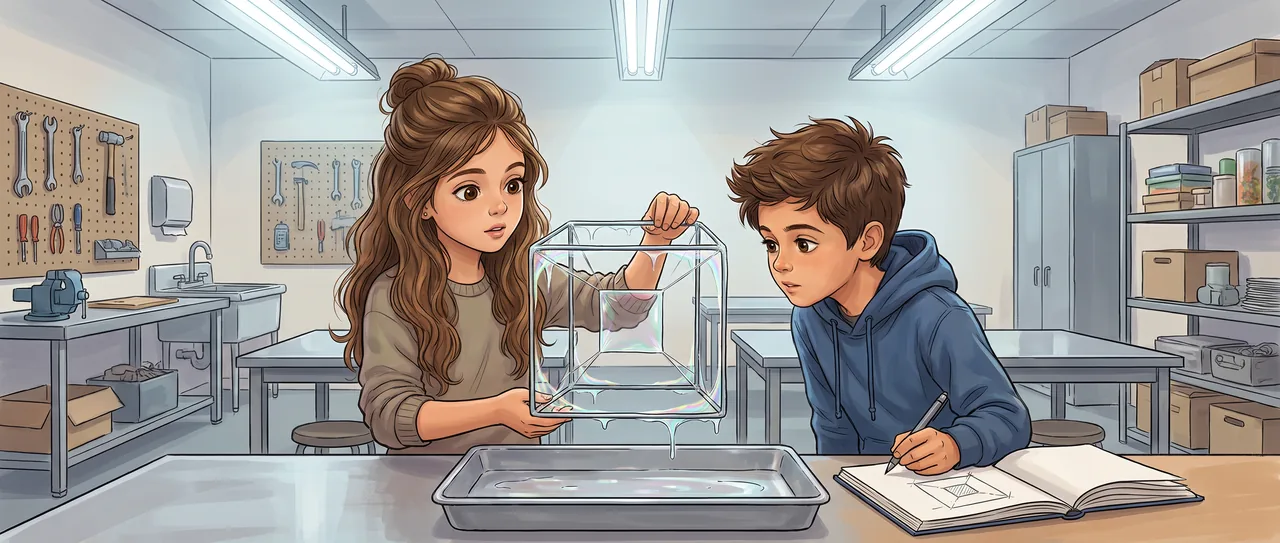
"You breathed on it." Maya dunked a fresh wire frame into the soap tray and pulled it out slow. A film bloomed across all the edges, and in the middle, without anybody asking, a small flat square appeared. Perfectly flat. Perfectly centered.
Soren leaned in. "Nobody drew that square."
"I know."
"We didn't program it. It just went there."
"Do it again," Maya said, and he did, with the same cube, and the same flat square showed up in the same place, like the soap had read a set of instructions that weren't written anywhere.
Soren set the frame down carefully and got out his notebook. He drew the cube, then the square inside it, and stared at the drawing like it owed him money.
"The soap wants to be small," he said finally. "The film. It's pulling itself as tight as it can. That square is the smallest surface that can stretch across those edges."
"So it's lazy."
"It's not lazy. It's fast. It finds the smallest shape faster than we could calculate it." He tapped the page. "No brain. No plan. It just falls into the right answer."
Maya was already looking at the soap bottle. She turned it around and read the back the way she read everything, too close and too long.
"Soap molecules," she said. "One end likes water. One end hates it."
"Says that on the bottle?"
"Says surfactant. I looked it up last week for something else." She uncapped it and squeezed a drop onto the steel table. "So if one end hates water, and one end loves it, and you drop a whole bunch of them in water, what do they do?"
Soren thought. "The water-hating ends hide. They point at each other. The water-loving ends face out."
"So they line up."
"They'd have to. To be comfortable. All of them at once."
Maya went very quiet, and then she pushed the wire cube out of the way. "That's a wall," she said. "If they line up back to back, tails inside, heads out on both sides, that's a wall two molecules thick. With water on both sides."
"Sure."
"Soren. That's a cell."
He looked up.
"That's what a cell is," Maya said, faster now. "The skin around a cell. It's a wall two molecules thick. My aunt does biology, she showed me the picture. Two rows of little tadpole things, tails pointing in. I thought somebody built it. Some machine in the body lining them up."
"And nobody does."
"Nobody does. They fall into it. Like the square." She put both hands flat on the cold table. "You dump the right molecules in water and the wall builds itself. No instructions. The instructions are just, hate water on this end, love it on the other. That's the whole recipe. The shape comes for free."
Soren was writing fast, the pen scratching. He stopped. "Wait. Every cell in you."
"Every cell in everything."
"The wall around every cell in my whole body assembled itself. Out of the shape of the pieces. Not because anything told it to."
"Because of what the pieces are."
They sat with that. The lights buzzed. Somewhere a fridge kicked on.
"My aunt said there's more," Maya said slowly, chasing something. "She said some proteins do it too. Little shells. Perfect ones, like tiny dice, hundreds of sides, and they snap together on their own into the exact same shape every time. Viruses do it. Some viruses are just a shell that builds itself around instructions to build more shell."
"That should be impossible," Soren said. "A perfect shape with no builder."
"But the soap did it." She pointed at the little flat square, still hanging in the wire, still perfect. "Right in front of us. Twice."
Soren looked at the square, then at the drop of soap on the table, then at the back of his own hand, at the skin there, and Maya watched him do it.
"How does it know when to stop?" he asked. "A shell. It adds pieces and adds pieces and then just, stops. At the right size. How?"
Maya opened her mouth. Closed it.
"I don't know," she said.
"Does your aunt know?"
"I don't think anybody all-the-way knows. She said people are still figuring out how to fold them on purpose. Like folding a shape you want out of a strand of DNA. She called it origami." Maya's eyes were very wide. "You write one long strand right, and it folds itself into a box, or a smiley face, or a little gear. You don't fold it. It folds itself. You just have to pick the pieces so the only comfortable shape is the one you wanted."
"So you don't build the thing," Soren said. "You build the reason it has to be the thing."
Maya turned and looked at him like he'd found the square.
"Say that again."
"You don't build the thing. You build the reason it has to become the thing. And then you let go."
Maya took the wire cube in both hands. "There's a wall inside me right now," she said, "a billion of them, and every single one put itself together because of the shape of what it's made of, and the same trick makes shells and boxes and gears, and somewhere a person is picking pieces so a strand folds into exactly what they drew." She looked at the little flat square of soap. "What could you make. If you knew all the reasons."
She dipped the frame again. The film spread, shivered, and pulled itself tight, and the flat square appeared in the center, on its own, one more time, exactly where it had to be.
Read the interactive version, listen to the narration, and earn a gold star →
A science-verified short story for curious kids · Curiosity Land