The Fringe on the Wall
The gallery had been closed for an hour, but the machine was still on.
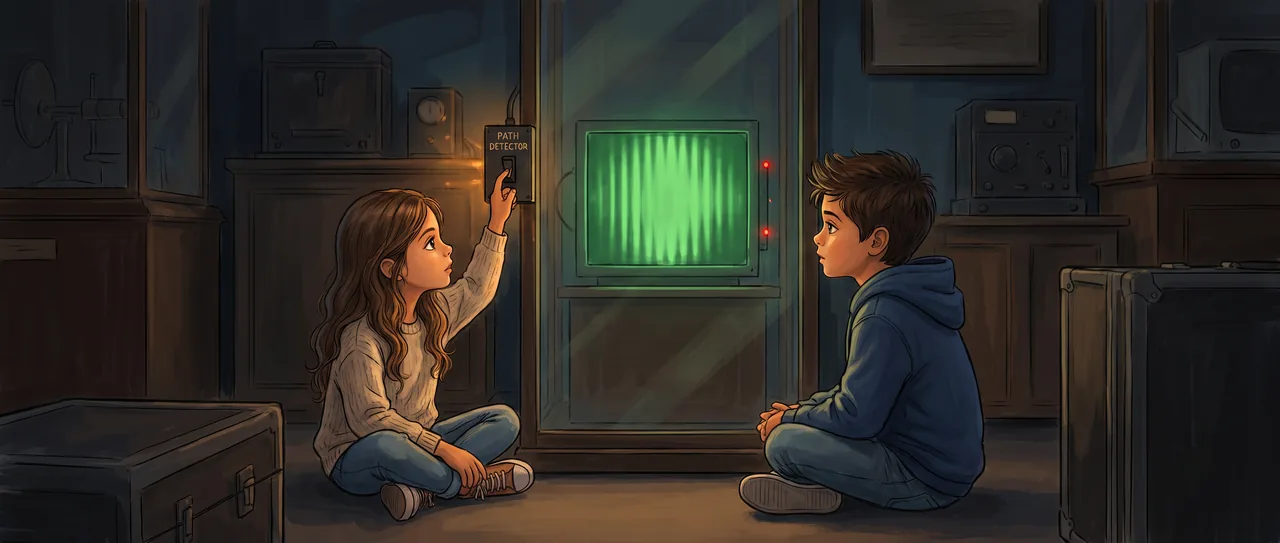
Maya found it first, the way she found most things, by walking toward the part of the room nobody else was looking at. A tall glass case with a green screen inside. On the screen, dots. One appearing every second or so, quiet as rain starting.
"Soren. Come look at this before they kick us out."
He came. He always came. He read the little brass plate bolted under the glass, because he read plates.
"Electron gun," he said. "It fires one electron at a time. Through those two slits. The dots are where each one lands."
"One at a time," Maya repeated. "So each dot is alone."
"Each dot is alone."
They watched. A dot near the middle. A dot to the left. A dot high up. A dot to the left again. Nothing you could argue with. Just specks, scattered.
"It's random," Maya said. She did not sound like she believed it. She sounded like she was daring it.
"Wait," Soren said.
So they waited. This was a thing they could do that other people apparently could not. A night technician wheeled a mop bucket past the far doorway, whistling, and did not stop.
The dots piled up. And the pile was not a pile.
"Soren."
"I see it."
Stripes. Bright bands of dots, then empty bands with almost nothing, then bright again. A fence of light building itself out of specks that had each arrived alone, seconds apart, with no way of knowing where the last one landed.
"How do they line up?" Maya said. "Each one comes when the one before it is already gone. There's nothing here to line them up with."
Soren crouched to the screen's level. He counted bands under his breath, one, two, three, four, five. Even spacing. The kind of spacing you get when two things overlap.
"Waves do this," he said slowly. "Water through two gaps. The ripples cross. Where two crests meet you get big waves, where a crest meets a dip you get flat water. Bright band, empty band, bright band."
"But that's waves crossing each other. Two ripples." Maya put her finger on the glass over a single fresh dot. "There's only one electron in there at a time. What's it crossing with?"
Soren didn't answer, because the honest answer was climbing up out of him and it was ridiculous.
"Say it," Maya said.
"It's crossing with itself," he said. "To make that pattern, each electron has to go through both slits. Both. At once. And overlap with itself on the other side."
Maya laughed, once, not because it was funny. "That's not allowed."
"I know."
"A thing goes through one hole or the other hole."
"I know."
"So which one does it go through?"
And there, bolted to the side of the case, was a little black switch under a second brass plate. PATH DETECTOR, it said. And under that, smaller: ON / OFF. It was set to OFF.
Maya looked at the switch. Soren looked at Maya.
"It's a detector," he said. "For watching which slit. If we turn it on, it tells us. Left or right. For every single electron."
"Then turn it on," she said. "I want to know which one it takes."
He reached up and clicked the switch.
A small light came alive beside each slit, blinking. Left. Right. Left. Left. Right. Now the machine was telling them, honestly, one electron at a time, exactly which gap it went through. No more mystery. One hole or the other hole, like the world was supposed to work.
"Good," Maya said. "Now watch the wall. Now we'll see the stripes get built by things we're actually tracking."
They watched the screen.
The new dots came. Middle. Left. Middle. High. A little lower. Spread out. Soft. A blur widening in the center and fading at the edges.
No bands.
Soren counted anyway, because he counted. One. He waited for two. There was no two. Just a smear, thickest in the middle, exactly what you would get from two ordinary holes with two ordinary streams of little pellets going through.
"Where'd the stripes go," Maya said. It was not really a question. Her voice had gone very careful.
"They stopped," Soren said.
"Turn it off."
He clicked the switch back to OFF. The blinking lights died. The machine went back to keeping its secret.
They held their breath and watched the new dots arrive, alone, seconds apart, knowing nothing about each other.
One. Two. Three. The bands came back. The fence of light rebuilt itself out of nothing, band, gap, band, gap, patient and exact.
Maya sat down on the floor in front of the glass. Soren sat down next to her. The mop bucket rattled somewhere and went quiet.
"Let me say it right," Maya said. "When nobody's checking, it goes through both. And makes stripes."
"Yes."
"When the machine checks, it goes through one. And the stripes stop."
"Yes."
"So the checking changes it. Not touching it. Just knowing which hole."
Soren opened his mouth to soften it and found he couldn't. "Just knowing," he said.
Maya pulled her knees up. "So the stripes were only there because nobody could say which way it went."
"The stripes are what not-knowing looks like."
She turned that over. He watched her turn it over. He had spent his whole life being the kid who wanted to know which hole, who read the plate, who asked the extra question that made teachers glance at the clock. And here was a thing in the world that only stayed beautiful as long as nobody asked it the question. The instant you pinned it down, it flattened into an ordinary answer.
"It doesn't want to be caught deciding," Maya said softly.
"It isn't deciding," Soren said. "I don't think it decides until something makes it." He stopped. "I don't actually know what it is until then. Nobody does. That's not us being dumb. That's the real part."
Maya reached up without standing and flicked the switch. On. Off. On. Off.
On the green screen, the fence of light dissolved into a smear, and rebuilt, and dissolved, and rebuilt, one quiet electron at a time, keeping its secret only when no one was allowed to know it.
Read the interactive version, listen to the narration, and earn a gold star →
A science-verified short story for curious kids · Curiosity Land