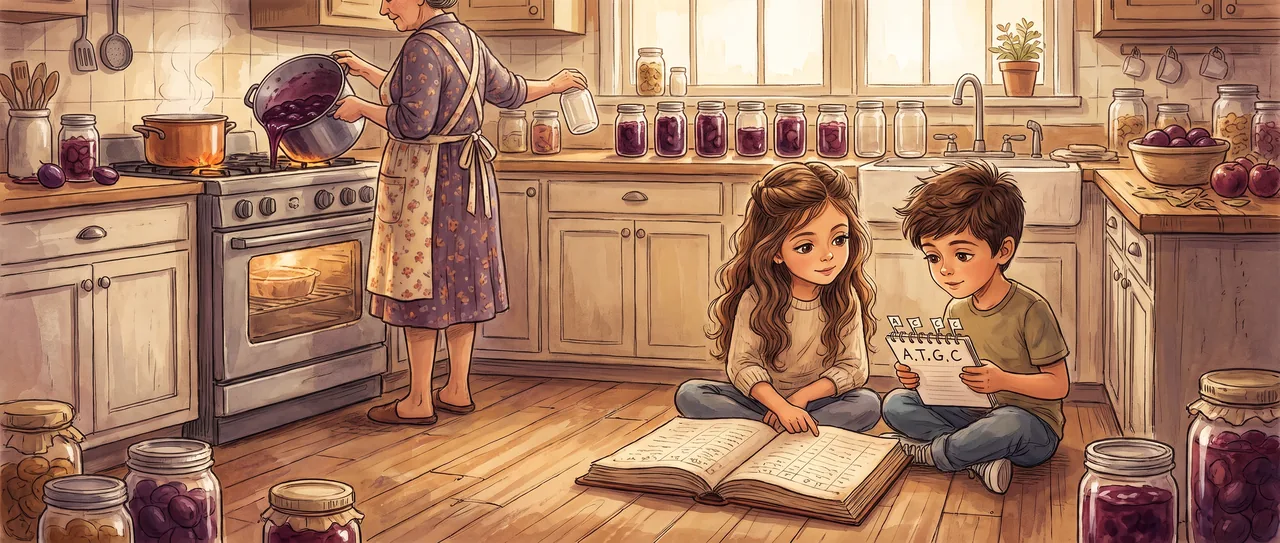
The Winter That Wasn't Hers
Maya found the ledger under the jar lids, in the drawer that always stuck.
"Your grandmother keeps a book of turnips," she said.
Soren leaned over it. The handwriting was small and careful, not his grandmother's. Dates ran down the left side. Beside each one, a word or two. Half loaf. Nothing today. Boiled the seed potatoes.
"That's not turnips," he said. "That's how much they ate."
His grandmother was at the stove, stirring plums into sugar until the kitchen smelled like a warm bruise. She did not turn around. "That was my mother's book," she said. "The winter the trains stopped. She was fifteen. She weighed less than you do now, Maya, at the end of it."
Maya turned a page. Nothing today appeared four times in a row.
"That was a long time ago," the grandmother said, in the voice people use to close a drawer. She went back to the plums.
Maya did not close the drawer. She sat down on the kitchen floor with the ledger in her lap.
"Okay," she said to Soren. "So her body did something. When there wasn't food. It had to."
"It held on," Soren said. "Slowed down. Kept every scrap."
"Right. And then the trains came back and there was food again." Maya tapped the page. "So the winter ended. For her."
"What do you mean, for her?"
Maya looked up. "I read a thing. About mice. They scared the mice with a smell, cherry or almond, something. And the mice that were never scared, the babies, the grandbabies, they still flinched at the smell."
Soren stopped. "That's not how it works. You don't inherit what happened to somebody. You inherit their genes. The letters. The letters don't change because you got scared."
"I know," Maya said. "That's why it's weird."
Soren pulled his notebook from his back pocket and drew a long line of the same letter over and over, A T G C, the alphabet he half remembered. "This is the code," he said. "This part doesn't change. You're right about that."
"But something changed," Maya said. "Because the mice flinched."
Soren stared at his line of letters. Then he drew little flags on top of some of them. Tiny tags standing up off the line.
"What are those," Maya asked.
"I don't know yet. But say the letters are the same. Say the code doesn't change. There could still be something sitting on top of it. Little switches. Telling the cell, use this part, ignore that part. Louder here. Quieter there."
Maya took the notebook. She looked at the flags. "So the code is the same but the reading is different."
"Same book," Soren said slowly. "Somebody went through and underlined different sentences."
The grandmother's spoon had stopped moving. Neither of them noticed.
"Okay but here's the thing," Maya said, and she was talking fast now. "Her mother. The fifteen-year-old. Her body turned some switches during the winter. Hold on to every calorie. Waste nothing. That's a smart thing to do in a famine."
"That's a survival thing," Soren said.
"So then she has a baby. Your grandmother." Maya pointed the spoon-end of the pencil at the woman by the stove. "And your grandmother has a baby. Your dad. And nobody's starving anymore. There's plums. There's sugar. There's a whole drawer of jar lids."
Soren saw where she was going and got there half a step before she said it.
"But if the switches carried over," he said. "If some of the flags got copied into the next book. Then a body could be still bracing for a winter that already ended. Two people ago."
The kitchen was very quiet. The plums ticked in the pot.
"That can't be right," Soren said, but he said it the way you say a thing you're hoping someone will knock down, because you can feel it standing up.
"Grandma," Maya said. "Did your mom, after the winter. Was she funny about food?"
The grandmother wiped her hands on her apron and took a long time doing it.
"She could not throw anything out," she said finally. "Not a crust. Not a peel. She fed us until we ached and then she worried we were thin. She was never hungry again a day in her life and she never once believed it." She looked at the two children on her floor. "And I am the same. I made too many plums just now. Far too many. I always do."
Soren looked down at his row of letters with the little flags standing up off them. He added one more flag, very lightly, at the far end of the line, past where the grandmother would be, past where his father was.
Maya watched his pencil.
"You think it reaches us," she said. Not a question.
"I think most of the flags get wiped clean," Soren said. "When a new person gets made, the body goes through and erases almost all of them. Starts fresh. It has to, or you'd be born already old." He pressed the pencil into the paper. "But scientists keep finding ones that don't get wiped. A few that survive the erasing. And nobody fully knows how, or which ones, or why those."
"So her winter," Maya said.
"Might not be over," Soren said. "Not all the way. Not in the part of me that decides how hard to hold on."
Maya put the ledger down on the floor, open, and looked at it a long moment. Nothing today. Nothing today. In handwriting belonging to a girl who was fifteen a hundred years before either of them was born, whose fear of an empty plate might be sitting quiet and folded inside Soren's own cells, waiting for a train that stopped running before his grandmother was even a thought.
"That's the strangest thing anyone's ever told me," Maya said.
"I didn't tell you," Soren said. "You told me. About the mice."
The grandmother lifted the pot off the heat. "It's too much," she said again, about the plums. "It's always too much." But she poured it out anyway, all of it, into jar after jar after jar, more sweetness than three people could eat in a season, lined up on the counter to save.
Soren counted the jars.
There were eleven, and she was still reaching for another.
Read the interactive version, listen to the narration, and earn a gold star →
A science-verified short story for curious kids · Curiosity Land