The Stars With Nothing In Them
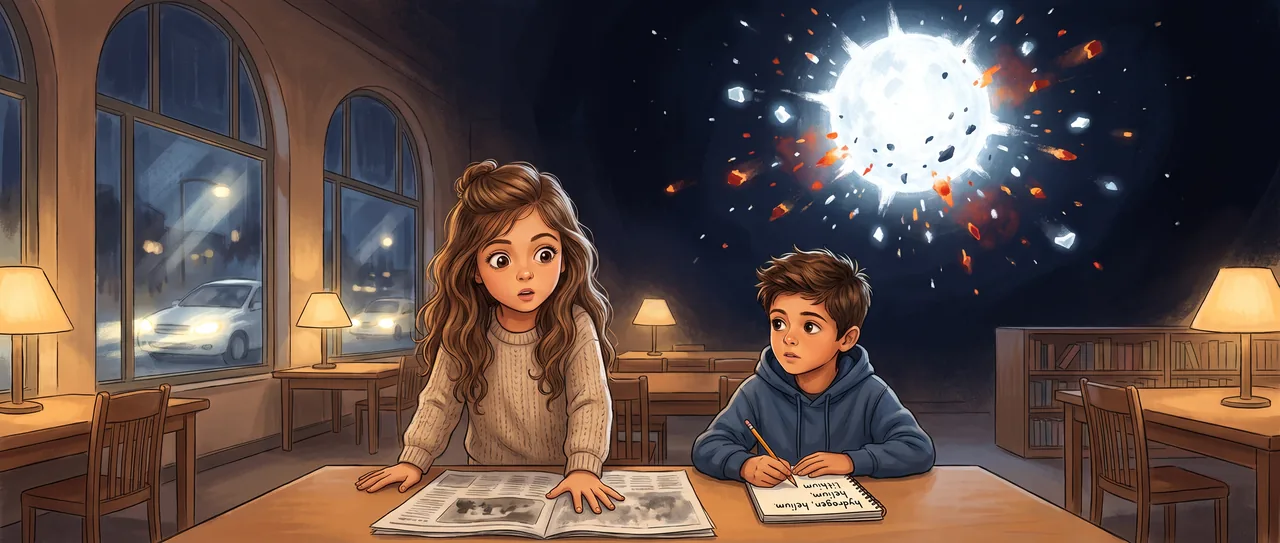
The library was closed but the lights were still on, so the librarian let them wait inside for Soren's dad. Maya had a newspaper open on the reading table. She had been holding the same page for four minutes without turning it.
"Look at this," she said. "The new telescope found stars that don't have anything in them."
Soren pulled the page toward himself. The headline said astronomers had spotted a candidate for the very first kind of star. He read the whole paragraph twice, the way he did.
"That can't be right," he said. "A star has to have something in it. That's what a star is."
"It says hydrogen and helium. And a tiny bit of lithium."
"Okay, so it has those."
"But nothing else," Maya said. "No iron. No oxygen. No carbon. Nothing."
Soren went quiet and looked at the ceiling tiles. Then he sat up.
"Where would the other stuff come from," he said. "If it's the first star. There's no star before it to make anything."
Maya put her finger on the article. "That's what I've been sitting here trying to figure out. Carbon comes from stars, right? Mr. Alvarez said that. We're made of stuff that came out of stars."
"Right."
"So the first stars couldn't be made of that stuff. Because there weren't any stars yet to make it."
Soren opened his notebook and wrote hydrogen, helium, lithium in a small careful line. He looked at how short the line was.
"That's only three things," he said. "The whole universe was only three things."
"Almost only two," Maya said. "The lithium part says trace. Trace means barely any."
They sat with that. Outside, a car went by and was not the right car.
"So no rocks," Soren said slowly. "You can't make a rock out of hydrogen."
"No rocks," Maya said.
"No planets." He was working it out with his pencil, tapping the short line. "Planets are rock and iron and ice. If those don't exist yet, then those stars had nothing going around them. Just the star. Alone."
Maya turned to look at him. "Say that again."
"There were no planets. There couldn't be. The atoms that make planets hadn't been invented yet."
"Been made yet," Maya said, but she was smiling, because she liked invented better and he knew it.
She stood up and walked a little, which she did when a thought was too big to sit under. "So the first stars are burning in the dark and there's nothing to look back at them. No worlds. No anybody. Just huge lonely fires."
"How huge," Soren asked.
Maya came back and scanned the column. "Hundreds of times heavier than the Sun. Some of them."
Soren wrote a number and then crossed it out because he wasn't sure. "That's a problem," he said. "The heavier a star is, the faster it burns. Mr. Alvarez said that too. Big ones don't last."
"The Sun lasts billions of years."
"The Sun is small," Soren said. He almost laughed at himself saying it. "The Sun is one of the small ones. These giant first stars, if they're hundreds of times bigger, they'd burn through everything really fast."
"How fast."
He found it lower in the article and read it out loud, carefully, like it might be a typo. "A few million years."
"A few million," Maya repeated.
"That sounds like a lot."
"It's nothing," she said. "Soren, it's nothing. The universe is fourteen billion. A million years is like a star being born and dying before you finish blinking."
He stared at the line in his notebook. Three elements. No planets. A million years.
"So they lived and died before anything could watch," he said. "And then what. They just went out?"
Maya stopped moving. She read the next sentence twice, the same way he did things twice, and then she put her hand flat on the newspaper.
"No," she said. "They exploded."
"Exploded into what?"
"Into everything else." Her voice went fast. "That's it. That's the whole thing. Listen. The star only has hydrogen and helium. But inside it, while it's burning, it's squishing those together into new stuff. Heavier stuff. And when it explodes, it throws all the new stuff out."
Soren's pencil stopped. "The carbon."
"The carbon. The oxygen. The iron. All of it. It gets made inside the first stars and then the explosion scatters it."
"And that's what the next stars are made from."
"And the planets," Maya said. "The planets that couldn't exist yet. Now they can, because now there's rock."
Soren looked down at his own hand holding the pencil. "And us."
"And us." Maya sat back down hard. "The iron in your blood. Mr. Alvarez said we're made of star stuff and I thought that was just a nice thing teachers say. But it's not nice. It's true and it's specific. A star with nothing in it had to burn all the way up and blow itself apart so that there could be a single atom of anything you're made of." He wrote first.
"They never got to see any of it," he said. "The planets. The people. They made the whole toolbox and then they were gone before anybody used a single tool."
"They didn't have anybody to be seen by," Maya said. "They were the only things in the whole universe. And now every single thing that isn't hydrogen or helium is a piece of one of them."
Soren looked at the newspaper photo. It was not really a photo of a first star. It was a smudge of light so old it had been traveling since before the Earth existed, before there was iron to make an Earth out of.
"That light left before there was anything to shine on," he said.
Headlights swung across the library windows and slid over the reading table and lit up the short line in the notebook. This time it was the right car. Neither of them moved to get up.
Read the interactive version, listen to the narration, and earn a gold star →
A science-verified short story for curious kids · Curiosity Land