The Slow Return
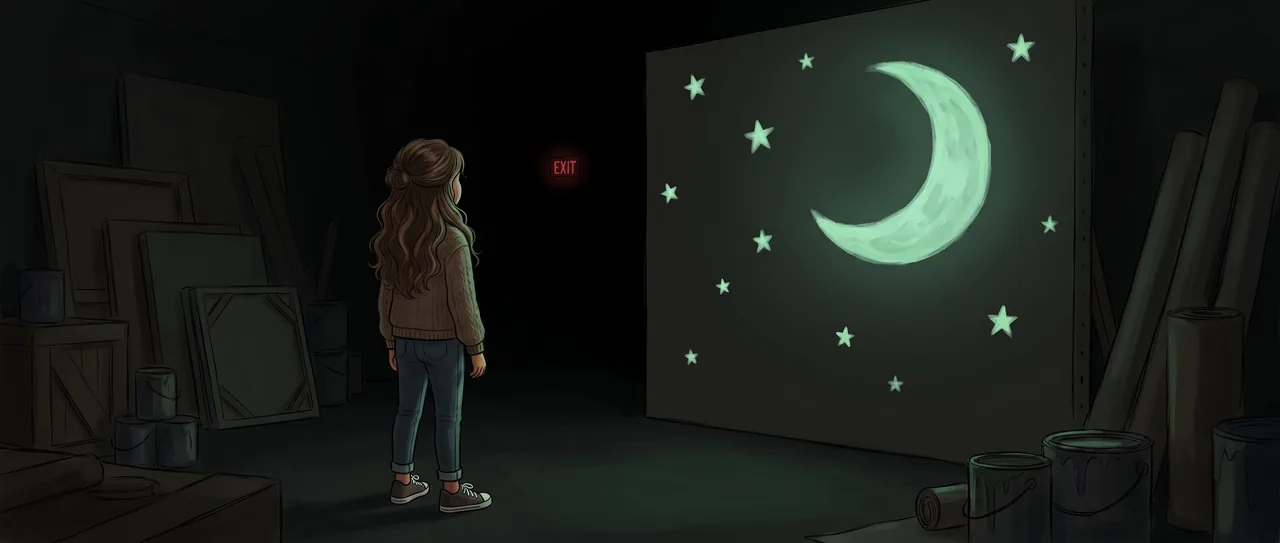
The theater smelled like sawdust and old coffee, and the work lights had been off for exactly one minute when Maya saw the moon breathing.
Not the real moon. The painted one. It hung on a canvas flat propped against the back wall, part of the forest scene from the play that had ended two hours ago. Everyone else had gone home. Maya had stayed to help her aunt, who ran the drama club and who was somewhere down the hall arguing on the phone about the cost of hauling scenery away.
Maya had switched off the big lights to save electricity. And there, in the dark, the painted moon was still shining.
Not brightly. A soft, cold, greenish light, the color of a firefly held under a cupped hand. It was fading, though. Slowly. Like something letting go of a breath it had held too long.
She walked closer. The floor creaked under her sneakers. The rest of the flat was black, invisible, but the moon floated there on its own, a pale round glow that lit nothing but itself.
Maya put her hand near it. No heat. That was the first thing that didn't fit. Things that made their own light were usually hot. A bulb. A flame. A stove ring. But the paint was cool as the wall around it.
She touched it. Just paint, slightly gritty, dry. And glowing.
Her aunt had painted this with the special powder, the expensive stuff, mixed into the moon and the stars so they'd shimmer during the darkened forest scene. Maya remembered the moment in the play. The stage lights had dropped, and for a few seconds the whole painted sky had glowed before slowly going dark, and the audience had gone quiet in that way audiences do when they forget they're watching a thing that was built.
But that was two hours ago. The stage lights had been off since then. So where was this light coming from now? The moon was dimmer than it had been a minute ago. She was sure of it. She cupped her hands around her eyes to block the tiny red glow of an exit sign and looked hard. Yes. Dimmer. It was running out of something.
Running out. That was the word that turned the key.
A thing runs out only if it had a supply. The paint wasn't making light. It was giving light back. It had taken the light in earlier, when the work lights and the stage lights had blazed on it for hours, and now, in the dark, it was returning that light, slowly, the way a warm brick returns heat to a cold room long after the fire has died.
Maya's skin went tight all over.
She wanted to test it. She always wanted to test it. She found the switch and flooded the room with the harsh work lights and counted to sixty, watching the flat, though of course she couldn't see the glow now, drowned as it was. Then she killed the lights again.
The moon blazed. Brighter than before. As bright as when she'd first walked in. It had drunk the light in one minute and was giving it back.
She laughed out loud in the empty room.
Then she did the other test, the one she needed to be sure about. She found a scrap of the same painted canvas, a cut-off star, on the props table. She carried it into the costume closet, a windowless space, and shut the door, and stood in the total dark holding it.
It glowed in her hand. A small green star, floating against nothing, lighting the faint lines of her own fingers.
She stayed in there longer than made sense. She wanted to watch it fade all the way. She wanted to know how long the paint could hold on. Minutes passed, and the star grew fainter, and fainter, patient the whole time, never flickering, never sputtering like a flame. Just a steady, slow letting-go.
And she thought about what the star was actually doing. Somewhere too small to see, in the paint itself, something had caught the light and trapped it. Not reflected it back right away, the way a mirror does, throwing it off the instant it arrives. Something in there had swallowed the light and kept it. Held onto pieces of the afternoon. Held onto the stage lights from a play that was already over, an audience that had already gone home, applause that had already stopped.
The star in her hand was still shining with light that no longer existed anywhere else.
The door opened. Work light spilled in, and the star vanished into her palm, just paint again.
"There you are," her aunt said. "I've been calling. What are you doing standing in the closet?"
"How long," Maya said. "How long can it hold the light? The paint."
Her aunt blinked, still half inside the phone call. "The glow stuff? I don't know. A while. Long enough for the scene." She shrugged. "It's just glow paint, Maya. Come on, we have to lock up."
Just glow paint. Maya looked down at the star in her hand and felt the enormous distance between what her aunt had said and what was true.
She followed her aunt out through the dark theater, past the big painted flat, past the moon, which had gone dim again but was not out, not all the way, and would not be for a long time yet.
At the door her aunt reached for the master switch and shut everything down, the whole building dropping into black at once.
Maya turned around before the switch had finished clicking.
Across the room, in the dark, the moon and every painted star came up at once, cool and green and patient, giving back the light of a day that was already gone, and kept on giving it, and did not stop.
Read the interactive version, listen to the narration, and earn a gold star →
A science-verified short story for curious kids · Curiosity Land