The Second Culprit
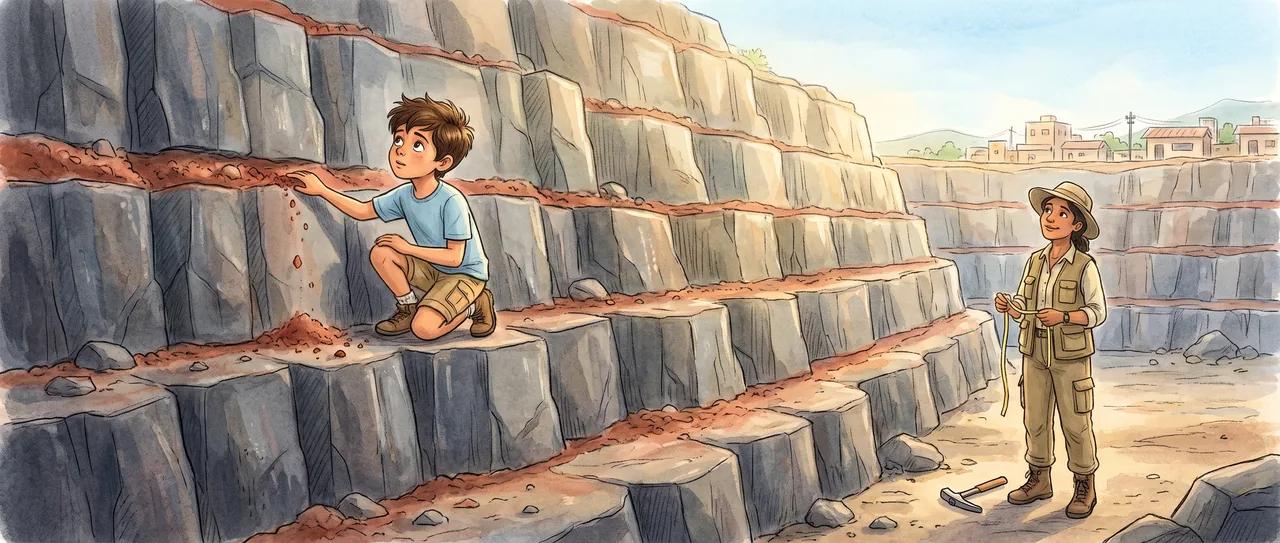
The quarry wall was gray-black and taller than Soren's house, and it was made of stairs.
Not stairs anyone had built. The rock rose in flat shelves, one on top of another, all the way up, like a giant had stacked slabs of the same dark bread. Soren counted eleven before the top got too bright to look at.
His aunt Priya was forty meters along the base, tapping the wall with a hammer and writing numbers on tape. She had told him that morning to entertain himself and not to fall into anything. This was the whole of her instruction.
Soren went to the wall and put his hand on the lowest shelf. It was cold. He knocked it with a knuckle. Solid. He climbed onto it and knocked the next one up, and something bothered him before he knew what.
The two shelves did not match.
The lower one was smooth and heavy. The one above had a crumbly reddish band running along its bottom edge, soft enough to flake under his thumbnail. Then it went hard and dark again. Every shelf had it. Hard rock, then a thin rotten seam, then hard rock again.
He walked the base of the wall reading the seams like lines in a book he could not read.
"Aunt Priya," he called. "Why are there stripes between the layers?"
"Weathering," she said, not turning. "Each flow cooled, sat around exposed, then got buried by the next one."
"How long is sat around?"
"Sometimes centuries. Sometimes way longer." She wrote a number. "That soft band is soil, basically. Rock rotting in the air."
Soren looked back up the wall. Eleven shelves he could count. Eleven times something had poured out, hardened, and then just waited, long enough to grow a skin of soil, before the next one came.
"How many are there? All the way up?"
"Here, dozens. Across the whole province, we think it stacked more than two kilometers thick." She finally glanced over. "You're standing on the Deccan Traps. All of this is one long story of the ground opening up."
Soren knew the word Deccan from a museum. He knew it sat near the end of the dinosaur time. He also knew, the way every kid knew, that the dinosaurs died because of the asteroid. Everybody knew that. It was the whole answer.
But the asteroid was one afternoon. One terrible afternoon and then dark.
He put his hand back on the crumbly seam.
A seam like this took centuries. And there were dozens of them, stacked two kilometers high. He tried to do the arithmetic and the arithmetic got away from him. Centuries times dozens times a country's worth of rock. That was not an afternoon. That was longer than there had been people.
"Aunt Priya. How long did all of it take? The whole stack."
"The main pulses? Something like a few hundred thousand years." She said it the way you say a boring fact. "On and off."
Soren sat down on the shelf.
The asteroid was a hit. He understood a hit. But something that lasted a few hundred thousand years was not a hit. It was a season that would not end. He thought about the seams again, the rotten bands, and understood they were not just soil. They were rests. They were the gaps where the ground stopped to breathe before pouring again.
And if something was pouring out of the ground for that long, it was pouring something into the air the whole time too.
"When rock comes out like this," he said slowly, "the melted kind. Does it let stuff out? Into the sky?"
Priya stopped writing.
"Gas," she said. "Yes. Carbon dioxide, mostly. Sulfur."
"For the whole few hundred thousand years?"
"For the whole time."
Soren looked at the wall again and it changed while he looked at it. It was not a stack of rock anymore. It was a record of the sky being fed. Every dark shelf was a breath out. Every soft seam was the world catching up, weathering, cooling, and then the ground breathing out again before it could finish.
Carbon dioxide held heat. He knew that one cold. It was why the blankets on his aunt's guest bed were too warm and why the greenhouse at school stayed hot in winter. Put enough of it in the air and the whole planet ran a fever.
A fever that lasted a few hundred thousand years.
"So it was already getting hot," he said, mostly to the rock. "Before."
"Before what?"
"Before the asteroid." He turned to her. "The world was already sick. This was already making it sick. The asteroid didn't start it."
Priya set her hammer down. She came over and stood below him and looked up at the wall the way you look at something you have seen ten thousand times and are seeing anyway.
"That," she said, "is an argument people are still having. Right now. Grown scientists, in journals, this year. How much was the rock and how much was the rock from space." She tapped the shelf he sat on. "Nobody has finished counting."
"Which one did it?"
"We don't know if it's a which one." She almost smiled. "Maybe the world was already staggering. Maybe the asteroid just pushed something that was already falling."
Soren looked up the wall, eleven shelves and then dozens more he could not see from here, two kilometers of breathing-out and catching-up, and none of it in any museum poster he had ever read. The posters all had the one afternoon. The bright streak, the wave, the dark. They had left out the season that would not end.
He had been given one answer his whole life. He had believed it because everyone believed it.
And it was sitting there, half the story, in stripes he could touch.
He scraped a pinch of the reddish seam loose and let it run through his fingers. Old air, gone to dust. He climbed to the next shelf up and put his hand on the seam there, and the one above that, counting breaths, and did not stop counting until his aunt called him down for lunch.
Read the interactive version, listen to the narration, and earn a gold star →
A science-verified short story for curious kids · Curiosity Land