The Sand Count
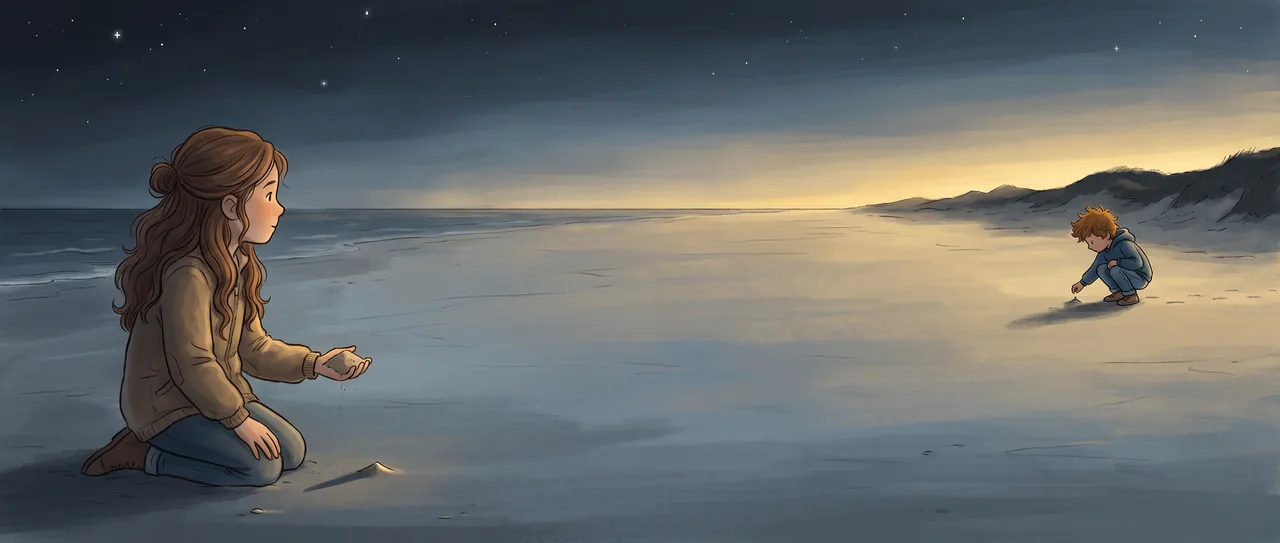
The sand was cold in a way the day never allowed. Maya dug her fingers in and came up with a fistful, and it ran out between her knuckles like water that had decided to be solid.
"Somebody said this," she told Soren. "There are more stars than all the sand on all the beaches. Everywhere. All of them."
Soren was lying flat on his back at the tide line, letting the last stars press down on his open eyes. The sky here, away from the town, was not black. It was crowded. It had grain in it, like the beach turned upside down.
"How would anybody count sand," he said.
"You don't count it." Maya let the fistful fall. "You weigh it. You figure out how much one grain weighs, then you weigh a beach, then you do all the beaches." She rubbed her palms together and felt the grit scrape and stick. "But that's not the part that's bugging me."
Soren waited. The waves came in soft, folding over, hissing back. The sound was made of a million tiny collisions.
"Pick up sand," Maya said, "and every grain is touching another grain. Squeeze it, it packs. There's no room." She pressed her fist tight and felt the sand refuse to go anywhere. "So if stars are like sand, the sky should be solid. All bright. No black anywhere. Why is it mostly black?"
Soren sat up slowly. Sand slid off his shoulders. He looked at his hand, then at the sky, then back.
"Because they're not touching," he said.
"Obviously they're not touching."
"No. I mean how much they're not touching." He scooped a small pile and smoothed the top of it with one finger until it was flat as a page. "Say this grain is our sun." He touched a single grain at the edge, one he could actually see catching the first gray light. "Where's the next star?"
"Right next to it. Everything's next to it."
"That's sand." He shook his head. "Stars aren't packed. Space is mostly space." "Nearest star to the sun is about four light-years. Light takes four years to cross it. And light is the fastest thing there is."
Maya went still. Her hand was still full of sand and she forgot it was there.
"So how far apart are the grains," she said. "If one grain is the sun. And the real distance is four light-years."
They did it in the sand, the way you can only do a thing when you can touch it.
Soren put one grain down. Then he stood up. He walked. Maya watched him get smaller against the paling sky, past the wet line, past the dry line, up toward the dunes where the beach grass started. He stopped so far away she had to squint. He crouched. He put down a second grain.
Then he came back, and it took a while, and the whole time neither of them said anything, because the walking was the sentence.
"That's two stars," Soren said when he got back, breathing a little hard. "Sun. And the next one. On this beach."
Maya looked at the one grain by her knee. Then out at the dunes where the other grain was, invisible now, a thing she had to take on faith because she'd watched him set it down.
"There's nothing in between," she said.
"Nothing. Not another grain. Not a rock. Not dust you could see. Just the whole beach. Empty." He wiped his hand on his jeans. "And that's the closest one. That's the neighbor. The others are farther."
Maya opened her fist and let the sand pour out, and now it looked wrong to her, obscene almost, all those grains crammed against each other with no room to breathe. She had had a whole galaxy in her hand and squeezed it into a lie.
"So both things are true," she said slowly. "There's more stars than all this sand. All the beaches. And each one is standing in an empty field so big you'd walk a whole beach to reach the next grain."
"More than the sand," Soren said, "and lonelier than anything on Earth can be."
The first real light was coming now, the flat gold that comes up the sand sideways and makes every single grain throw its own long shadow. Maya could suddenly see them, individually, thousands of them at her knee, each one separate, each one edged in its own dark.
"That's the part nobody says," she said. "They tell you there's so many. They make it sound crowded. Like the sky's a beach." She shook her head. "It's the opposite. It's the emptiest thing there is. It just has a lot of empty."
Soren pulled his notebook out of his jacket and it was already going soft at the corners from the sea air. He drew one dot. He measured with his eyes, the whole distance up to the dunes, and made a small mark at the top of the page, and left everything between the dot and the mark blank.
Maya looked at that blankness. Most of the page. Empty on purpose, and correct.
"Do it again," she said. "Put another one down. I want to see how far three goes."
Soren looked at the beach. From here to the dunes had been star two. Star three would be past the dunes, past the beach grass, somewhere in the town, past the town.
"I can't," he said. "It doesn't fit on the beach anymore."
"Then use a bigger beach."
"There isn't one."
Maya laughed, and it came out strange, half wonder and half something with no name. She lay back the way Soren had, and put her open eyes up into the sky that was fading now, the grains of it winking out one by one as the gold came up.
Each one, she thought. Each one standing a whole beach away from its nearest neighbor. And more of them than she could ever, ever hold.
She reached one hand up into the last of them and closed her fist slowly on nothing, on the four empty years between here and the nearest light, and held it there against the brightening sky.
Read the interactive version, listen to the narration, and earn a gold star →
A science-verified short story for curious kids · Curiosity Land