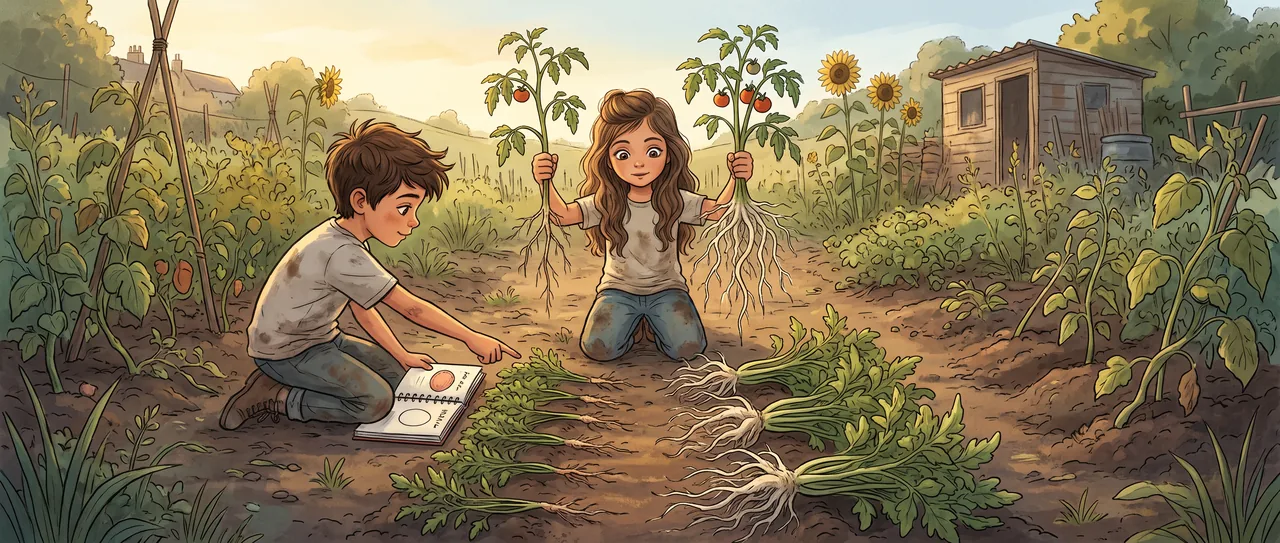
The Ones That Knew Each Other
"Look at this one," Maya said. She held up a clump of soil with a tomato plant hanging off it, roots dangling like wet hair. "It's got barely any roots."
Soren took the next plant out of the bed. Its roots were a fat white beard, so thick he had to shake the dirt loose with both hands. "Mine's the opposite."
"Same kind of plant. Same seed packet. Aunt Fee bought one packet." Maya laid the two plants side by side on the path. "So why does one of them go crazy underground and one of them barely bothers?"
"Different spots in the bed," Soren said. "Different water. Different light."
"Maybe." Maya was already crouched over the bed, staring at the holes where the plants had been. "But look where the big-root one was. It was jammed right up next to Aunt Fee's marigolds."
Soren looked. The tiny-root one had come from the middle of the bed, surrounded by its own kind on every side.
"So the one near strangers grew a huge root system," Maya said slowly. "And the one surrounded by tomatoes grew a small one. That's backwards. If you're crowded by your own kind you should be fighting harder, not less."
Soren pulled his notebook out of his back pocket. He drew two circles, one fat, one thin, and wrote where each plant had grown beside it.
"Let's check," he said. "If it's crowding, then any crowding should do it. Doesn't matter who's crowding you."
They dug up the rest of the bed carefully, keeping track of where each plant had stood. Maya called out and Soren wrote. Middle plants, ringed by tomatoes, kept coming up with skinny modest roots. Edge plants, next to the marigolds and the beans and the bare fence line, came up with enormous grasping ones.
"It's not just crowding," Soren said, looking at the page. "The ones crowded by tomatoes went easy. The ones crowded by not-tomatoes went hard."
Maya sat back on her heels. "They can tell."
"Tell what?"
"Who's who. Down there." She pointed at the dirt. "The middle ones knew they were next to other tomatoes and didn't bother competing. The edge ones knew they were next to strangers and grabbed everything they could."
Soren wanted to say that was ridiculous, that a plant does not know anything, it has no eyes and no nose and no brain. But he had the page in front of him, and the page did not care what was ridiculous.
"They'd have to be reading something," he said. "Off the other roots. Chemicals in the soil, maybe. Every root leaks stuff out. If your neighbor's leak smells like your own leak."
"Then you don't fight it," Maya said. "You share."
"You don't fight family," Soren said, and then heard himself say it, and went quiet.
Maya wasn't listening to him anyway. She had gone back to the two first plants, the fat-root one and the thin-root one, and she was holding them up level with her eyes like a scale.
"From one packet," she said. "So they're all siblings. Same parent plant. The middle ones were sitting in a whole ring of brothers and sisters, and they knew it, and they didn't take more than their share."
"You can't know that from roots."
"I know it from the roots being different for no reason we planted." She set the plants down. "Something in the bed decided who was kin. Not Aunt Fee. Not us. The plants sorted it out themselves, in the dark, by feel."
Soren looked at his two drawn circles, the fat one and the thin one. He thought about the middle plant, ringed on all four sides by its own family, choosing to grow small. Not because it was weak. Because it didn't need to armor up against the ones it recognized.
"That's a decision," he said. "With no brain. That's a whole plant making a decision about who's family, using nothing but chemistry it leaks into the ground."
"And getting it right," Maya said. "Every time. Look at the pile. It got it right every single time."
They both looked at the two rows they had made without meaning to make them. Skinny roots on one side, from the middles. Wild grasping roots on the other, from the edges. Not one plant in the wrong row.
"Aunt Fee's going to want these bagged," Soren said, but he didn't move.
Maya wasn't moving either. "There's a whole conversation happening under every garden," she said. "Every field. Every forest. Roots feeling around for who's related to them. Sending stuff to their own. Holding back from strangers. And the whole time it just looks like dirt."
"It looks like nothing," Soren said. "It looks like a plant standing still."
"That's the part that gets me." Maya pressed the back of her wrist against her mouth, thinking. "They can't move. They can't see each other. They spend their whole lives in the one spot. And they still figured out how to know their family in the dark and take care of them."
Soren wrote one line under his two circles. Then he looked up at the rest of the allotment, all the beds, all the plots, the whole hillside of gardens going quiet in the late afternoon.
"Every one of these," he said. "Right now. Under all of them."
"Doing it right now," Maya said. "While we're just standing here talking about it."
Soren crouched and put his hand flat on the emptied bed, over the holes where the middle plants had been, the ones that had known they were among family and grown gentle because of it. He couldn't feel anything. That was the whole point. He couldn't feel anything, and it was happening anyway, in every plot on the hill, a hundred silent families sorting themselves out by touch and smell in a dark he would never be able to enter.
Across the path, a fresh row of Aunt Fee's beans leaned toward each other in the wind, and under them the soil said nothing at all.
Read the interactive version, listen to the narration, and earn a gold star →
A science-verified short story for curious kids · Curiosity Land