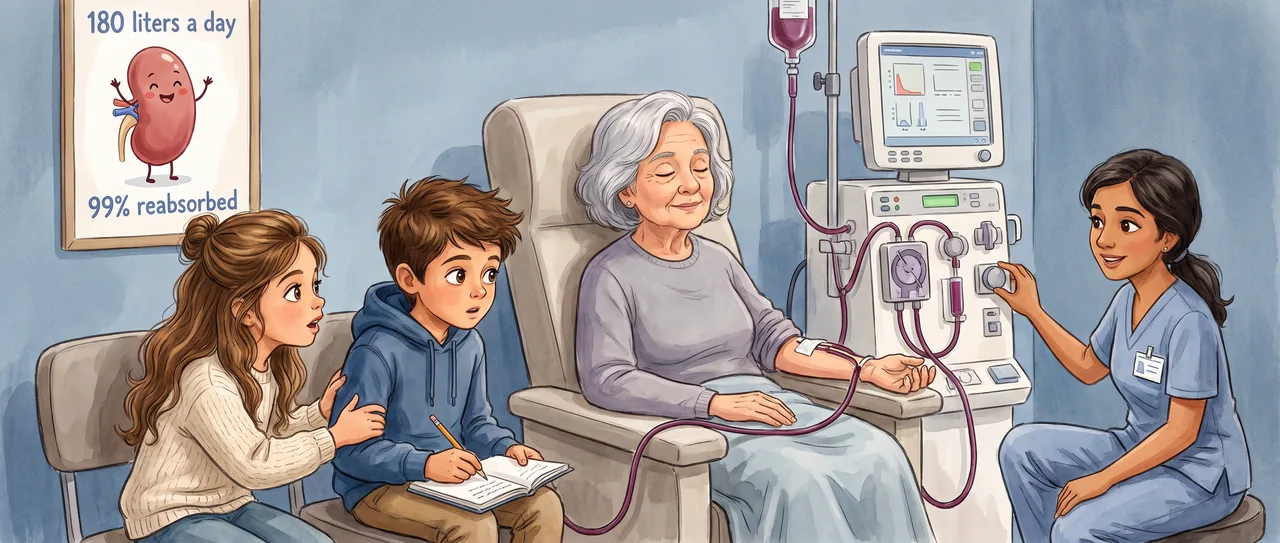
The Ninety-Nine
The machine beside Maya's grandmother made a sound like a slow heartbeat, and a tube ran out of her arm the color of a plum.
"Four hours," Maya said. "Every time. Three times a week."
"How much blood is even in her?" Soren asked.
"Nana. How much blood do you have?"
Her grandmother smiled with her eyes closed. "About five liters, the nurse says. Same as you, small as you are."
Soren wrote five liters in his notebook and looked at the machine, which was pulling her blood out, cleaning it, and giving it back, a little at a time, over and over.
"That machine does what her kidneys used to do," Maya said. She read it off the poster on the wall. "It filters her blood."
"Five liters, and it takes four hours," Soren said. "That seems slow."
A nurse crouched to check a dial. Her name tag said Priya, and she had the look of someone who answered the same questions all day and had stopped minding.
"It is slow," Priya said. "We go gentle. Too fast and the body doesn't like it." She tapped the machine. "This does in twelve hours a week what a healthy kidney does without stopping."
"Without stopping," Maya repeated.
"Never stops," said Priya, and went to the next chair.
Soren was doing something with his pen. "Okay. Say a real kidney did five liters in four hours, like this machine. Slow. That's five liters, then it's done, right?"
"But it doesn't stop," Maya said. "So it does five liters again. And again."
"How many agains in a day?"
Maya looked at the ceiling. "There's a number for it. The poster."
The poster had a cartoon kidney with a smile and a speech bubble. The speech bubble said: I filter 180 liters of blood every day!
Soren stopped writing.
"That's wrong," he said. "She only has five."
"It's not wrong," Maya said slowly. "It's the same five."
"What?"
"The same five liters. Going through. Over and over." She was working it out with her hands, one palm pushing into the other. "A hundred and eighty divided by five."
Soren wrote it. "Thirty-six."
"So thirty-six times a day, all her blood goes through." Maya frowned. "That doesn't feel like enough."
"The number's right, though."
"The number's right and the feeling's wrong," Maya said, which was a thing she said a lot. "Read the poster again."
Soren read the small print under the cartoon. "It says the plasma part gets filtered more than that. Sixty times. Your whole blood volume, processed sixty times a day."
"Sixty," said Maya. "While you sit here. While you sleep."
They were quiet. The machine beat its slow beat. Nana's chest rose and fell.
"Wait," Soren said. "If it filters a hundred and eighty liters a day, where does it go? You'd have to pee a hundred and eighty liters. That's a bathtub. That's more than a bathtub."
"You don't, though," Maya said. "Nobody pees a bathtub."
"So the number's wrong."
"The number's right." She held up a finger. "Read the last line."
Soren read it and his mouth stayed open a little.
"It reabsorbs ninety-nine percent of the water," he said.
"Ninety-nine." Maya said the word like she was tasting it. "So it filters out a hundred and eighty liters. Then it takes almost all of it back."
"Why would it do that?" Soren said. "Why pull out a whole bathtub of water just to put it back? That's the most work for the least amount of, of anything."
That was the question that stopped them both.
Maya looked at her grandmother's arm, at the plum-colored tube, at the machine doing gently and loudly what a kidney did quietly and never.
"Because it's not about the water," Maya said.
"Then what's it about?"
"It's about what's IN the water." She was leaning forward now. "Salt. And the other stuff. The, what did Priya say, the chemistry." She grabbed his arm. "Soren. You can't pick out one grain of salt from a whole ocean by reaching in. But if you poured the whole ocean through a sieve and then decided, drop by drop, which drops to keep, you could get it exactly right."
Soren stared at her. Then he started writing very fast.
"So it dumps everything," he said. "All of it. The water, the salt, all of it, a hundred and eighty liters. And then it chooses."
"It chooses," Maya said. "Ninety-nine percent, yes, keep, yes, keep, yes, keep. One percent, no. Out."
"And the yes and no aren't the same everywhere," Soren said, still writing. "Because if you ate a bag of chips, you'd need to say no to more salt. And if you drank nothing all day, you'd need to say yes to more water." He looked up. "It's deciding all day. It never gets the same answer twice."
"Sixty times a day," Maya said. "Adjusting every time. Keeping you exactly the same inside while everything outside changes."
They both looked at Nana.
"And her kidneys stopped choosing," Soren said quietly.
"So the machine chooses for her," said Maya. "Slow. Twelve hours a week. Not sixty times a day."
"That's why it's four hours," Soren said. "Not because blood is slow. Because choosing is hard."
Priya came back to check the dial. She saw the two of them staring at the machine like it had said something.
"You two alright?" she asked.
"How does it know?" Maya said. "The machine. How does it know how much salt to leave her?"
"We test her blood," Priya said. "We set the numbers."
"But a kidney sets its own numbers," Maya said. "Sixty times a day. Without anyone testing anything."
Priya paused, her hand on the dial. "Yeah," she said. "It does. Nobody tells it. It just knows." She looked at the machine, which cost more than a car, and then at the small of her patient's back where the kidneys sat, quiet, retired. "This whole thing is us trying to copy something the size of your fist."
Nana opened her eyes.
"Two of them," she said. "You've each got two."
Soren put his hand flat against his own back, low, on the left side, and felt his pulse going there, deciding things he would never have to think about.
Read the interactive version, listen to the narration, and earn a gold star →
A science-verified short story for curious kids · Curiosity Land