The Air Inside the Beans
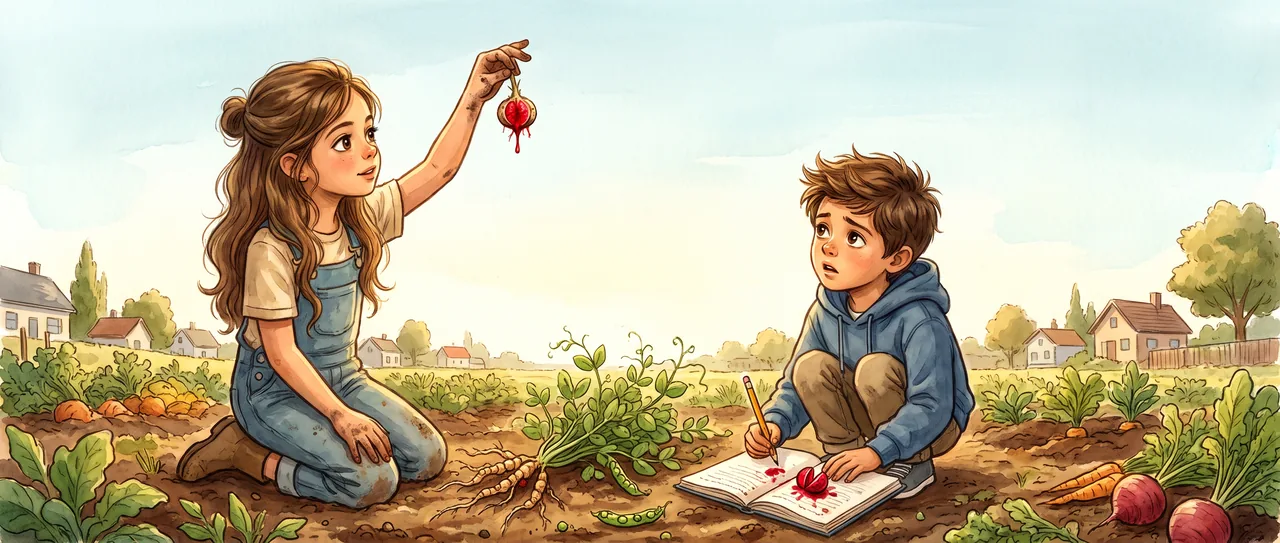
Maya yanked a whole pea plant out of the ground and shook the dirt off the roots.
"Look at these," she said. "They've got bumps."
Soren crouched. The roots were pale and stringy, and along them sat little round beads, pink and swollen, like someone had strung beads on the thread and forgotten.
"That's a disease," he said. "Probably. Something's growing in the roots."
"Then why are the peas the best ones in the garden?" Maya asked. "Mr. Okafor's tomatoes are half dead over there and he's had fertilizer trucked in twice. Nobody touched these peas all summer."
Soren pressed one of the beads with his thumbnail. It split, and the inside was not pink. It was red. Bright, wet, blood red.
"That is extremely not a normal plant color," he said.
"Cut another one."
He did. Same thing. Red center, like the middle of a cut beet, except peas were not beets and roots were not supposed to have any color at all down there in the dark.
Maya sat back on her heels. "Okay. New list. Things that don't make sense. One, the sick-looking plant is the healthy plant. Two, the roots are bleeding."
"It's not blood," Soren said. "It can't be blood. Plants don't have blood." He was already digging in his bag for the notebook. He wrote roots red inside, drew a lumpy line of beads.
Mr. Okafor wandered over, wiping his hands on his knees. He ran the garden and mostly he wanted his tomatoes to behave.
"Those are nodules," he said, glancing down. "Peas and beans get them. Farmers used to rotate beans through a field to freshen the soil. Old trick. Don't ask me how it works, I just grow the things." He drifted back toward his sad tomatoes.
"Freshen the soil," Maya repeated. "How does a plant freshen soil? Plants take stuff out of soil. They don't put it back."
"These ones put something back," Soren said slowly. "That's why the next crop grows better. That's the trick." He looked at the red bead in his palm. "But put what back?"
Maya was quiet, turning a nodule over. "There's something living in there," she said. "That's why it's a different color. That's why it's warm-looking. It's not the plant. It's something the plant is keeping."
"You can't know that from the color."
"The plant's not sick and it's not fertilized and it's the best one here. Something is feeding it. Something living in the bumps." She held it out. "What's the one thing plants can't get, even when they're sitting in perfect dirt?"
Soren thought about the fertilizer bags stacked by the shed. Every one of them said the same three letters on the front, big and bold.
"Nitrogen," he said.
"Nitrogen," Maya said. "And where's all the nitrogen?"
Soren looked up. He actually looked up, at the plain empty afternoon sky, because he couldn't help it.
"It's in the air," he said. "It's most of the air. It's almost four out of every five breaths."
"So the air is stuffed with nitrogen and the tomatoes are starving to death for it." Maya laughed, a little wild. "It's everywhere and they can't touch it."
"Because the nitrogen in the air is locked," Soren said. He was writing fast now, the pencil scratching. "It comes in pairs. Two nitrogens holding onto each other so hard that nothing can pry them apart. Plants can't. Animals can't. We're breathing it right now and it goes straight back out. Useless."
"But the beans can."
"No." Soren stopped. "No, look at what Mr. Okafor said. Beans get the nodules. The beans don't make them. Something moves in." He held up the split bead. "The red thing. Whatever's living in here, that's what pries the pairs apart. The plant builds it a house and feeds it, and it pulls nitrogen out of the air and hands it over."
Maya stared at the little red center. "It's a factory," she said. "A factory the size of a pinhead. Making air into food."
"Not the plant's air. The plant can't reach it either." Soren's voice had gone careful, the way it did when he was standing at the edge of something. "The bacteria reach it. That red color even protects them while they work. The whole planet's nitrogen, everything alive, every bit of us, it has to come through something too small to see, living in a bump on a root."
"Everything alive," Maya said.
"Your muscles are made of it. Nitrogen. Everybody's are. It had to get out of the air first, and for billions of years the only thing that could do that was them." He tapped the nodule.
Maya went still, and then she pointed at the fertilizer bags by the shed. "Except now."
"What?"
"Those bags. You said the tomatoes got fertilizer. Nitrogen fertilizer. Somebody put nitrogen in a bag." She stood up. "If bacteria were the only thing that could unlock it, where'd the bag nitrogen come from?"
Soren opened his mouth and closed it.
"People figured out how to do it," he said. "The bacteria trick. In a factory. A real one, with machines." He looked at the bag, then at the red bead, then at his own hand holding the pencil. "They learned to pull the pairs apart the way the bacteria do. That's what's in the bag. Air, unlocked."
"So some of the nitrogen in us," Maya said slowly, "came from bacteria in dirt. And some of it came from a factory."
"A lot of it," Soren said. "For people alive now. Close to half, I think I read. Half the nitrogen in your body was air that a machine unlocked. And the other half was air that something in a root unlocked." He looked down at his arm like it belonged to someone else. "Either way it was the sky. All of it used to be sky."
Maya held her nodule up between two fingers, against the actual sky, the pale ordinary blue of it, four-fifths of it the thing nobody could touch.
"Breathe in," she said.
They both did.
"Almost none of that counts," she said. "It just goes back out."
Soren laughed, and it came out shaky.
Maya set the split nodule in his open notebook, red side up, staining the page, and pointed her dirty finger up at the blue.
Read the interactive version, listen to the narration, and earn a gold star →
A science-verified short story for curious kids · Curiosity Land