Seventy Things That Are Only Mine
The museum was closing, and Soren had been left in the genetics hall while his mother finished something in the back offices that involved three phone calls and a lot of the word invoice.
He did not mind. The lights over the exhibits stayed on even after the front doors locked, and the guard, a tall man named Ochoa with keys that jingled when he walked, said Soren could stay as long as he did not touch the touchscreens too hard.
Soren touched them exactly hard enough.
The first one showed a family. A cartoon mother, a cartoon father, and between them a cartoon child, all connected by glowing lines. Press here to inherit a trait, it said. He pressed. The child's eyes turned brown, borrowed from the father. He pressed again. The hair went curly, borrowed from the mother. Half from one, half from the other. That was the whole idea. He had known it since he was seven.
He wrote the numbers from the wall into his notebook. Twenty-three chromosomes from the mother. Twenty-three from the father. Forty-six total. Everything accounted for. Everything borrowed.
But the next screen bothered him.
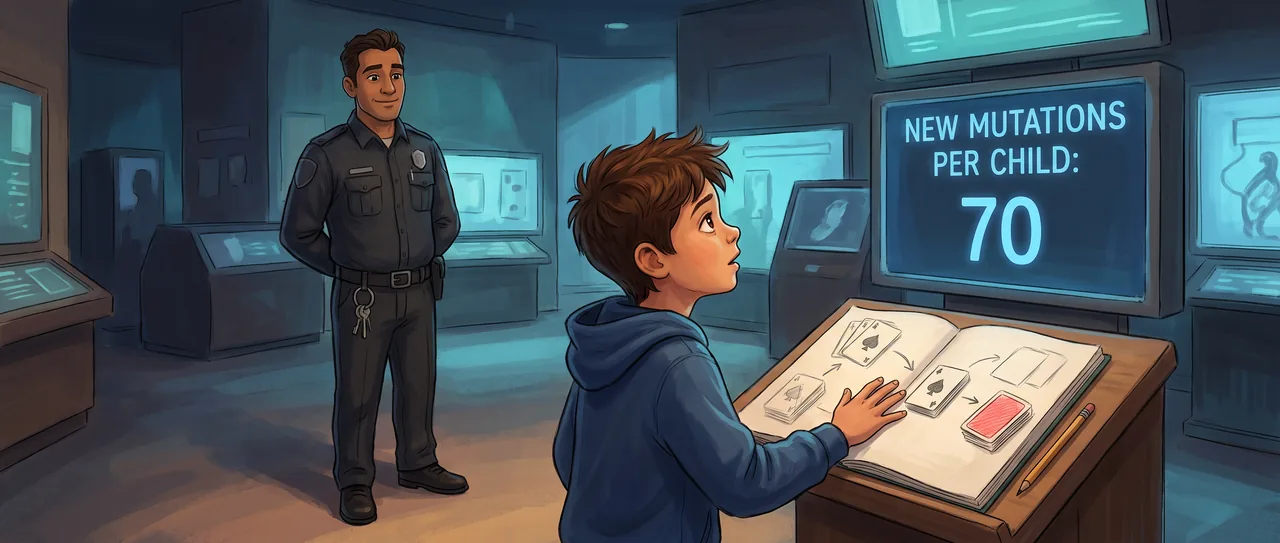
It was a counter, the kind that ticks up, and it was counting something in real time. The label said: NEW MUTATIONS PER CHILD. The number sat there. Seventy.
Soren stood in front of it and did the arithmetic he already knew. If everything came half from one parent and half from the other, the number should have been zero. Nothing new. Only shuffled. A deck of cards dealt into a different order, but the same fifty-two cards.
Seventy was not a shuffle. Seventy was cards that were not in either deck.
He pressed the info button.
A diagram unfolded. When a cell copies DNA to make an egg or a sperm, it copies three billion letters. It is fast and it is careful, but it is not perfect. Every so often a letter lands wrong. A C where there should have been a T. A rung added to the ladder. A rung dropped. The copy is almost exact. Almost.
Seventy times, on average, it is not.
Soren read it twice. Then he went and found Ochoa, who was leaning against the wall by the coat check with his arms folded, listening to a small radio.
"The seventy," Soren said. "The mutations. Those aren't from the parents."
"If you say so," said Ochoa. "I just make sure nobody steals the double helix."
"They can't be from the parents," Soren said, more to himself now. "If they were in the parents, they wouldn't be new. That's what new means."
Ochoa turned the radio down a little, which Soren took as permission to keep going.
"So where were they before?" Soren asked.
"Before what?"
"Before the kid. Every letter in me came from my mom or my dad. That's the rule. Half and half. Except seventy of them. Those seventy weren't in my mom. They weren't in my dad. So they weren't anywhere. They weren't in anyone, ever, until me."
Ochoa scratched his jaw. "Huh," he said. "When you put it like that."
Soren went back to the counter. It had ticked higher, because somewhere in the world children were being born and the museum was pretending to count them.
He opened his notebook and drew two decks of cards, his mother and his father. Then he drew arrows down to a third deck, himself. He had always pictured this as a sorting problem. Take some from here, some from there, stack them up. But now he drew, next to the third deck, a small pile of cards with nothing on their faces. Blank. Cards that had not existed until the dealing itself made them.
Seventy blank cards. He colored one in.
He thought about his grandmother, who was dead, and her mother before her, whom he had never met, and back and back, a chain of people copying three billion letters and handing them down. Every one of them had made mistakes. Every one of them had added a few cards that were only theirs. Some of those cards got thrown away when that person died with no children. Some got kept, handed forward, and were now sitting inside him, indistinguishable from the ancient ones, part of the deck he would deal to no one or someone.
And his own seventy. His own seventy were not from the chain at all. His own seventy started with him. If he ever had children, those seventy might travel forward for ten thousand years, and every single one of those future people would be carrying something that began, that had its very first morning, inside one eleven-year-old standing in a museum after closing.
He checked the diagram again to be sure he was not making it up. He was not. The screen said the same thing in smaller words. Most of the seventy do nothing. They land in the long empty stretches between genes and simply ride along. A few change something small. Now and then, across all the people who have ever lived, one of them changes something that matters, and that is where new things come from. Not just new people. New kinds of people. The whole slow river of it.
Soren looked at his hands. Same hands as an hour ago.
"My mom and dad," he said to Ochoa, who had wandered over, "gave me almost everything. But not everything. There's a part of me that isn't a copy of anyone."
"Everybody wants to be original," Ochoa said, smiling. "Turns out you already are. By accident."
"Not by accident," Soren said. "By copying. The copying isn't perfect, so it makes new things. If it were perfect, nothing would ever be new. Everyone would just be their parents forever."
Ochoa stopped smiling in the joking way and looked at the counter like he was seeing it for the first time.
"How many did you say?" he asked.
"Seventy," said Soren. "Around seventy."
His mother's voice came from the offices, calling that she was almost done, two more minutes. Soren did not answer. He was looking at the counter, and the counter ticked up, and up again, each number a child somewhere with seventy things that had never been in the world before.
He put his hand flat over the notebook page where he had drawn the blank cards, and he counted the ticks out loud, and he did not stop when Ochoa's keys began to jingle toward the door.
Read the interactive version, listen to the narration, and earn a gold star →
A science-verified short story for curious kids · Curiosity Land