Twenty-Three
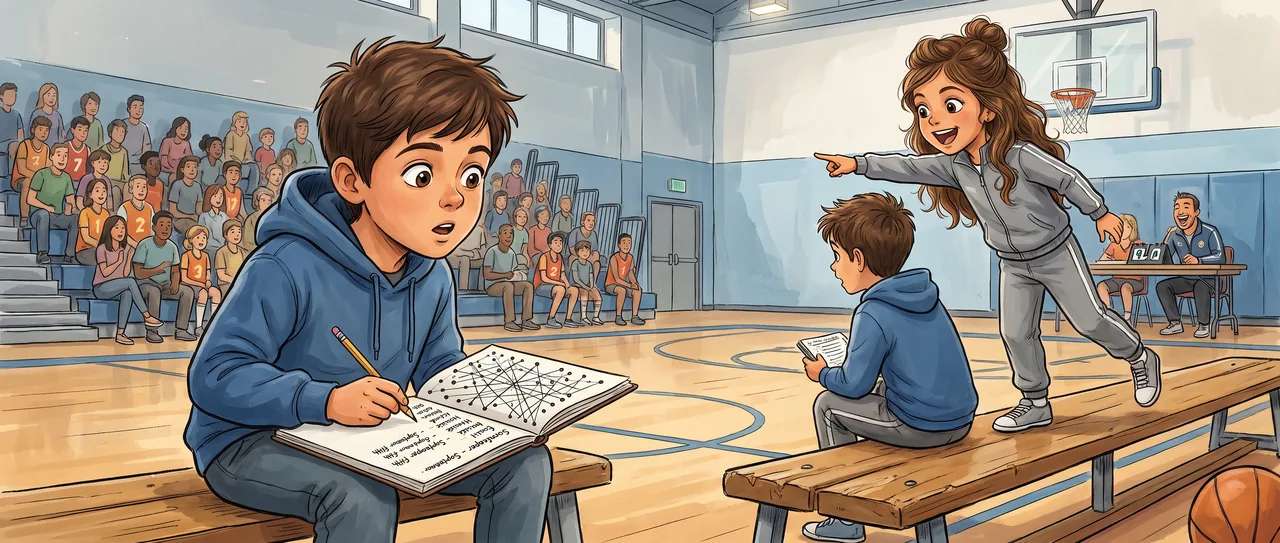
The game was late. Something about a referee stuck in traffic. So Maya and Soren sat on the cold bench at the edge of the gym while the whole school filled the bleachers behind them.
"Bet you a granola bar," Maya said, "that two people in this gym have the same birthday."
"How many people are here?"
"Loads. Two hundred, easy."
"That's cheating," Soren said. "Two hundred people, there are only three hundred sixty-five days. Of course two match. Make it hard."
"Fine." Maya scanned the room. "Our bench. Us plus the subs plus the coaches plus the scorekeeper's table." She counted with her finger, pointing at heads, lips moving. "Twenty-three."
Soren laughed. "Twenty-three out of three hundred sixty-five days. No way. That's practically nothing."
"Bet."
"You'd lose." He pulled the notebook out of his jacket and wrote a column of days across the top of a page. "Look. First person has a birthday. Second person has to miss it. That's three hundred sixty-four days out of three hundred sixty-five. Easy for them to miss."
"Okay."
"Third person has to miss both. Still easy, three hundred sixty-three out of three hundred sixty-five." His pencil moved fast. "By the twenty-third person they only have to dodge twenty-two used days. Twenty-two out of three hundred sixty-five are taken. Almost nothing is taken. Everybody dodges everybody. Nobody matches."
"So you're saying it's a safe bet for you."
"I'm saying it's a great bet for me. I want two granola bars."
Maya wasn't listening to the odds. She was watching his pencil. "You keep saying person versus person. Like it's a line. Second person misses first person. Third misses the first two."
"Because that's what it is."
"Is it?" She turned on the bench to face the whole group. "You're not standing in a line. You're all in a room. Everybody can match anybody."
Soren stopped writing.
"Go stand up," Maya said. "You. Coach Ruiz. Everybody on our twenty-three list. I want to see something."
"We can't make the coaches stand up."
"Then use your pencil. Dots. One dot for every person." She jabbed the page. "Now draw a line between every two dots that could be a match."
Soren drew three dots and connected them. Three lines. He drew a fourth dot. "Now it's six lines." A fifth. "Ten." His pencil slowed. "Every time I add a dot, I add a line to all the dots already there."
"So how many lines for twenty-three dots?"
He did it at the edge of the page, muttering. "Twenty-three people. Each one pairs with twenty-two others. Twenty-three times twenty-two. But that counts every pair twice, me-and-you and you-and-me. So divide by two." He wrote the number and went quiet.
"Say it."
"Two hundred fifty-three." He looked up. "Two hundred fifty-three pairs. In twenty-three people."
"Two hundred fifty-three chances to match," Maya said. "Not twenty-three. You were counting people. The matching doesn't happen to people. It happens to pairs."
Soren stared at the little web of lines on the page, getting denser toward the middle where he'd tried to connect them all. "That's more than half of three hundred sixty-five," he said slowly. "Two hundred fifty-three pairs, and each pair is a little shot at landing on the same day. That many tries."
"So who's winning the bet?"
"Hang on." He was already turning back to his first column, the three-hundred-sixty-four-out-of-three-hundred-sixty-five one. "You still have to multiply all those together. Everybody has to dodge for nobody to match. And dodging gets a tiny bit harder each time." His pencil ran down the numbers. "Three sixty-four over three sixty-five, times three sixty-three over three sixty-five, times three sixty-two, all the way down twenty-three times."
"Guess."
"I don't guess with numbers, I do them." But he chewed the pencil. "The pairs say the match should be likely. So the chance of nobody matching should be under half. I'll guess the chance somebody matches is a little over half. Fifty something percent."
"With twenty-three people. That you said was practically nothing."
"With twenty-three people that I said was practically nothing." He finished the long multiplication in the margin, sighing between steps, and circled the answer. "Chance nobody shares. About forty-nine percent. Chance somebody does. About fifty-one."
Maya grinned. "Better than a coin flip."
"That's insane," Soren said, but he said it happily. "Twenty-three people out of a whole year of days and it's still a coin flip. Because you're not asking about days. You're asking about pairs, and pairs pile up way faster than people do."
"So let's find out who owes who a granola bar." Maya stood up on the bench. "Everybody on the bench! Coaches, subs, table people. Birthdays. Go around. First one, go."
"March twelfth."
"October third."
"July nineteenth."
Soren wrote each one in a fast column, watching for a repeat, his pencil hovering.
"August thirtieth."
"January first."
"May sixth."
Seventeen down. Nothing. Soren felt the smallest flicker of hope for his granola bars.
"February fourteenth."
"November ninth."
"April twenty-second."
Twenty. Twenty-one. Coach Ruiz, twenty-two.
"September fifth," said Coach Ruiz.
Soren's pencil stopped over the page. Halfway up his own column, in his own handwriting, there it was. The scorekeeper, person number six. September fifth.
"Two of you," Soren said, and his voice came out strange. "Two of you are September fifth."
The scorekeeper and Coach Ruiz looked at each other across the gym, and Coach Ruiz pointed and laughed out loud.
"Twenty-two," Maya said. "We didn't even need all twenty-three."
Soren looked from the two matching people to the little web of lines on his page, all those crossings bunched in the middle. "Try it with the whole bleachers," he said, not looking up. "Two hundred people. The pairs would be. " He started the multiplication in the margin, twenty-three times twenty-two over two, but bigger, and his hand couldn't keep up with how fast the lines were multiplying in his head.
Behind them the referee finally jogged in, and the whole gym stood, and somewhere in that standing crowd Soren knew there were thousands and thousands of invisible lines, every person tied to every other person, matches hiding in all of them.
He kept writing, faster.
Read the interactive version, listen to the narration, and earn a gold star →
A science-verified short story for curious kids · Curiosity Land