The Woman Who Remembered a War
Maya was supposed to hold the microphone still and not talk. Those were the two rules.
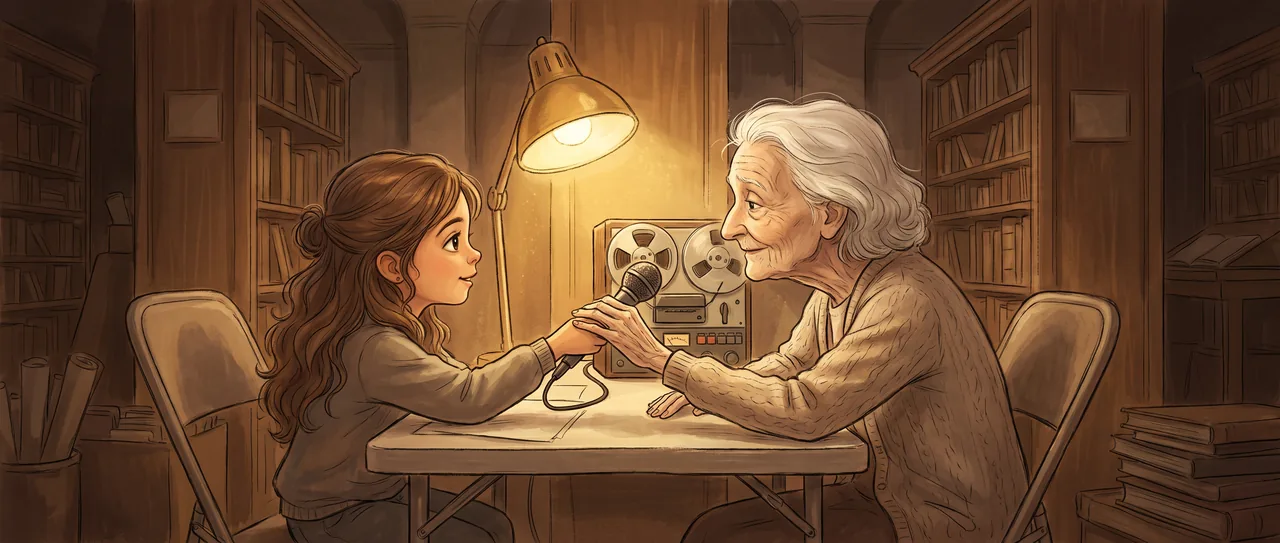
The museum had set up folding tables in the old reading room, and one by one the oldest people in town came to sit under the lamp and tell their stories into the recorder. Maya's job was to point the microphone at their mouths. Her aunt ran the sound board and had told her, twice, that this was a listening job, not a talking job.
The woman in the chair now was named Eleanor Voss. She was one hundred and six years old. Her hands lay in her lap like folded paper, and when she spoke her voice was thin but it did not shake.
"I was born in nineteen eighteen," Eleanor said. "In the autumn. My mother told me later she was surprised I lived, because everyone around us was dying."
Maya held the microphone steady.
"The influenza," Eleanor said. "They called it the Spanish flu, though it wasn't Spanish. It took my two older brothers in one week. I was a baby. I caught it too. I don't remember any of it, of course. I only know because my mother wrote it in the family Bible. Eleanor, sick November, recovered."
The recorder's little needle bounced.
"Here is the strange part," Eleanor said, and she almost smiled. "When I was ninety, some doctors came. Researchers. They wanted blood from people who had lived through nineteen eighteen. My daughter drove me. I thought it was foolish. I said, that was ninety years ago, there's nothing left of it in me. What could a baby's sickness leave behind?"
Maya forgot she was not supposed to talk.
"What did they find?" she asked.
Her aunt frowned at her from behind the board. Eleanor turned her head slowly and looked at Maya as if she were glad someone had interrupted.
"They found it," Eleanor said. "They took my blood, and somewhere in it were little cells that still remembered the exact shape of that flu. The one from nineteen eighteen. Not a cousin of it. That one. They told me my body could still build the weapon against it, if it ever came back."
Maya stopped hearing the room.
Ninety years. Eleanor had been a baby who could not talk, could not walk, could not remember. But something inside her had looked at the flu once, in the November she was two months old, and had written it down. And that writing was still there when she was ninety. It was still there now, at one hundred and six, sitting in the chair under the lamp.
"You still have it," Maya said. It was not a question.
"They said so," Eleanor said. "Somewhere in here." She touched her own chest with one folded-paper hand.
Maya thought about her own arm. She had gotten a shot before the school year, in the spring, and her arm had been sore for a day and then she had forgotten about it entirely. She had thought of it as a thing that happened and then ended.
But it hadn't ended. That was the thing turning over in her now. The shot was a photograph her body had taken. And the body kept its photographs. It kept them for a day, and then for a spring, and then it just. Kept keeping them.
"How does it not forget?" Maya asked. "Everything forgets. I forget what I had for breakfast."
Eleanor laughed, a dry rustling sound. "I don't know how. Nobody told me how. They only told me that it does."
Her aunt had come around from the board and was crouching beside Maya now, but she wasn't stopping the interview. She was listening too.
"There are people alive right now," Maya said slowly, working it out into the microphone as if the recorder needed to hear it, "who fought a war in nineteen eighteen. And they're still holding the map to win it. And most of them don't even know they're holding it."
"I didn't know," Eleanor said. "For ninety years I didn't know. I was just an old woman. And then a doctor found a whole battlefield inside me that I had forgotten before I was even old enough to remember it."
Maya looked at Eleanor's chest, at the folded hand resting there. Under the sweater, under the skin, under the ribs, there were cells older than every building in this town, cells that had been made in a month when Eleanor's brothers were still alive, cells that had never once let go of a shape they saw for the first time before Eleanor had a single word for anything.
"It means," Maya said, "that a part of you is a hundred and six years old and it's better at remembering than the rest of you."
"The best part, maybe," Eleanor said.
Maya did not lower the microphone. She kept it pointed at Eleanor, but her eyes had gone to her own arm, to the smooth place near her shoulder where the spring soreness had been, where something had quietly filed a picture away and would keep it, she understood now, long after she stopped being a girl in a museum, long after she was the oldest person anyone knew, long after she forgot this room and this lamp and even this woman.
Her body would not forget. Her body was already a library, and it had been open, and taking down records, since the day she was born.
Eleanor reached out and closed her hand around Maya's wrist, the one holding the microphone, and held it there so it wouldn't shake.
"Steady," Eleanor said. "You'll want to get all of it."
The needle on the recorder kept bouncing, writing the old woman's voice down onto the tape, one more thing built to remember for a very long time.
Read the interactive version, listen to the narration, and earn a gold star →
A science-verified short story for curious kids · Curiosity Land