The Two Ways to Miami
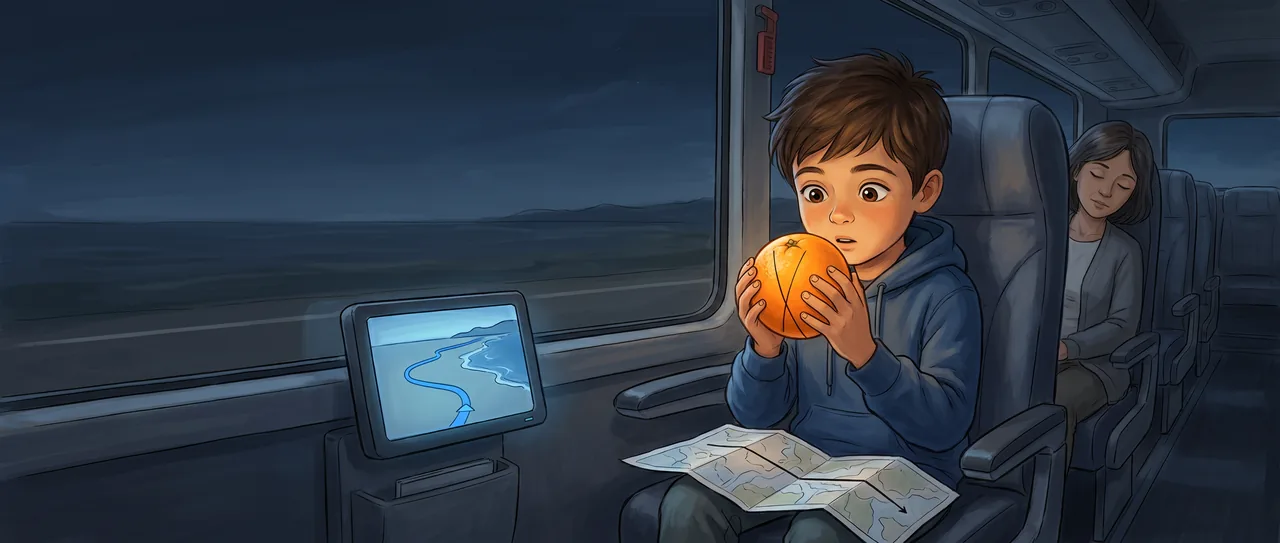
The bus smelled like cold coffee and heater. Soren had the window seat, and his aunt had the aisle, and his aunt was asleep with her mouth open before they even left the station.
He had bought the map at the last gas station. It cost two dollars and it was enormous, the whole country folded down into a square. He liked how it opened. He liked how you could put your thumb on where you were and your other thumb on where you were going.
They were going from Chicago to Miami. Soren laid a pen against the map and drew a straight line between the two cities. It went down through the middle, across Kentucky, down along Georgia. Clean. A straight line is the shortest way. Everybody knew that.
He folded the map and watched the road.
Somewhere in the third hour he got the idea that he could check. The bus had a little screen up front that showed the route as a thin blue thread. He watched it for a long time. The blue thread did not follow his straight line. It bent east, out toward the coast, and then came down.
He unfolded the map again and compared. His pen line and the blue thread did not match. The driver was going the long way.
Soren thought about this. Bus drivers went the way the highways went. Highways followed rivers and towns. That was a good enough answer, and for about twenty minutes he believed it.
Then he stopped believing it, because of the orange.
His aunt had packed oranges. He rolled one across his tray and it did not roll straight either. He caught it. He looked at it. He put his pen line on the orange, from the top to a spot near the side, and drew.
Then he tried to draw a second line right next to the first one, going the same direction. Two lines, side by side, both perfectly straight, both going down the curve of the orange. He drew them careful and even, like train tracks.
The two lines were not staying side by side. They started apart at the top and they leaned in as they went down. Down near the bottom of the orange they crossed. They touched. Two straight lines, both going the same way, and they had run into each other.
Soren sat very still with the orange in his hand.
He knew the rule. He had known the rule since he was little. Two lines going the same direction never meet. That was what parallel meant. You could draw them across a whole page and they would never touch, not if the page went on forever.
But the page here was not flat. The page here was an orange. And on the orange the rule broke, and it did not break because he had drawn badly. It broke because the surface was curved, and on a curved surface there was no such thing as a line that stayed the same distance away.
He took out his notebook. His hand went fast. He drew the orange, and the two lines, and the place where they crossed. He drew the flat map, and his pen line, and the blue thread that went the long way around.
Then he understood the map and the orange were the same problem.
The Earth was a ball. The map was flat. Somebody had taken the ball and squashed it out into a square so it would fold into his pocket, and squashing it had lied about the distances. On the real Earth, the shortest way from Chicago to Miami curved out toward the coast, exactly like the blue thread. His straight pen line across the flat map was not the short way at all. It only looked short because the map was flat and the world was not.
The driver was not going the long way. The driver was going the true way. Soren's pen was the one that had gone wrong, and it had gone wrong the instant it believed the map was flat.
He pressed his forehead to the cold window. Outside, the highway ran ahead into the dark, and it looked straight. It looked perfectly straight, the way a floor looks flat, the way a page looks flat. He knew now that this was the trick of standing too close to something big. If he could pull far enough back, the straight road would show itself curving over the shoulder of the planet, the way his two orange lines curved until they kissed.
He thought about how far back you would have to stand.
And then he had the thought that made his hands cold, the one he wrote down in letters that came out crooked. If flat was a lie about the ball, maybe flat was a lie about everything. Maybe the space the bus moved through, the plain empty air, the nothing between the stars, maybe that was curved too, somewhere, somehow, curved by something too big for him to feel from inside it. Maybe there was no flat anywhere. Maybe flat was just what curved things looked like when you were too small and too close and stuck riding along on top of them.
He did not know if that was true. He wrote it down as a question, with a real question mark, because he could not test it from a bus seat.
But he had tested the orange. Six times, now, drawing the two lines and watching them meet. Six times they met. The rule he had been taught since he was small was not the whole rule. It was the rule for flat places. And he was not sure, anymore, that there were any truly flat places at all.
His aunt woke up, blinked at the window, and asked if they were almost there.
Soren looked at the blue thread on the screen, curving down the coast, taking the true way.
"We're going the short way," he said. "It just doesn't look like it."
Outside, the straight road kept bending under them, too slowly to see.
Read the interactive version, listen to the narration, and earn a gold star →
A science-verified short story for curious kids · Curiosity Land