The Tube That Remembered
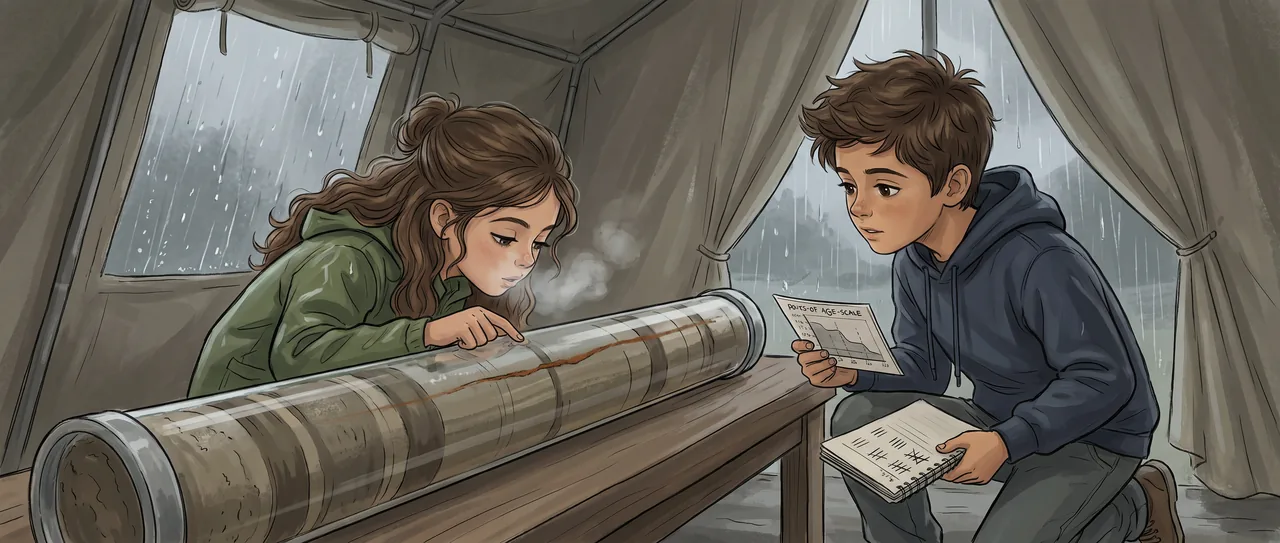
The rain came sideways, so they went inside the tent on the deck, where a long clear tube lay on a table like something waiting to be read.
"It's mud," Soren said. "Somebody drilled up mud and put it in a museum."
"It's striped," Maya said. She crouched to eye level with it. "Look. It's not just mud. It changes."
The tube ran the length of the table, and along its length the color shifted. Pale gray. Then a band of green-brown. Then something almost white, packed fine, then darker again. A paper card taped near one end said CORE SECTION 14 and nothing else. Whoever labeled it had stopped.
"Which way is old?" Maya asked.
Soren found a diagram bolted to the tent pole. A drawing of the ship, a pipe going down through the water, down into the seabed, pulling up a straw of the ocean floor.
"The top is new," he said. "The bottom is old. It piles up. Stuff drifts down and lands and just... sits. Layer on layer."
"So the bottom of the tube is the deepest down." Maya put her finger near the far end. "And the deepest down is the longest ago."
"Right."
"How long ago?"
Soren checked the diagram. There was a scale printed small along the side. He read it twice to be sure he wasn't off by a lot.
"This one tube," he said slowly. "Bottom to top. It's more than the dinosaurs."
Maya turned her head. "Say that again."
"The whole thing. It's older at the bottom than the dinosaurs are dead."
They both looked at the tube differently after that. It was not a table anymore. It was a stack of days that had never been shuffled.
"So every stripe is weather," Maya said.
"Not weather. Longer. Each thin part might be a year. The fat bands are longer than that. Cold times make one kind of mud, warm times make another." He pulled his notebook from his jacket and flattened it on his knee, and his pencil moved down the page in short marks, one for each band he could count.
"So you could find an ice age." Maya was moving her finger along, not touching the glass, just tracking. "If cold looks different, you could point at the ice age."
"You could point at a lot of them. There were more than one."
"Where?"
Soren stopped counting. "I don't know which band is which. I'd need the chemistry. Scientists melt tiny bits and check what's in the shells. The little sea animals build shells out of the water. If the water's warm the shell comes out one way. Cold, another way. The shell keeps the recipe of the water it grew in."
Maya was quiet. Then: "So the animal wrote down the ocean without knowing."
"Kind of. Yeah."
"That's the best thing I've heard all week."
She crouched lower and went slowly, band by band, toward the deep end. Soren followed her finger with his eyes. And near the bottom, before the very oldest gray, there was a thin line neither of them had mentioned. Not gray, not green. A dull rusty streak, thinner than a pencil, like a single closed door across the whole tube.
Maya stopped on it.
"This one's wrong," she said.
"Wrong how?"
"It doesn't match either side. The stuff under it is one thing. The stuff over it is another. And this line's in between and it's not like either. It's a seam."
Soren leaned in. She was right. Above the rusty line the mud looked ordinary, patient, year after year. Below it, the same. But the line itself cut across all of it, sharp, like the whole ocean had held its breath for one thin moment and then let it out changed.
"A seam," he repeated. He looked at the age scale. He looked at the rusty line. He did the arithmetic on the page, the depth from the bottom, and his pencil stopped.
"Maya."
"What."
"That line's about sixty-six million."
She didn't move.
"Sixty-six million years," he said again. "That's the one. Above it there are little sea shells of all kinds. Below it, different kinds. And after this line a whole lot of them just aren't there anymore."
"The dinosaurs," Maya said.
"Not just the dinosaurs. Almost everything. The line is the day it happened. The rock from space. The dust went all the way around the planet and came down and settled, everywhere, all at once, one thin layer in every ocean on Earth." He touched the edge of the table, not the glass. "It's in this tube. That's what stopped whoever was labeling it. They got to fourteen and hit the line and I bet they went to get somebody."
Maya was still crouched at the rusty streak. The rain hammered the tent. She put her face very close to the glass, close enough to fog it.
"So underneath here," she said, and her voice had gone careful, "is the last ordinary morning. Everything down there didn't know yet."
"Yeah."
"And you could count up from the line and find the first thing that came back. The first shell after."
Soren looked at the mud above the seam, the patient bands going up and up toward the new gray at the top, toward this morning, toward the rain outside.
"They did come back," he said. "The whole top half of the tube is them coming back."
Maya sat down on the wet deck in front of the table so her eyes were level with the deep end, with the oldest gray, with the last ordinary morning under its thin rust door.
"Get the scale," she said. "I want to find where we are."
Soren unbolted the little diagram and brought it over and knelt beside her, and together they laid it along the tube and started counting up from the line, band by band, toward the top.
Read the interactive version, listen to the narration, and earn a gold star →
A science-verified short story for curious kids · Curiosity Land