The Thing That Stays
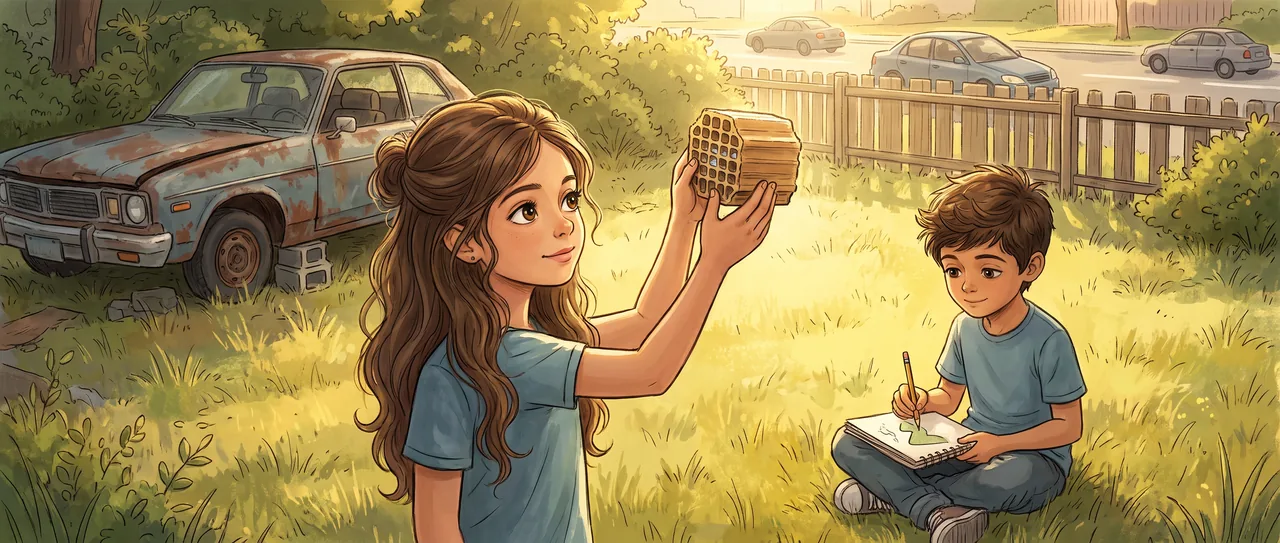
Aunt Ravi cut the pipe with a saw that threw sparks, and a heavy lump the size of a loaf of bread thudded onto the grass.
"Careful," she said. "That one's worth money. Scrapyard pays extra for those." Then her phone rang and she walked toward the house, still talking about brake lines.
Soren crouched over the lump. It was rusted on the outside, but where the saw had opened it, something honeycombed glinted through the grime.
"Why would a scrapyard pay extra for a rusty pipe?" he said.
"They wouldn't," said Maya. She was already turning it in her hands. "So it's not the pipe."
She found the honeycomb and pressed her thumbnail into it. Hundreds of tiny square tunnels, packed together, all running the same way.
"It's ceramic," she said. "Feel it. Cold."
Soren felt it. "Cars are hot. Exhaust is hot. Why put something this fragile in the hottest, angriest part of a car?"
"Because it's doing something," Maya said. "And it has to be right in the way of everything coming out."
They looked at the tunnels. The tunnels looked like nothing.
"Ravi said the exhaust used to be poison," Soren said. "Old cars, before these. Carbon monoxide. The stuff that kills people in closed garages."
"And now it isn't poison."
"Now it's mostly water and regular air stuff. Carbon dioxide. Nitrogen." He said it slowly. "Something in here turns the one into the other."
Maya held the honeycomb up to the light. Way down inside the tunnels, past the grime, the walls had a faint gray shine, like the surface of a spoon.
"There," she said. "That coating. That's the expensive part."
"That's almost nothing," said Soren. "That's a smear."
"Ravi," Maya called. "How much of the expensive metal is in here?"
Aunt Ravi lowered the phone. "Platinum and palladium. Little bit of rhodium. Altogether? About a tablespoon, spread out over all that ceramic. Worth more than the whole rest of the car, though." She went back to her call.
Soren sat down hard in the grass.
"A tablespoon," he said. "A tablespoon of metal cleaned up the poison from every single mile that car ever drove."
"That's why it's spread so thin," Maya said. She was tracing the tunnels with her finger. "You wouldn't spread a tablespoon like this if you were trying to save it. You'd spread it like this if you wanted the gas to touch as much of it as possible."
"But a tablespoon can't keep working forever. It'd get used up. Like how a match works once."
Maya stopped tracing.
"Does it get used up?" she said. "Ravi, does the metal get used up?"
"Nope," Ravi called. "That's the whole trick. Same metal, whole life of the car. That's why it's worth digging out."
Soren stared at the gray shine.
"That's not possible," he said. But he said it the way he said things right before he believed them. "If it changes the gas, the gas changes it back? It does the reaction and just, what, walks away clean?"
"Say it again," Maya said.
"The poison gas comes in. It touches the metal. On the metal, it becomes the safe gas. And the metal is exactly the same afterward." He looked up. "So it does it again. And again. To the next bit of gas, and the next."
"A tablespoon," Maya said, "doing the same small thing a trillion times and never running out."
They were both quiet. A breeze came through the yard and moved through the honeycomb, and for a second Soren imagined he could feel it going tunnel to tunnel.
"Here's what I don't get," Maya said. "Poison gas doesn't just turn into safe gas by itself. If it did, old cars wouldn't have killed anybody. It needs something. Heat, or a spark, or a lot of energy."
"Right," said Soren. "You'd have to force it."
"But this doesn't force it. This is cold in my hand. There's no spark in here." She turned the ceramic over. "So the metal isn't forcing the gas. It's, what, making it easy? Making it so the gas can change without needing all that push?"
Soren pulled his notebook out of his back pocket. He drew two hills with a valley between them, then drew a second, lower hill next to the first.
"Say changing the gas is like getting over a mountain," he said, tapping the tall hill. "Old way, the mountain's too high. Almost nothing gets over. That's why the poison stayed poison." He tapped the low hill. "The metal doesn't move the gas. It just, it lowers the mountain. Same gas, same destination. Shorter climb."
"And the mountain stays lowered," Maya said. "For the next one. And the next."
"That's why a tablespoon is enough." His pencil stopped. "It's not about how much you have. It's about how many times a tiny thing can help without being used up."
Maya looked at the honeycomb, then at the whole dead car up on its blocks, then out past the fence at the road, where cars went by, one after another after another.
"Every one of those," she said quietly. "Every car out there has a spoonful."
"Doing it right now," said Soren. "While we're sitting here. In every single one."
Maya stood up. She held the ceramic block out toward the road, the way you'd hold something up to check it against a light.
A car passed. Then another. Then a truck, loud and gray-smoking, and even the truck, she knew, had a tablespoon inside it lowering a mountain a trillion times a second so the air behind it stayed something they could breathe.
"I want to see it happen," Maya said. "The actual touching. The exact spot on the metal where the gas changes."
Soren was already writing the question down. Down the road, one after another, the cars kept coming, and every one of them went by clean.
Read the interactive version, listen to the narration, and earn a gold star →
A science-verified short story for curious kids · Curiosity Land