The Star That Was Leaving
The whole block had gone dark, so the sky came back.
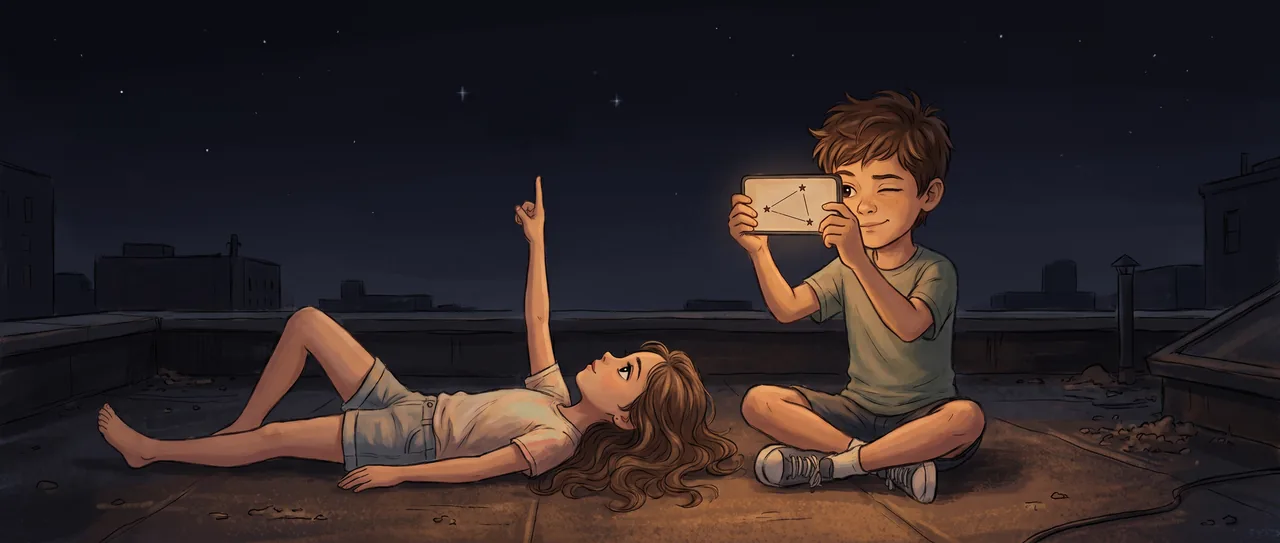
Maya was lying flat on the warm tar of the roof, and Soren was sitting up with his phone held toward the stars, the screen dimmed almost to nothing.
"You're cheating," Maya said. "That's a star app."
"It's a star map from my dad's old astronomy book. I photographed the pages. No signal needed." Soren tilted the phone. "It's from nineteen eighty-nine."
"Then it's wrong."
"Star maps don't go wrong. The stars barely move. That's the whole point of them."
Maya pointed straight up without sitting up. "That one moved."
Soren looked where she pointed, then at the phone, then back up. "Which one."
"The medium one. Left of the bright pair. On your dad's map there's supposed to be a little triangle there. Three dots. I only count two in the sky."
"You can't count sky dots against a book. The book's not to scale."
"Then hold it up and line it up."
He did. He held the old photographed page against the real sky, one eye closed, matching the bright pair like nails he could hang the whole thing on. The triangle on the page had three corners. The sky had two.
"Okay," Soren said slowly. "One corner is missing."
"Missing where?"
"Stars don't go missing. If it burned out we'd see it fade, and it wouldn't just be gone from one map to now." He was quiet. "Unless it isn't gone. Unless it moved."
"That's what I said."
"You said moved like a person walks. I mean moved like, it's not at that corner anymore because it left."
Maya sat up. "Stars don't leave."
"That's what everybody thinks. That's what the maps are built on. Everything up there is supposed to be basically stuck. The Big Dipper looks the same as it did when your grandma was a kid." He lowered the phone. "But that's an average. Some of them aren't stuck."
"Then find it. If it moved, it moved somewhere. It didn't evaporate."
Soren swiped to the next photographed page, then the one after. "My dad wrote in the margins. Look." He turned the screen so she could read the cramped handwriting under a diagram of the whole galaxy, a flat spiral seen edge-on. Near the center someone had drawn a tiny dark circle and an arrow, and next to the arrow, three words: it throws them.
"Throws what?"
"Stars." Soren's voice did a small thing. "There's a black hole in the middle of the galaxy. A giant one. Millions of times heavier than the sun. And sometimes a pair of stars wanders too close to it, and the black hole grabs one and flings the other one away. Like, away away. It called it a slingshot."
Maya looked up at the two remaining corners of the triangle. "How fast is flung?"
"He wrote a number." Soren tilted the phone into what little light there was. "Three point eight million kilometers an hour."
Neither of them said anything for a second.
"Say that slower," Maya said.
"Three point eight. Million. Kilometers. Every hour." He put the phone face down on the tar so the number would stop being real for a moment. "Fast enough that the whole galaxy can't hold onto it. It's not orbiting anymore. It's not coming back around. It's leaving."
"Leaving to where? There's nothing out there. Between galaxies."
"That's the point. It's going into the nothing. On purpose. Well. Not on purpose. It got thrown."
Maya lay back down. She found the two corners again. She kept her eyes exactly on the empty spot where the third should be, and she did not look away from it.
"So the map's not wrong," she said. "The map is just old. It's a photo of where things were. And one of them didn't stay in the photo."
"Right."
"So every star map is a little bit out of date the second you draw it."
"Right. But mostly by tiny amounts. A hair. This one moved a whole corner in thirty years, which means it's really moving, which means—" He stopped.
"Which means it might be one," Maya said. "A thrown one."
Soren picked the phone back up but didn't look at it. "We can't prove that from a roof. Real astronomers do this with the exact same idea, though. They photograph the sky, then photograph it again years later, and they look for the one dot that jumped. That's how they find them. The runaways."
"How many did they find?"
"Not a lot. They're rare. A handful, going that fast." He finally looked at her. "Somebody had to be the kind of person who notices one dot out of thousands is in the wrong place. Everybody else looks at the sky and sees a picture. They looked and saw a thing missing."
Maya was still staring at the gap. "Like a triangle with a corner gone."
"Yeah," Soren said. "Exactly like that."
She thought about the star. Not the science of it. The star. Something that had spent maybe a billion years going around and around the middle of everything, and then one wrong turn near the dark circle in the drawing, and now it was falling outward forever, past the edge of the map, past the edge of the whole spiral, out where there were no other stars close enough to see.
"Is it scared," Maya said, and then, "never mind, it's a star, it's not anything." But she didn't take it back all the way.
"It's still shining," Soren said. "That's the part I keep thinking. It's out there in the empty part with nothing around it and it's still burning exactly as bright. It doesn't know it left. It's just going."
Below them, somewhere on the block, the power came back on with a hum, and windows lit up yellow one by one, and the sky began to close over again, the faint stars washing out first, then the medium ones.
"Quick," Maya said. "Before they're gone. The two corners. Where they are right now."
Soren lifted the phone and photographed the sky, the real one, the two remaining points and the dark space where the third used to be.
He checked the screen. The photo held two dots and a gap, and above the roofline the city's light climbed higher, and the last true stars went out one at a time until there was only the picture.
Read the interactive version, listen to the narration, and earn a gold star →
A science-verified short story for curious kids · Curiosity Land