The Layer That Should Not Be There
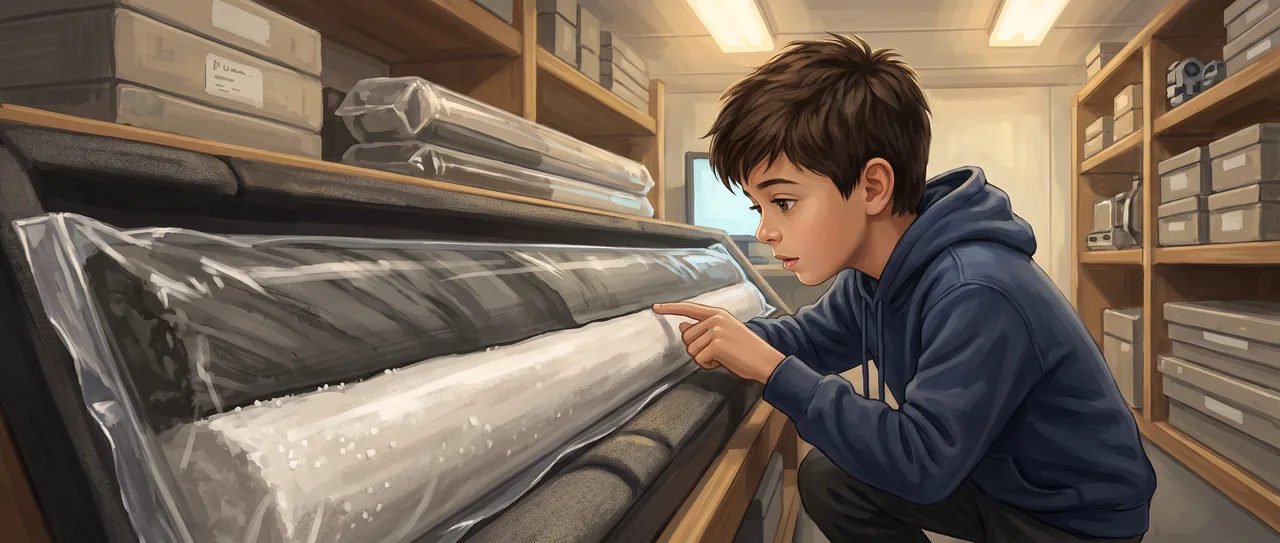
The core came up wrapped in plastic, longer than Soren was tall, and his aunt Priya set it on the padded rack and said she'd be back in twenty minutes and please do not touch the label ends.
She did not say do not look.
Soren looked. The core was a straw of mud pulled straight up out of the seabed, and it was striped like something layered on purpose. Dark bands, pale bands. Gray silt that had settled slow, one grain at a time, the way rain settles dust. He put his face close to the plastic. He could read it a little, the way you read tree rings. Slow, slow, slow.
Then there was the white part.
It sat about two-thirds of the way down, a fat band the color of old bone, and it was wrong. He knew it was wrong before he knew why, the same way you know a stair is missing in the dark. He wrote in his notebook: white layer, thick, no small lines in it. The gray had a thousand tiny lines. The white had none.
Salt. He pressed the plastic flat with a thumb and the white caught the light in little cubes. Not sand. Crystal. Salt, and a lot of it, thick as a dictionary, laid down in a place that was two thousand meters underwater right now, with a ship floating over it and fish swimming in the dark above the drill hole.
He knew how salt got left behind. You left salt behind when water dried up. He'd done it on a saucer on a windowsill, seawater in the sun, and after four days there was a white ring where the water used to be.
But you could not dry up two thousand meters of sea on a windowsill.
Priya came back and he asked her before she was through the door. This white part. How does salt get down there.
She pulled her gloves on. Evaporites, she said. That's the interesting bit, that's why we cored here. She tapped the white through the plastic. That's the sea drying out.
All of it, Soren said.
Mostly all, she said, already looking at her tablet. It's a whole story. I've got a meeting.
Soren stayed with the core.
He worked it like a broken machine, from the wrongness outward. Salt that thick meant a lot of water gone, and a lot of water gone meant the sea had emptied, and the sea could not empty while the Atlantic kept pouring in through the gap at Gibraltar. So the gap had to close. He drew it: a bathtub with the drain open and the tap shut off. The tap was the ocean. Somebody shut the tap.
He checked himself the way he always did. If the tap shut, would the tub really empty? The Mediterranean was hot, in the middle, in the sun. More water left the top than the rivers brought in. He'd felt that himself, the way the saucer went dry faster than he thought it would. So yes. Tap off, sun on, and the whole sea sinks down and down, three kilometers, four, five, until the bottom is a desert of salt so deep the sky above it would be a strip of blue at the top of a canyon you could lose a mountain in.
He sat with that. A place with no water, below where water should be, hotter than any desert on the surface because it was so far down. And it was here. Directly below the floor he was standing on. The floor, the ship, the two thousand meters of cold sea, and then, buried, the ghost of a desert.
But the sea was full now. He looked back at the core, up past the white band, into the gray again. The gray came back. Slow lines, one grain at a time, mud settling in still deep water.
So the water returned. He tried to draw that the same slow way it had left, a little each year, the tap turning back on drip by drip.
It didn't fit.
He went back to the boundary, the exact line where white salt stopped and gray mud started. If the water had crept back slow, that line would be smeared, blended, salt fading into mud over a long soft climb. He put his eye right against the plastic at the line.
The line was a knife. White, then gray. No blend. No slow.
His breath fogged the plastic and he wiped it and looked again to be sure, because a knife-sharp line meant the opposite of slow. It meant fast. It meant one day there was a salt desert five kilometers down and not long after there was a deep dark sea, and there was no gentle in between recorded in the mud because there had been no gentle.
The tap didn't turn back on. The wall broke.
He could see it now the way you see a thing you cannot unsee. The land dam at Gibraltar giving way, and the whole Atlantic coming through one gap, a waterfall taller than any waterfall that exists, pouring down into a hole the size of a sea, day after day after day, filling five kilometers of empty in maybe a couple of years. Loud beyond loud. The desert drowning.
Priya came in with two coffees she'd forgotten were for other people and found him kneeling at the rack.
The line's sharp, he said. He pointed. The salt's got no small lines, it dried slow. But the top of it is a knife. It didn't fill slow. It filled all at once.
She stopped in the doorway.
Zanclean, she said quietly. That's the word for it. She came and crouched next to him and looked where he was looking, at the boundary, like she hadn't looked at it in a while. Some people think the flood filled it in a couple of years. Right there. That line is the before and the after.
Soren didn't answer. He was looking through the plastic, through the knife-line, down past the floor of the ship into the two thousand meters of black water, imagining the sound.
He put his finger on the gray just above the white and traced upward, one slow grain at a time, following the sea coming home over the drowned desert, and did not reach the top of the core before Priya's coffee went cold in her hand.
Read the interactive version, listen to the narration, and earn a gold star →
A science-verified short story for curious kids · Curiosity Land